Opacity Database (Aerosol)
Aerosol scattering and absorption can significantly affect the observed spectra of exoplanets and brown dwarfs. This page summarises the Mie scattering aerosol database included in POSEIDON.
Aerosol Database
POSEIDON v1.2 includes an extensive database of Mie scattering properties for atmospheric aerosols. The database and its computation are detailed in full in Mullens et al. (2024).
Species |
Common Name (Name in POSEIDON) |
Plot (Click) |
Database Reference |
Refractive Index References |
Wavelength Range |
Notes |
|---|---|---|---|---|---|---|
\(\mathrm{\textbf{Super-Hot}}\) |
||||||
\(\mathrm{CaAl_{12}O_{19}}\) |
Hibonite (Hibonite) |
|
\(\hookrightarrow\) Link |
\(\hookrightarrow\) DOCCD Link \(\hspace{1.0em}\) (Hibonite E||c) |
2–30 μm |
Crystalline (hexagonal, uniaxial) Natural Crystal (\(\mathrm{Ca_{0.85}Al_{11.37}Ti_{0.26}Fe_{0.38}O_{19}}\)) Extraordinary (E||c) used |
\(\mathrm{Al_{2}O_{3}}\) |
\(\gamma\) Corundum (Al2O3) |
|
\(\hookrightarrow\) Link |
0.34–30 μm |
Crystalline (cubic, isotropic) Both Alumina and ISAS (combustion product) used |
|
\(\mathrm{Al_{2}O_{3}}\) |
Corundum (Al2O3_KH) |
|
\(\hookrightarrow\) GitHub |
\(\hookrightarrow\) DOCCD Link \(\hspace{1.0em}\) (Porous) |
0.2–30 μm |
Mix of amorphous alumina (porous, isotropic) + \(\gamma\) crystalline corundum (cubic, isotropic, ISAS) |
\(\mathrm{CaTiO_{3}}\) |
Perovskite (CaTiO3) |
|
\(\hookrightarrow\) Link |
\(\hookrightarrow\) DOCCD Link \(\hspace{1.0em}\) (CaTiO3) |
2–30 μm |
Crystalline (orthorhombic, near-cubic and isotropic) Natural Crystal |
\(\mathrm{CaTiO_{3}}\) |
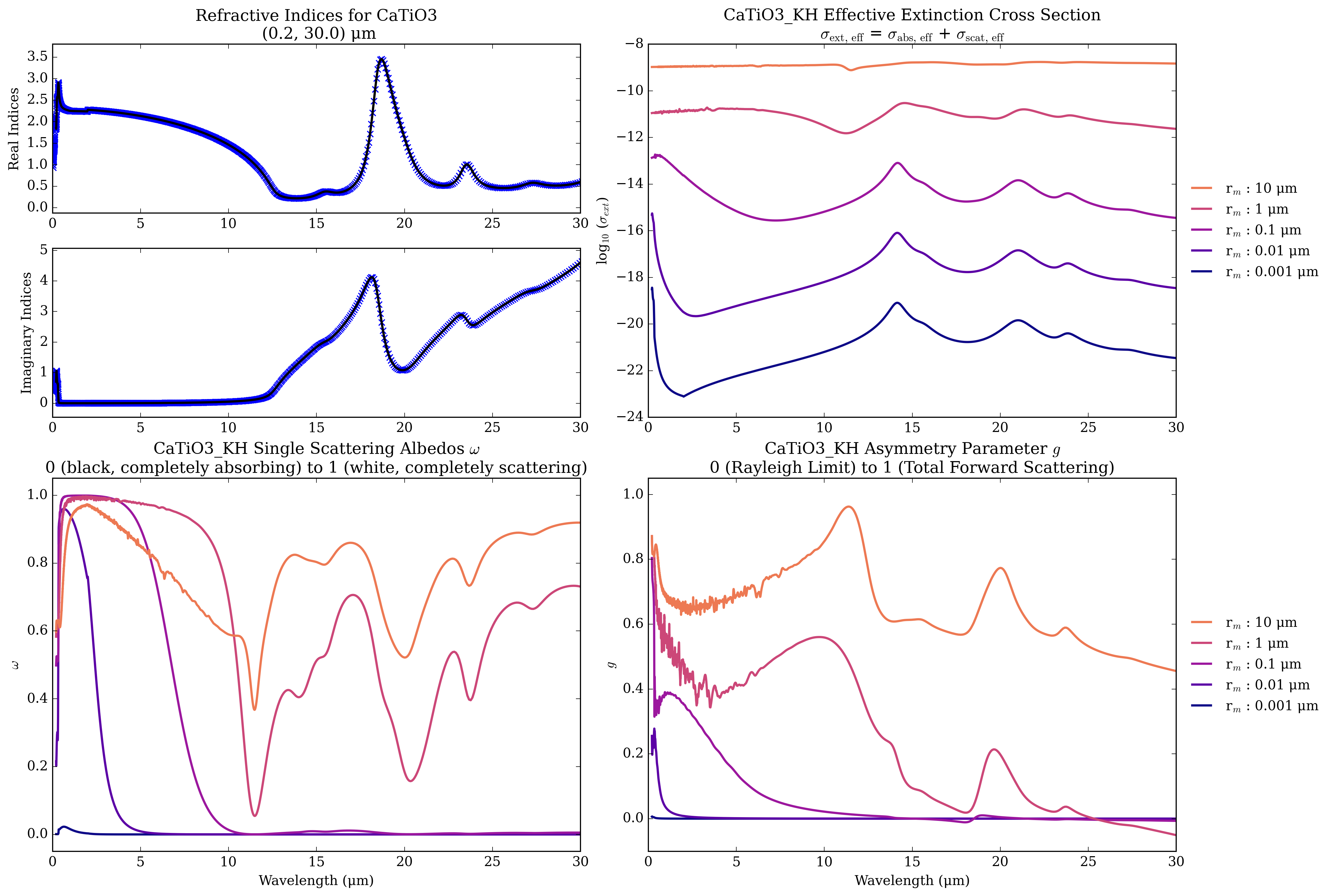
Perovskite (CaTiO3_KH) |
|
\(\hookrightarrow\) GitHub |
\(\hookrightarrow\) DOCCD Link \(\hspace{1.0em}\) (CaTiO3) |
0.2–30 μm |
Crystalline (orthorhombic, near-cubic and isotropic) Natural Crystal + Synthetic Single Crystal |
\(\mathrm{\textbf{M-L Dwarf}}\) |
||||||
\(\mathrm{TiO_{2}}\) |
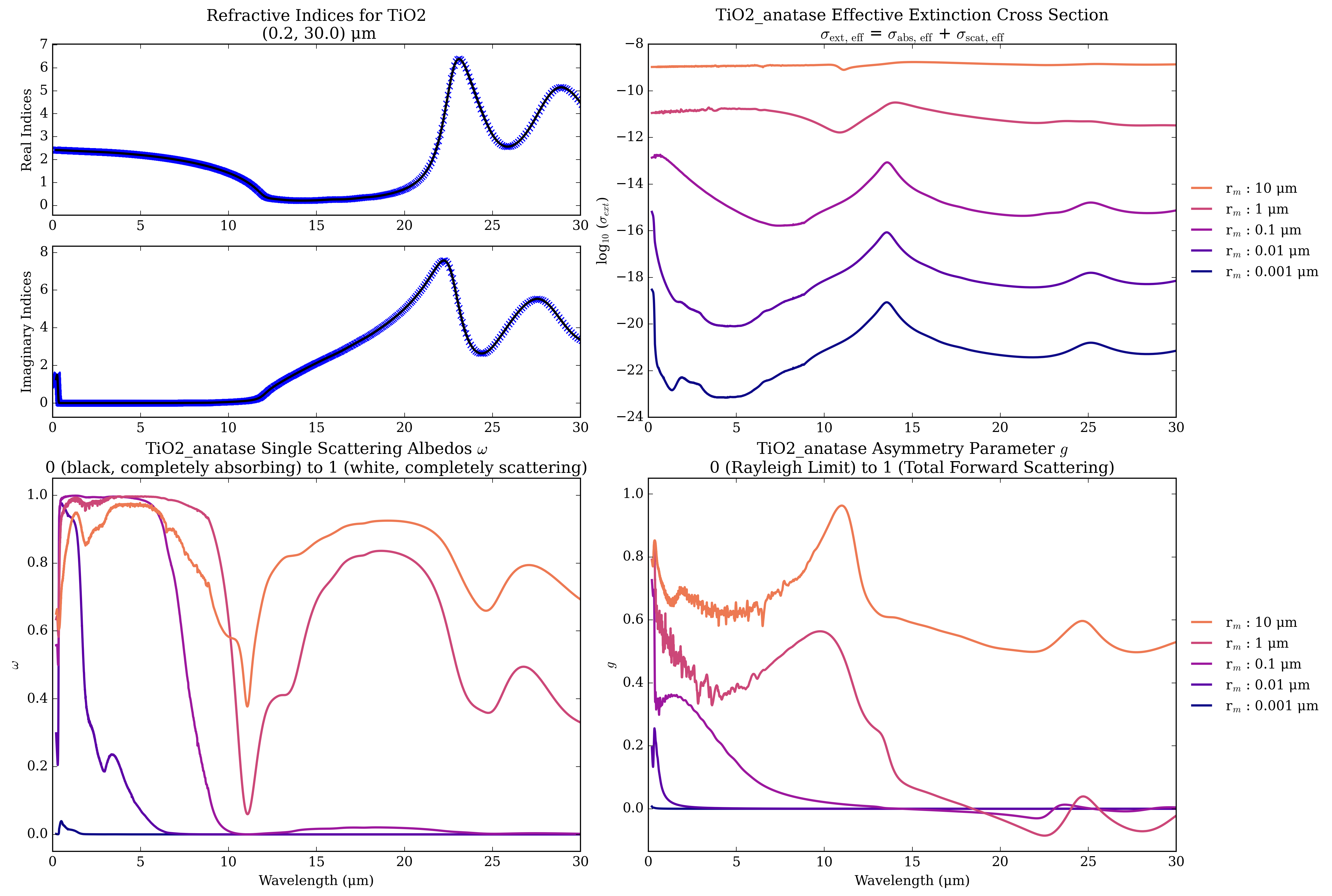
Anatase (TiO2_anatase) |
|
\(\hookrightarrow\) GitHub |
\(\hookrightarrow\) DOCCD Link \(\hspace{1.0em}\) (Anatase) |
0.2–30 μm |
Crystalline (tetragonal, uniaxial) Natural Anatase (\(\mathrm{Ti_{0.992}V_{0.008}O_{2}}\)) + Thin Film Natural crystal indices averaged by polarization (2/3 Ordinary + 1/3 Extraordinary) |
\(\mathrm{TiO_{2}}\) |
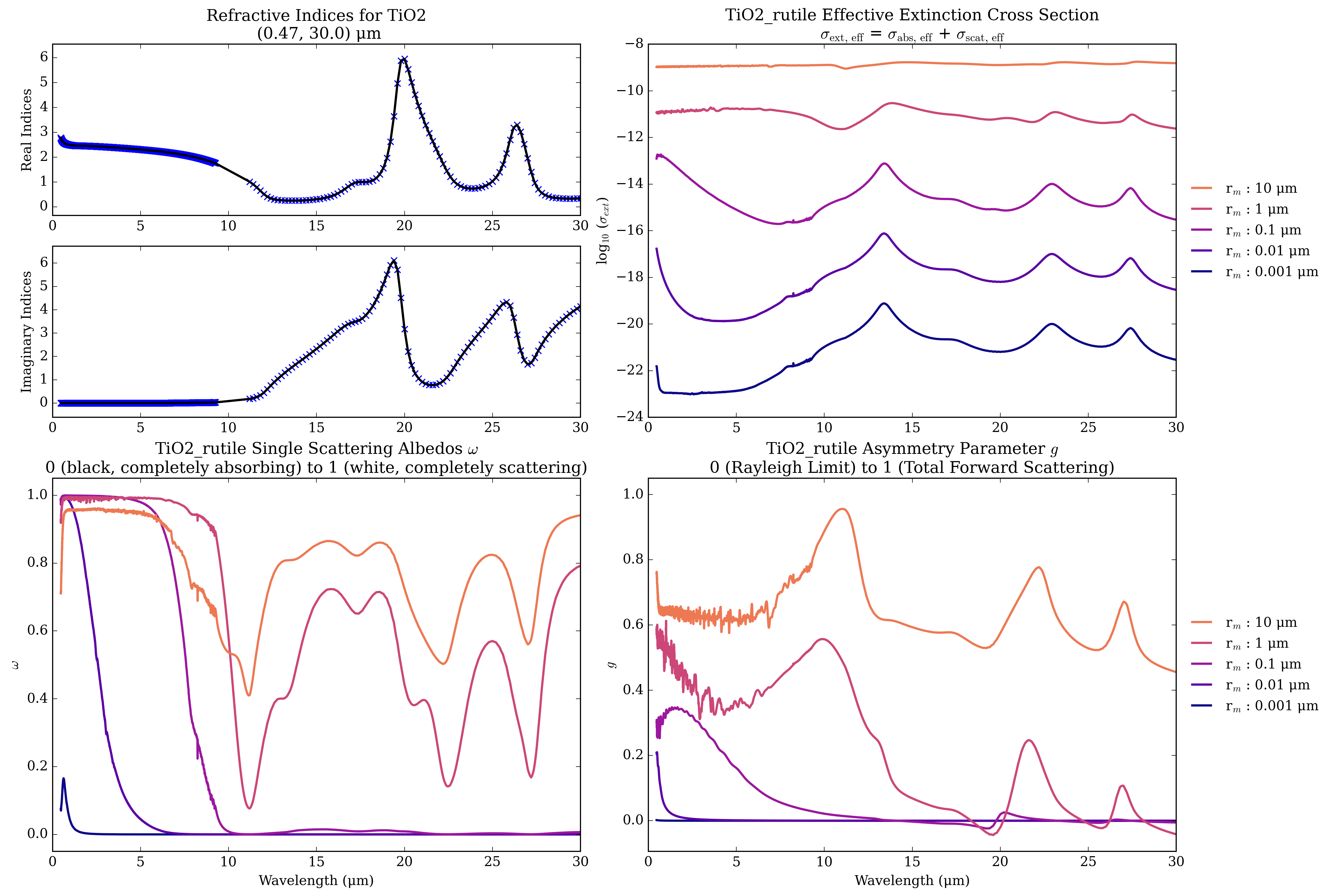
Rutile (TiO2_rutile) |
|
\(\hookrightarrow\) GitHub |
Palik (1985) [Vol 1, Sec 39] (C) \(\hookrightarrow\) DOCCD Link \(\hspace{1.0em}\) (Rutile, E||a,b) |
0.47–30 μm |
Crystalline (tetragonal, uniaxial) Natural Rutile (\(\mathrm{Ti_{0.984}V_{0.008}Fe_{0.008}O_{2}}\)) Ordinary (E||a,b) used |
\(\mathrm{TiC}\) |
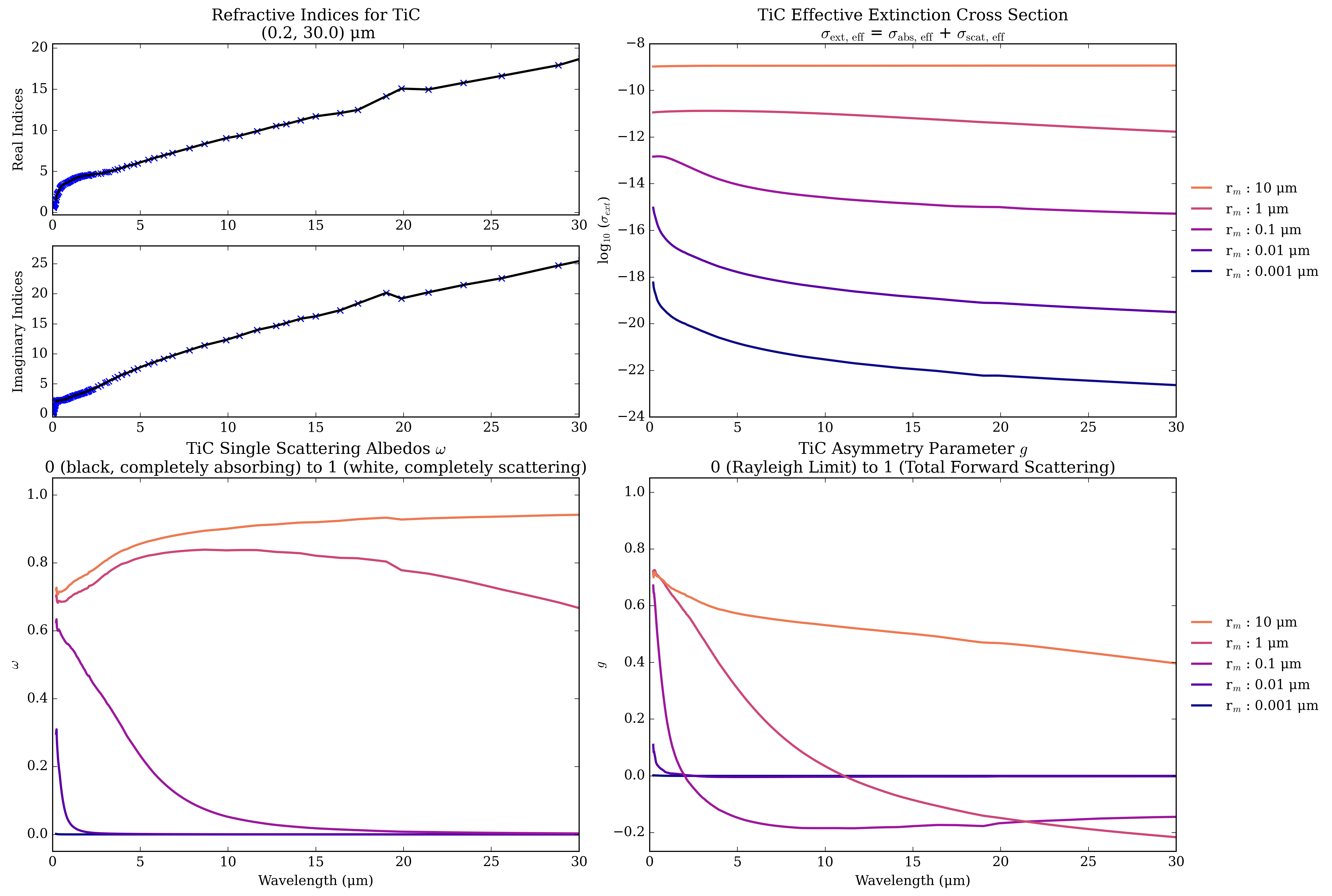
Titanium Carbide (TiC) |
|
\(\hookrightarrow\) GitHub |
0.2–30 μm |
Crystalline (cubic, face centered, isotropic) Synthetic Single Crystals |
|
\(\mathrm{VO}\) |
Vanadium Oxide (VO) |
|
\(\hookrightarrow\) GitHub |
0.3–30 μm |
\(\mathrm{VO_2}\) thin film as a VO proxy (\(\mathrm{VO_2}\) is monoclinic, uniaxial but thin film is random orientation) |
|
\(\mathrm{C}\) |
Meteoritic Nano-Diamonds (NanoDiamonds) |
|
\(\hookrightarrow\) GitHub |
0.2–30 μm |
Crystalline (cubic, isotropic) Natural Crystal |
|
\(\mathrm{\textbf{Iron}}\) |
||||||
\(\mathrm{Fe}\) |
\(\alpha\) Iron (Fe) |
|
\(\hookrightarrow\) GitHub |
0.2–30 μm |
Crystalline (cubic, body centered, stil slightly anisotropic due to ferromagnetism) |
|
\(\mathrm{FeO}\) |
Wüstite (FeO) |
|
\(\hookrightarrow\) Link |
0.21–30 μm |
Crystalline (Cubic, face centered, isotropic) Synthetic |
|
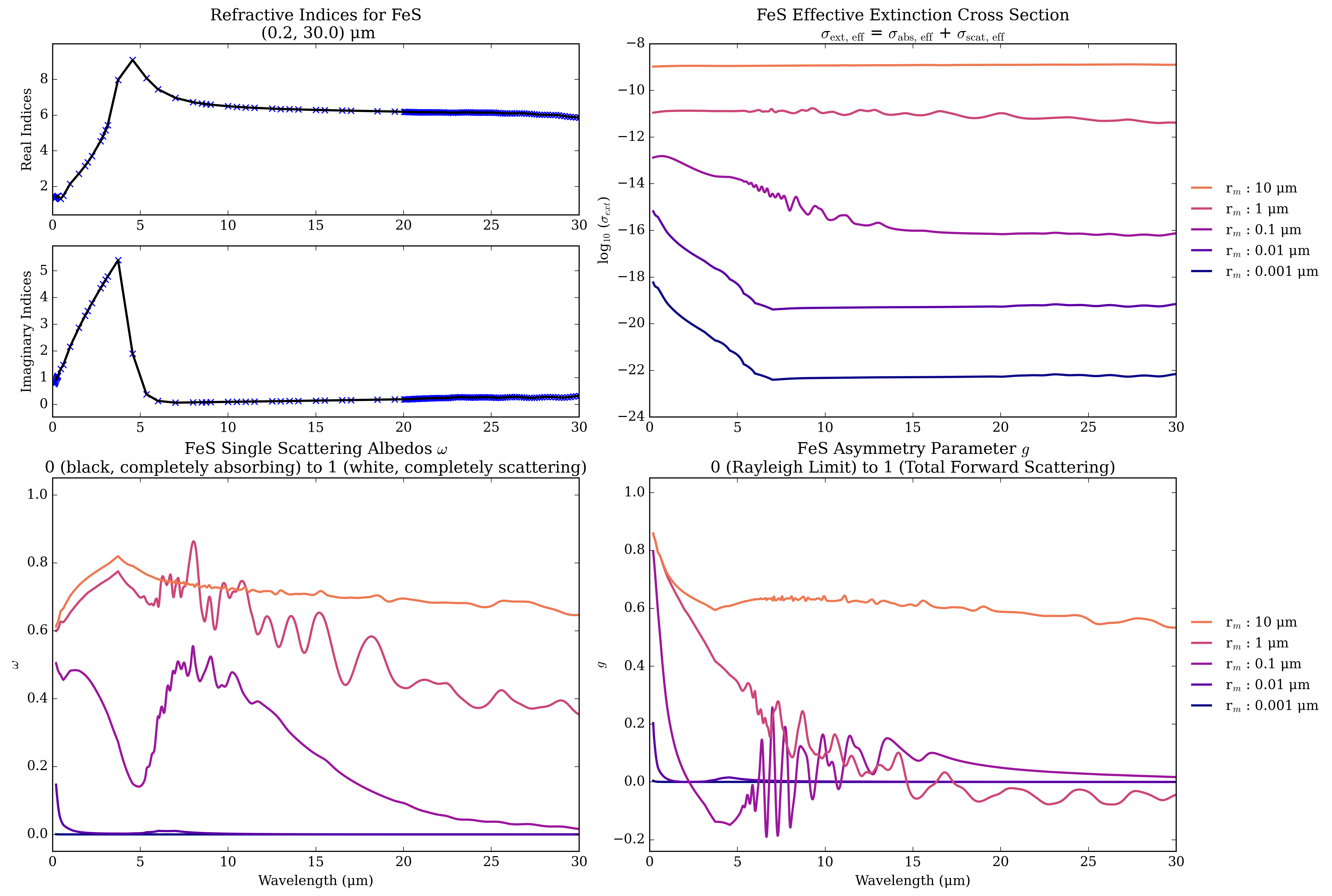
\(\mathrm{FeS}\) |
Troilite (FeS) |
|
\(\hookrightarrow\) GitHub |
\(\hookrightarrow\) DOCCD Link \(\hspace{1.0em}\) (FeS) |
0.2–30 μm |
Crystalline (Hexagonal, grows as an isotropic slab) Natural + Synethic crystal |
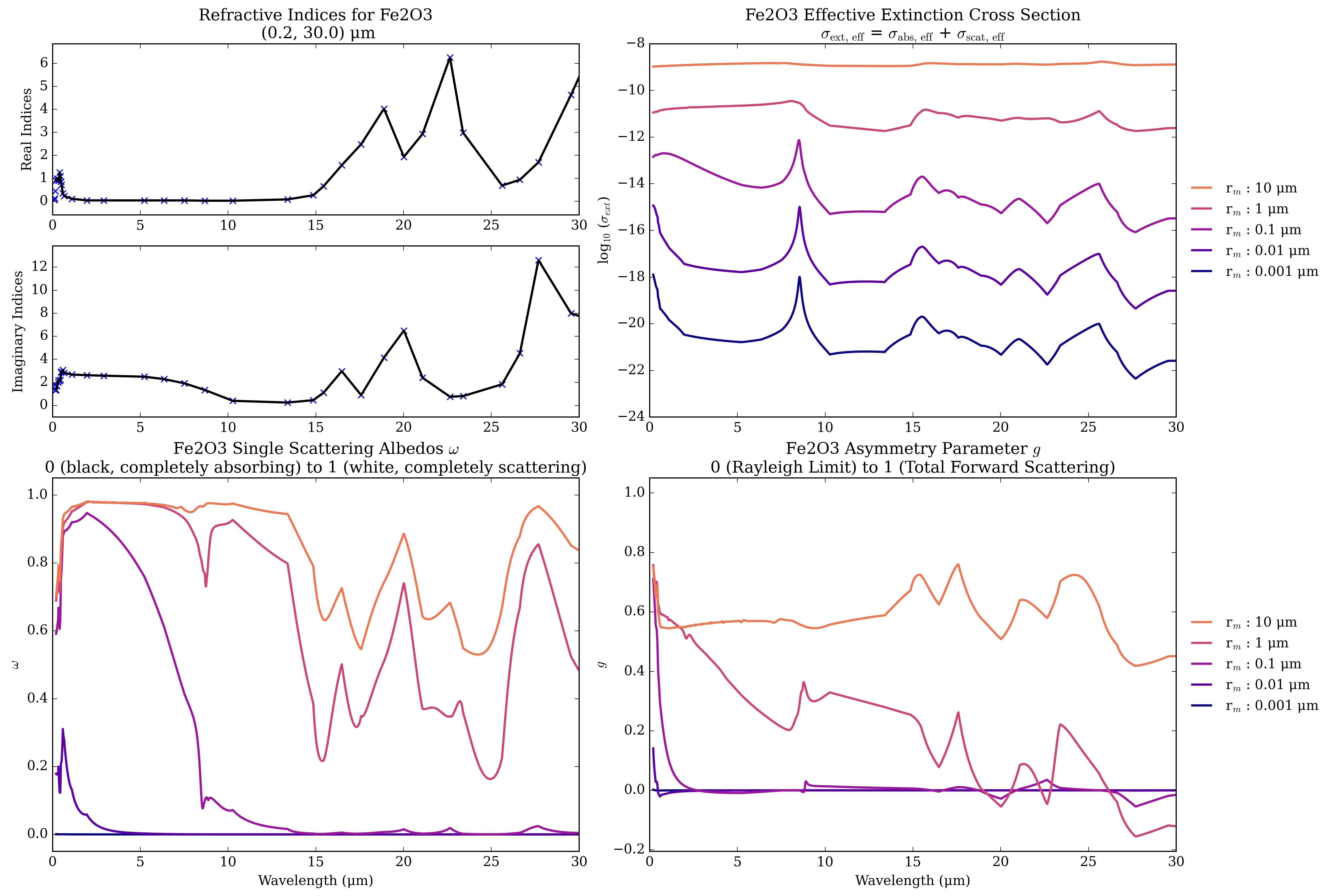
\(\mathrm{Fe_2O_3}\) |
Hematite / \(\alpha \mathrm{Fe_2O_3}\) (Fe2O3) |
|
\(\hookrightarrow\) Link |
Unpublished, Triaud in DOCCD \(\hookrightarrow\) DOCCD Link \(\hspace{1.0em}\) (Fe2O3 E||a,b) |
0.2–30 μm |
Crystalline (Rhombohedral, uniaxial) Ordinary ray (E||a,b) used |
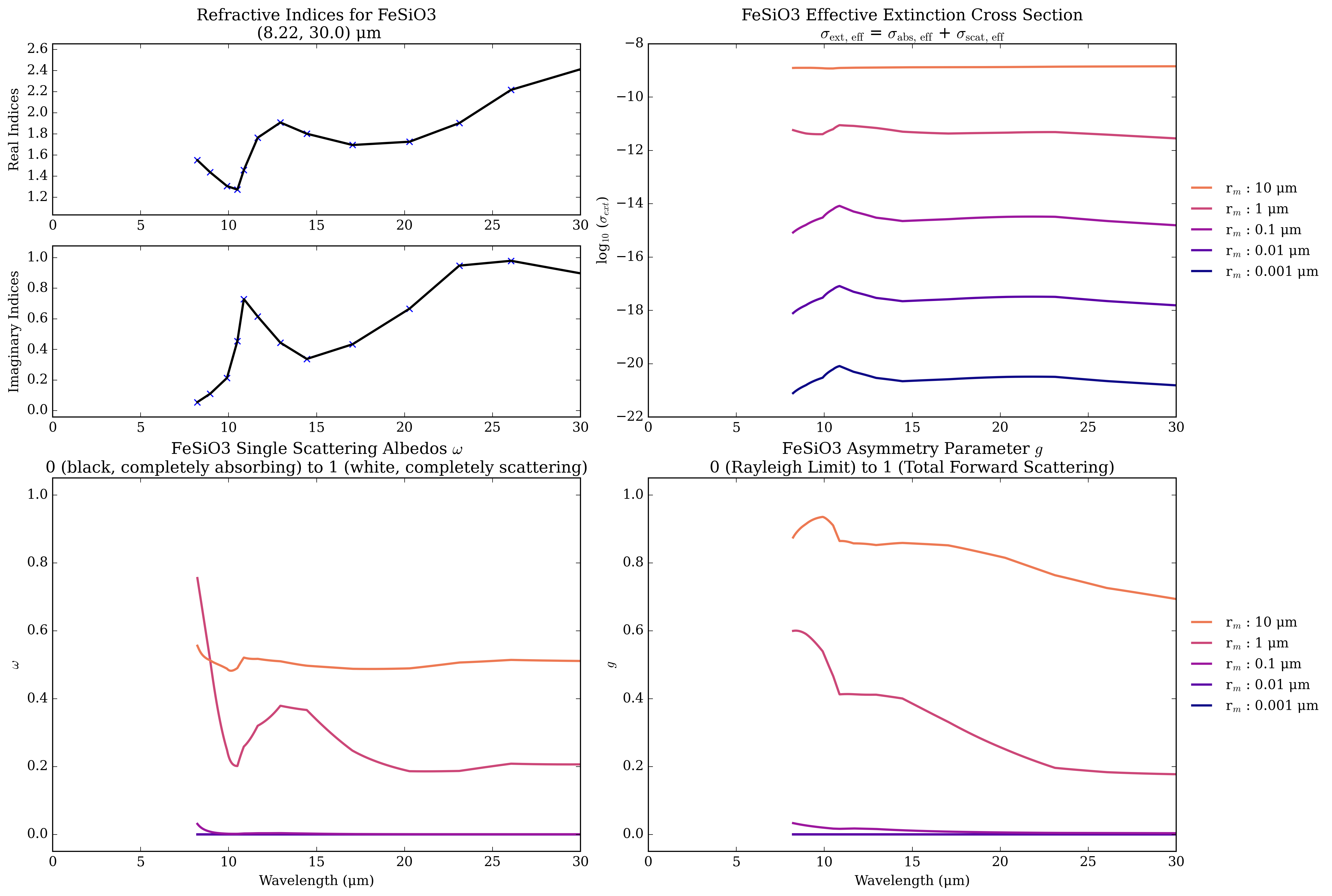
\(\mathrm{FeSiO_3}\) |
Ferrosilite (FeSiO3) |
|
\(\hookrightarrow\) Link |
8.22–30 μm |
Amorphous (isotropic) Iron-rich olivine |
|
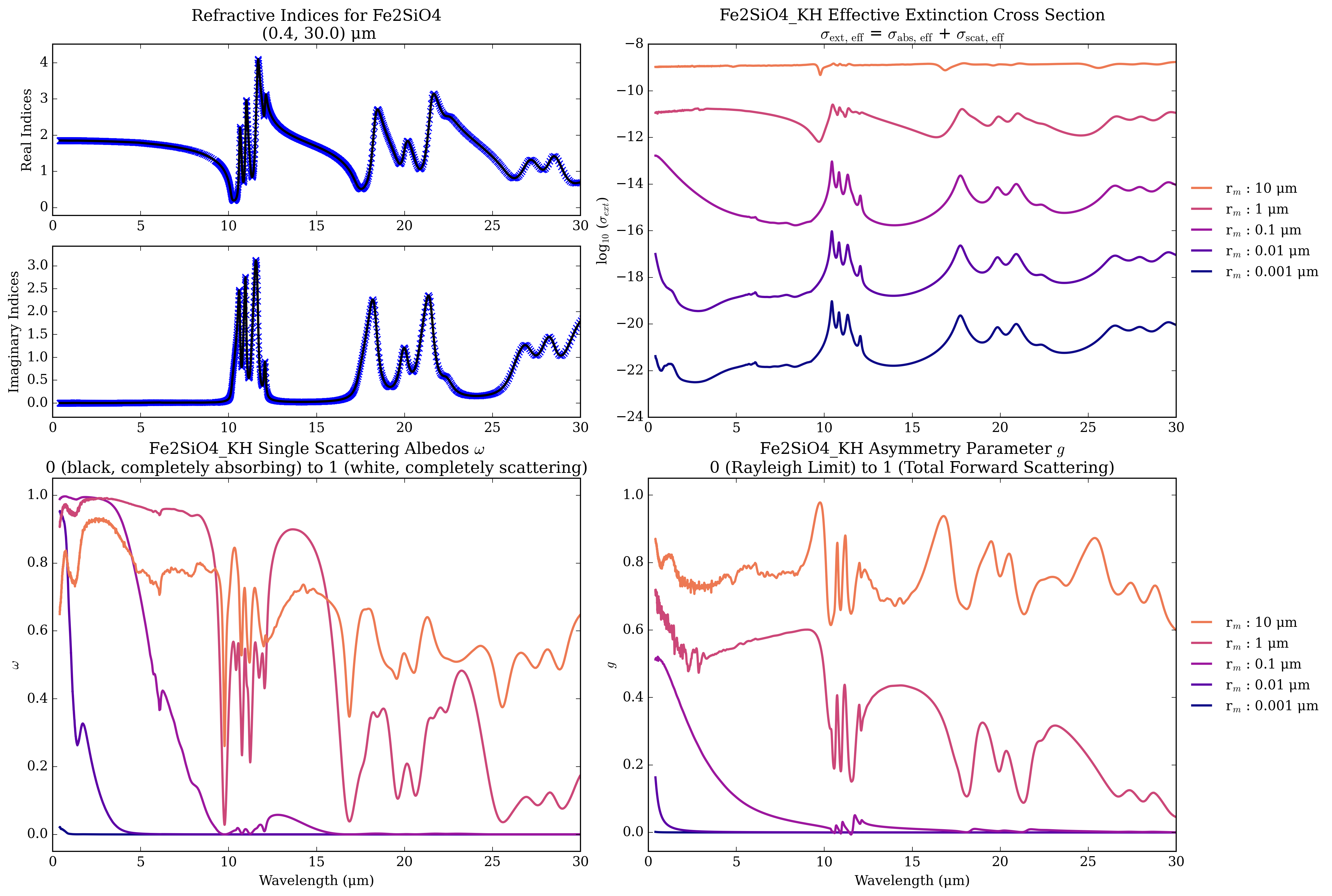
\(\mathrm{Fe_2SiO_4}\) |
Fayalite (Fe2SiO4_KH) |
|
\(\hookrightarrow\) GitHub |
\(\hookrightarrow\) DOCCD Link \(\hspace{1.0em}\) (Fayalite (synthetic)) |
0.40–30 μm |
Crystalline (orthorhombic, biaxial) Synthetic Single Crystal Each polarization (E||c,b,a) averaged |
\(\mathrm{\textbf{Magnesium}}\) |
||||||
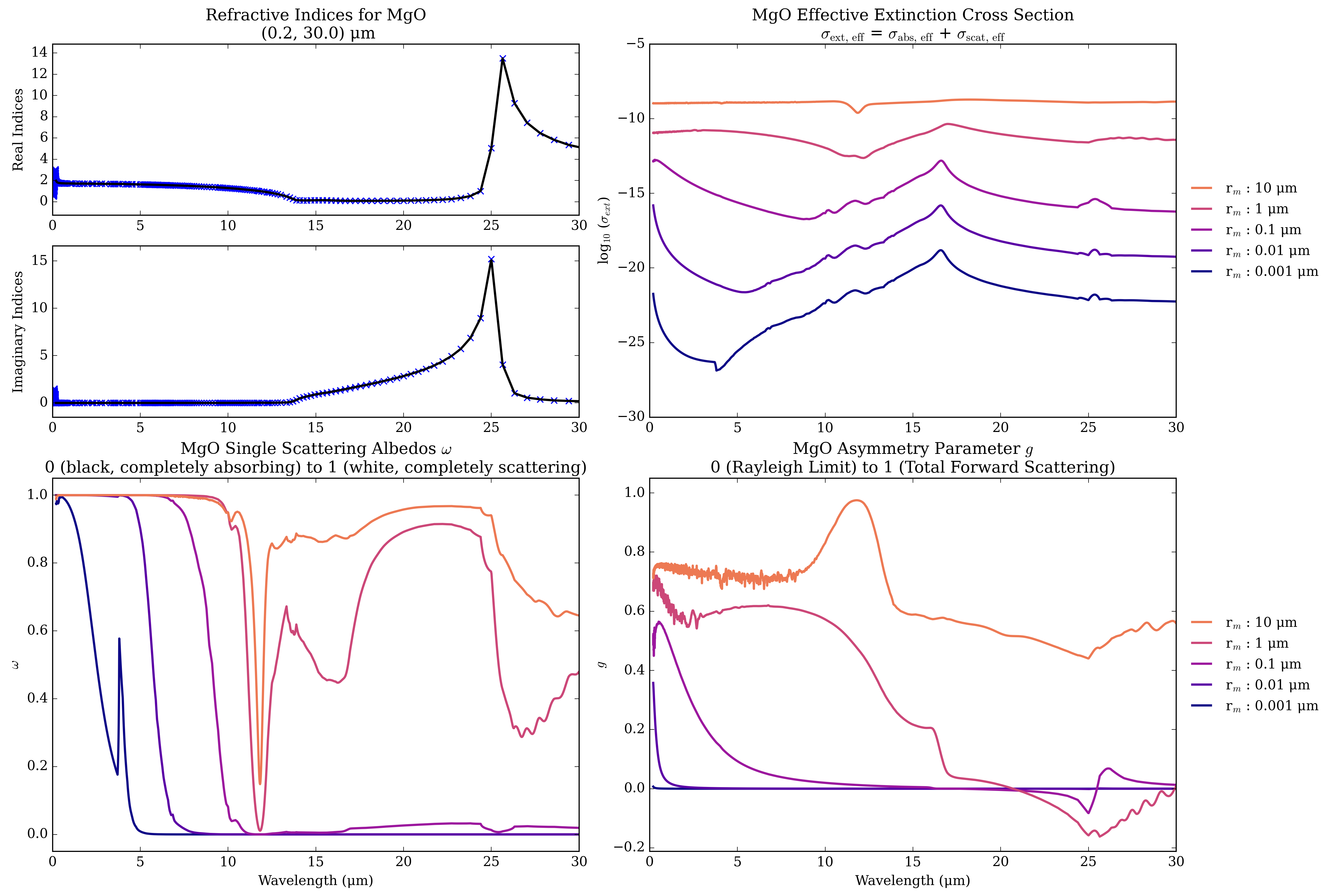
\(\mathrm{MgO}\) |
Periclase (MgO) |
|
\(\hookrightarrow\) GitHub |
0.2–30 μm |
Crystalline (cubic, isotropic) KH18 filled empty Palik entries with Kramers-Kronig analysis or spline interpolation |
|
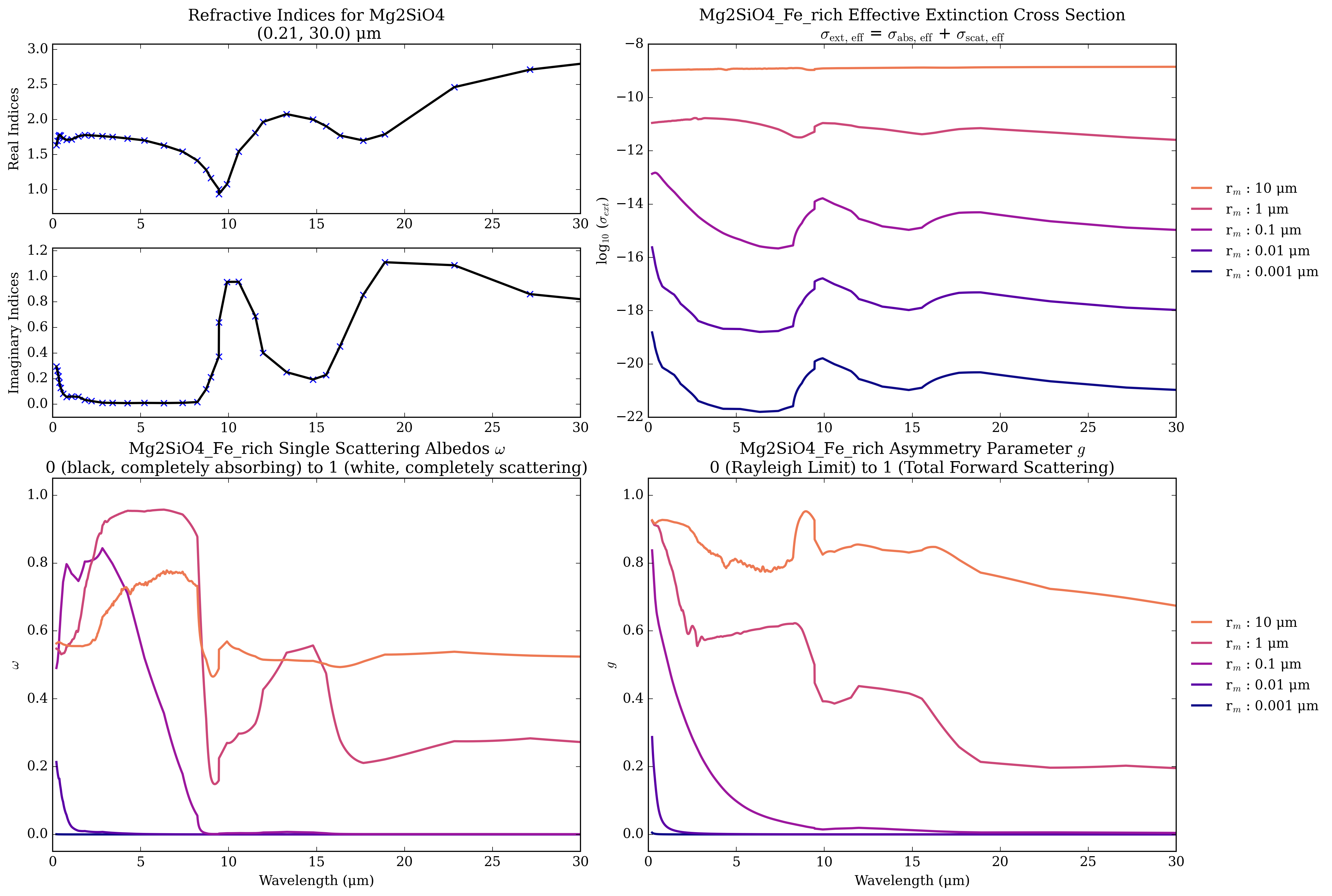
\(\mathrm{Mg_{0.8}Fe_{1.2}SiO4}\) |
Forsterite ‘Iron-rich’ (Mg2SiO4_Fe_rich) |
|
\(\hookrightarrow\) Link |
\(\hookrightarrow\) DOCCD Link \(\hspace{1.0em}\) (Mg(0.8)Fe(1.2)SiO4) |
0.21–30 μm |
Amorphous (glass, isotropic) Olivine |
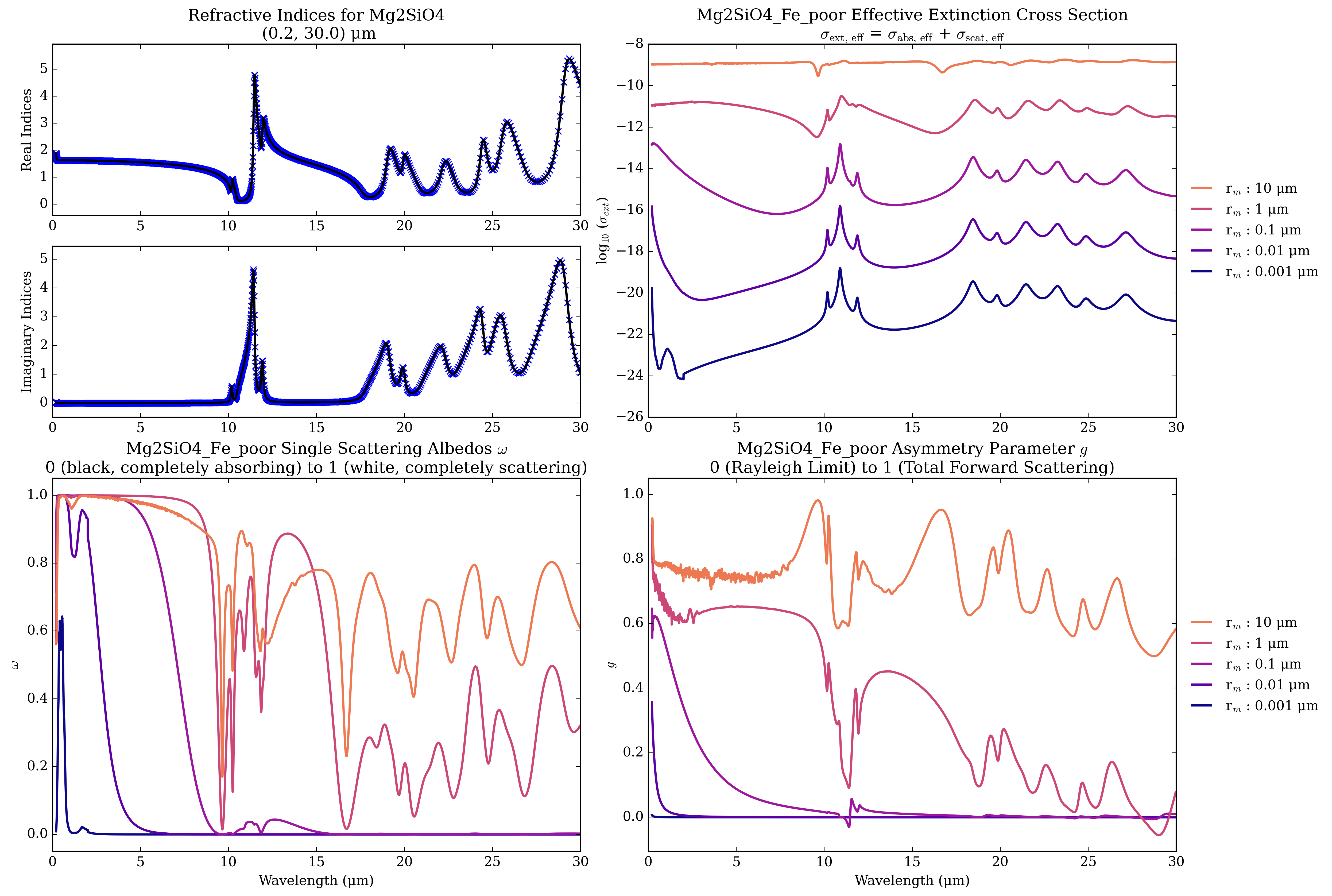
\(\mathrm{Mg_{1.72}Fe_{0.21}SiO4}\) |
Forsterite ‘Iron-poor’ (Mg2SiO4_Fe_poor) |
|
\(\hookrightarrow\) Link |
\(\hookrightarrow\) DOCCD Link \(\hspace{1.0em}\) (San Carlos Olivine) |
0.2–30 μm |
Crystalline (orthorhombic, biaxial) Natural crystal Extraordinary ray (E||c) used Olivine |
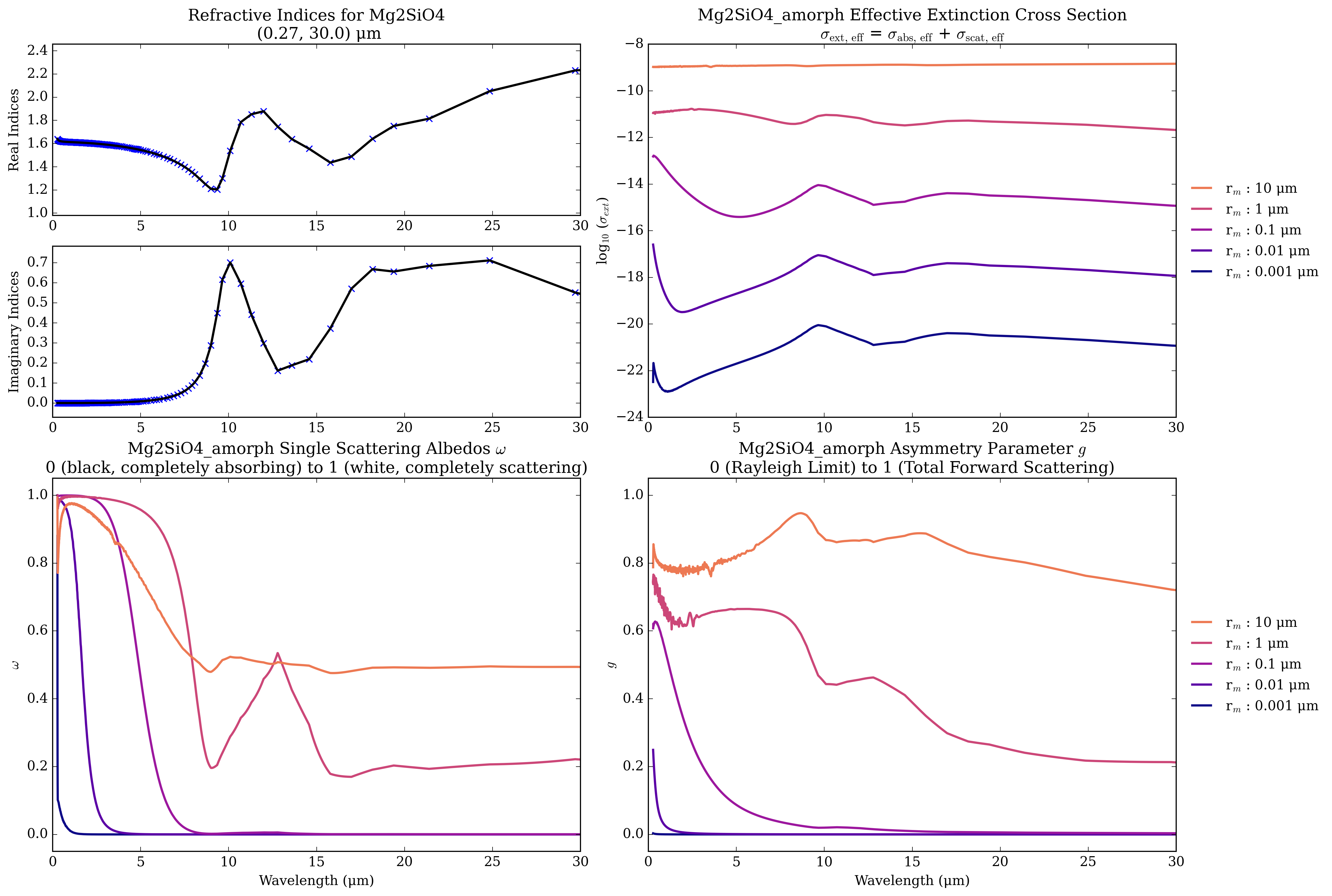
\(\mathrm{Mg_{2}SiO4}\) |
Forsterite (Mg2SiO4_amorph) |
|
\(\hookrightarrow\) DOCCD Link \(\hspace{1.0em}\) (Mg(2)SiO(4)) |
0.27–30 μm |
Amorphous Sol Gel (synthetic, isotropic) |
|
\(\mathrm{Mg_{2}SiO4}\) |
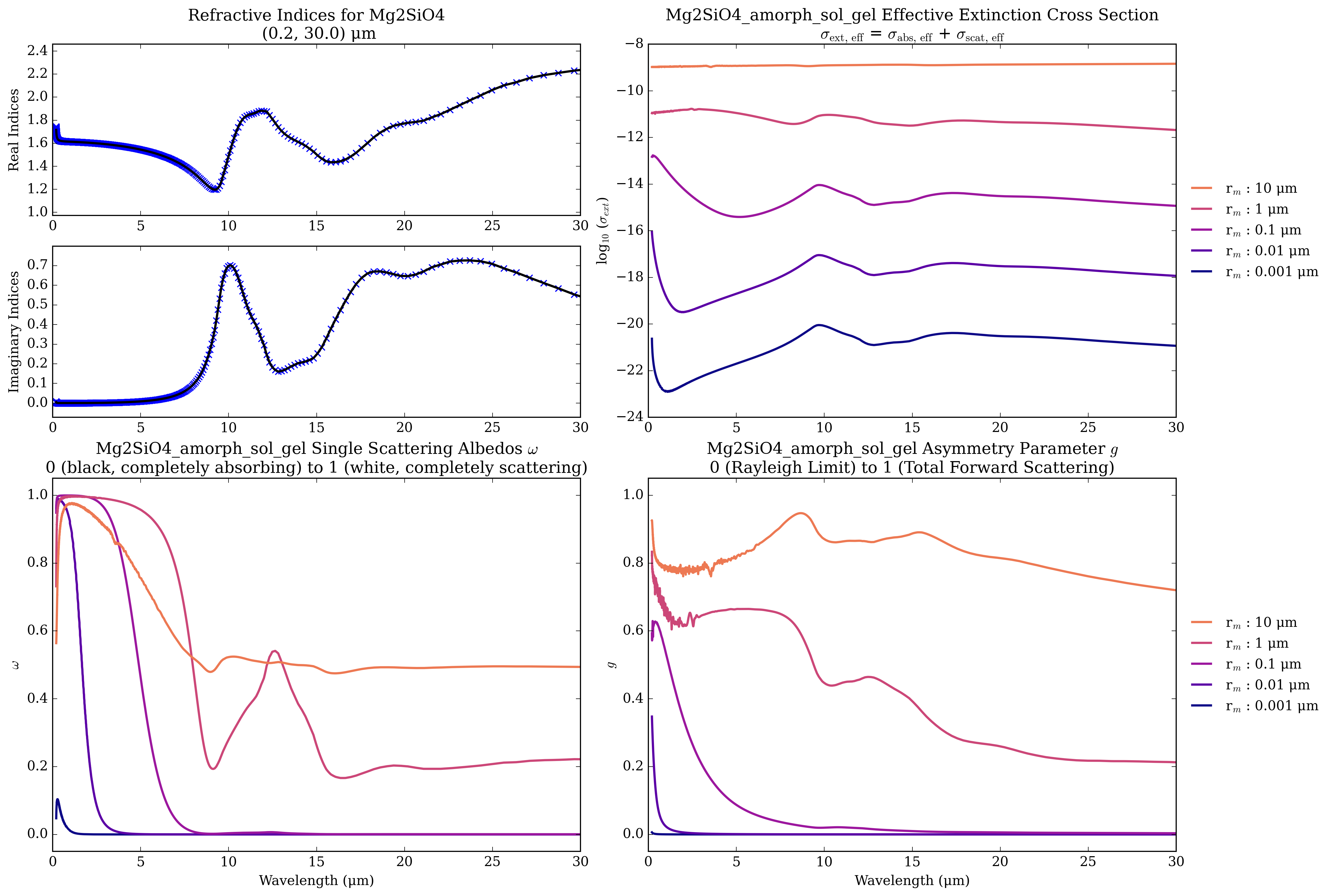
Forsterite (Mg2SiO4_amorph_sol_gel) |
|
\(\hookrightarrow\) GitHub |
\(\hookrightarrow\) DOCCD Link \(\hspace{1.0em}\) (Mg(2)SiO(4)) |
0.2–30 μm |
Amorphous Sol Gel (synthetic, isotropic) |
\(\mathrm{Mg_{2}SiO4}\) |
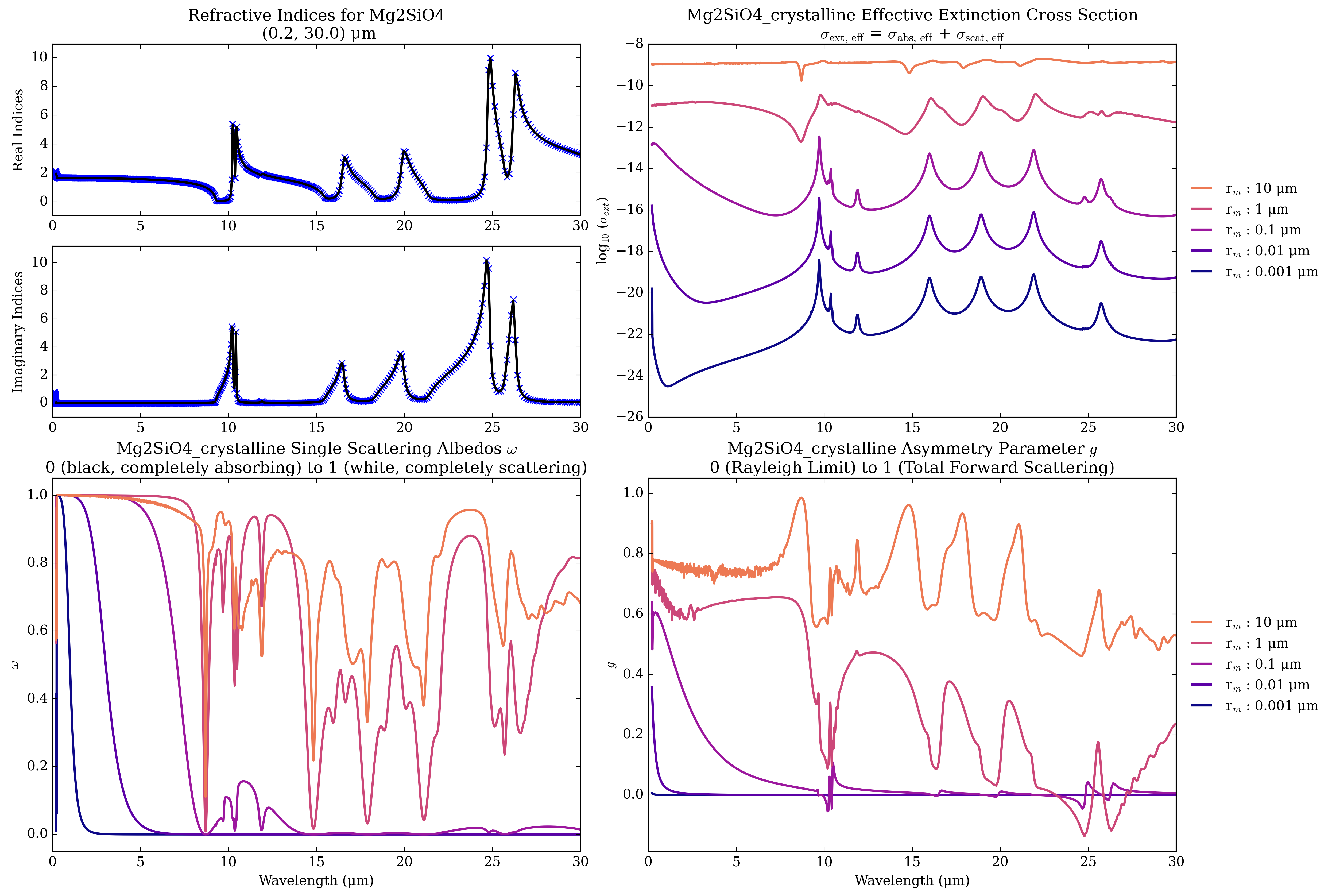
Forsterite (Mg2SiO4_crystalline) |
|
\(\hookrightarrow\) GitHub |
0.2–30 μm |
Crystalline (orthorhombic, biaxial) Synthetic Single Crystals E||a and E||b polarizations combined Olivine |
|
\(\mathrm{MgFeSiO_4}\) |
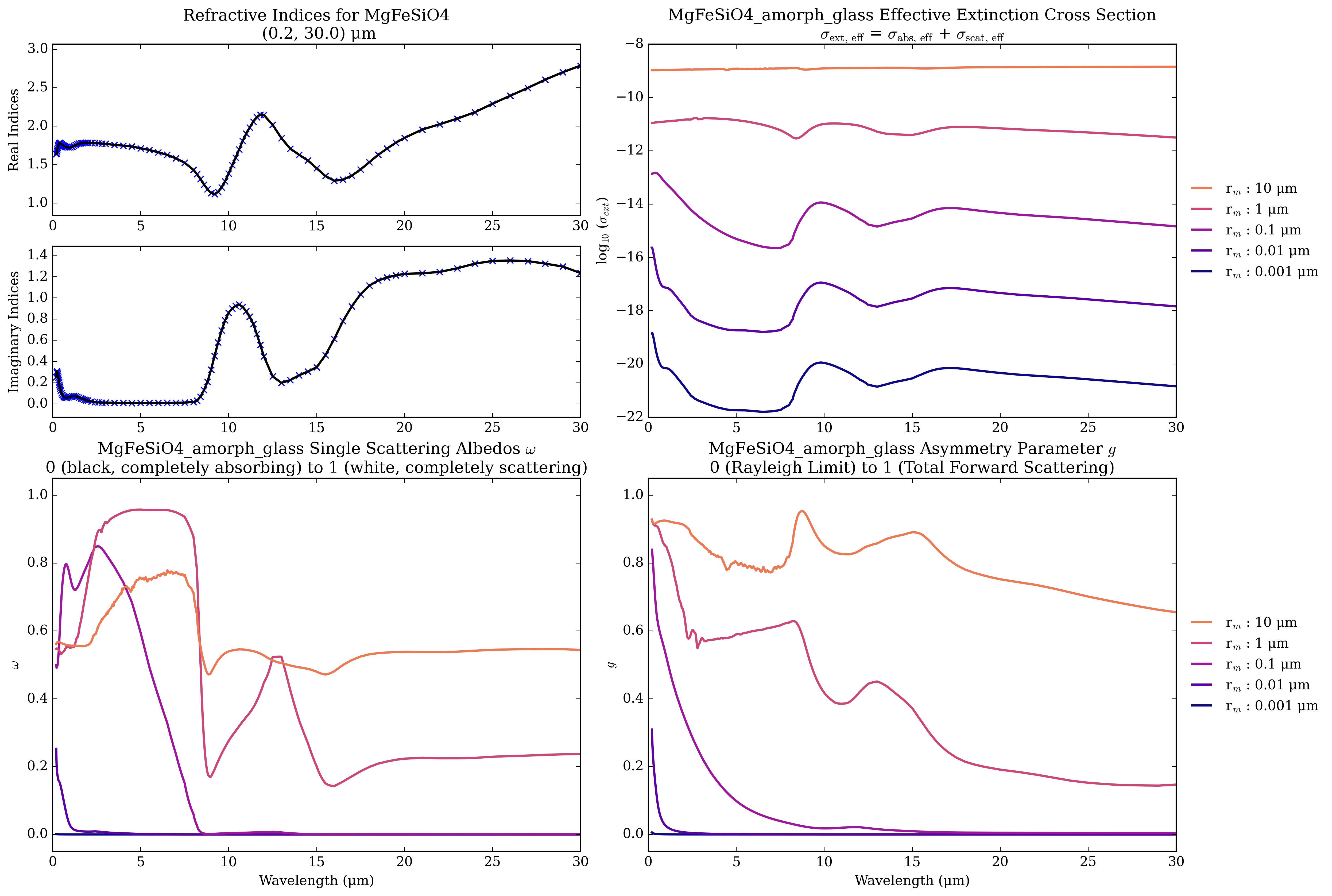
Olivine (MgFeSiO4_amorph_glass) |
|
\(\hookrightarrow\) GitHub |
\(\hookrightarrow\) DOCCD Link \(\hspace{1.0em}\) (MgFeSiO[4] [3.71 g/ccm]) |
0.2–30 μm |
Amorphous (glass, isotropic) Synthetic |
\(\mathrm{Mg_{0.8}Fe_{1.2}SiO_4}\) |
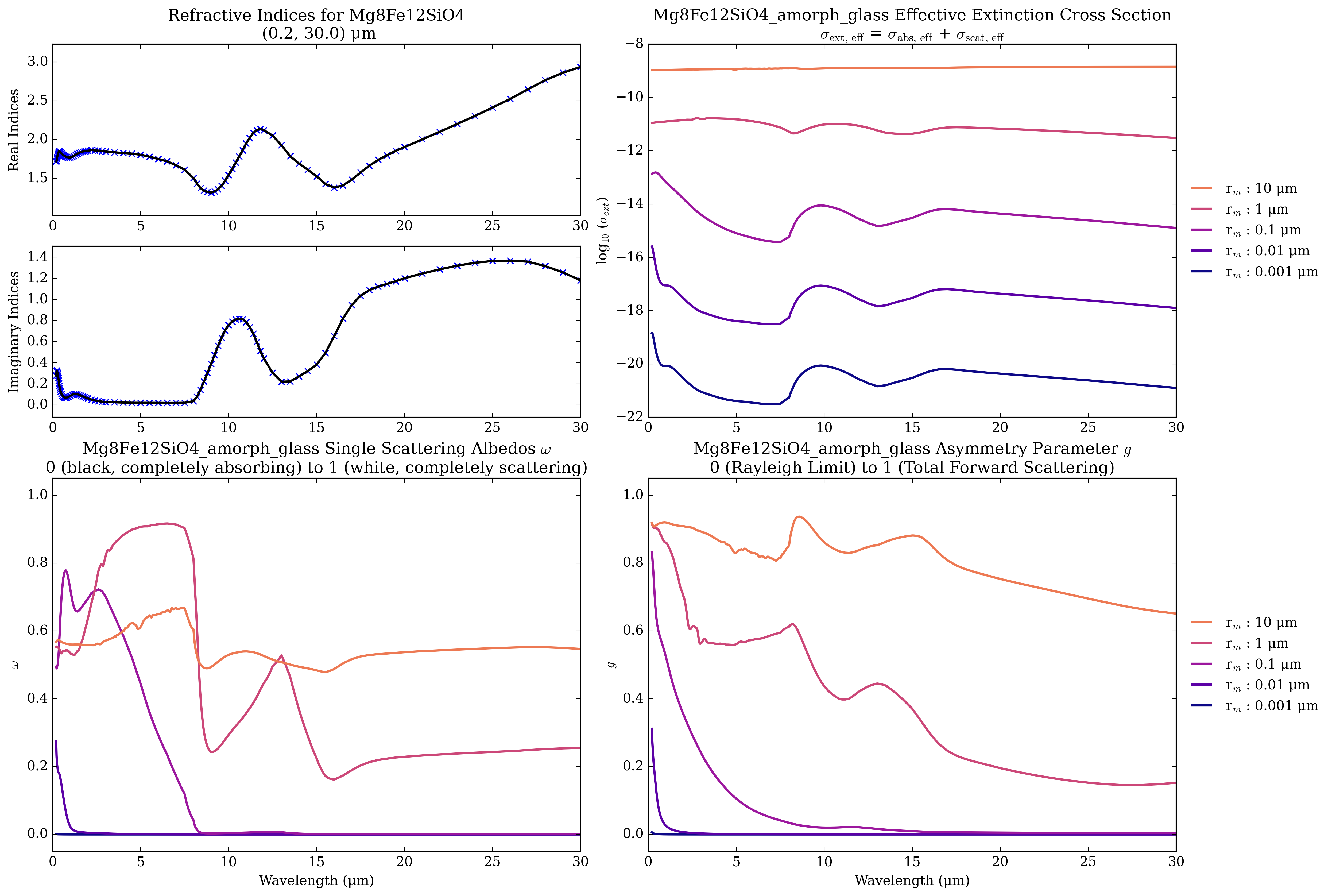
Olivine (Mg8Fe12SiO4_amorph_glass) |
|
\(\hookrightarrow\) GitHub |
\(\hookrightarrow\) DOCCD Link \(\hspace{1.0em}\) (Mg(0.8)Fe(1.2)SiO4) |
0.2–30 μm |
Amorphous (glass, isotropic) Synthetic |
\(\mathrm{MgSiO_3}\) |
Enstatite (MgSiO3) |
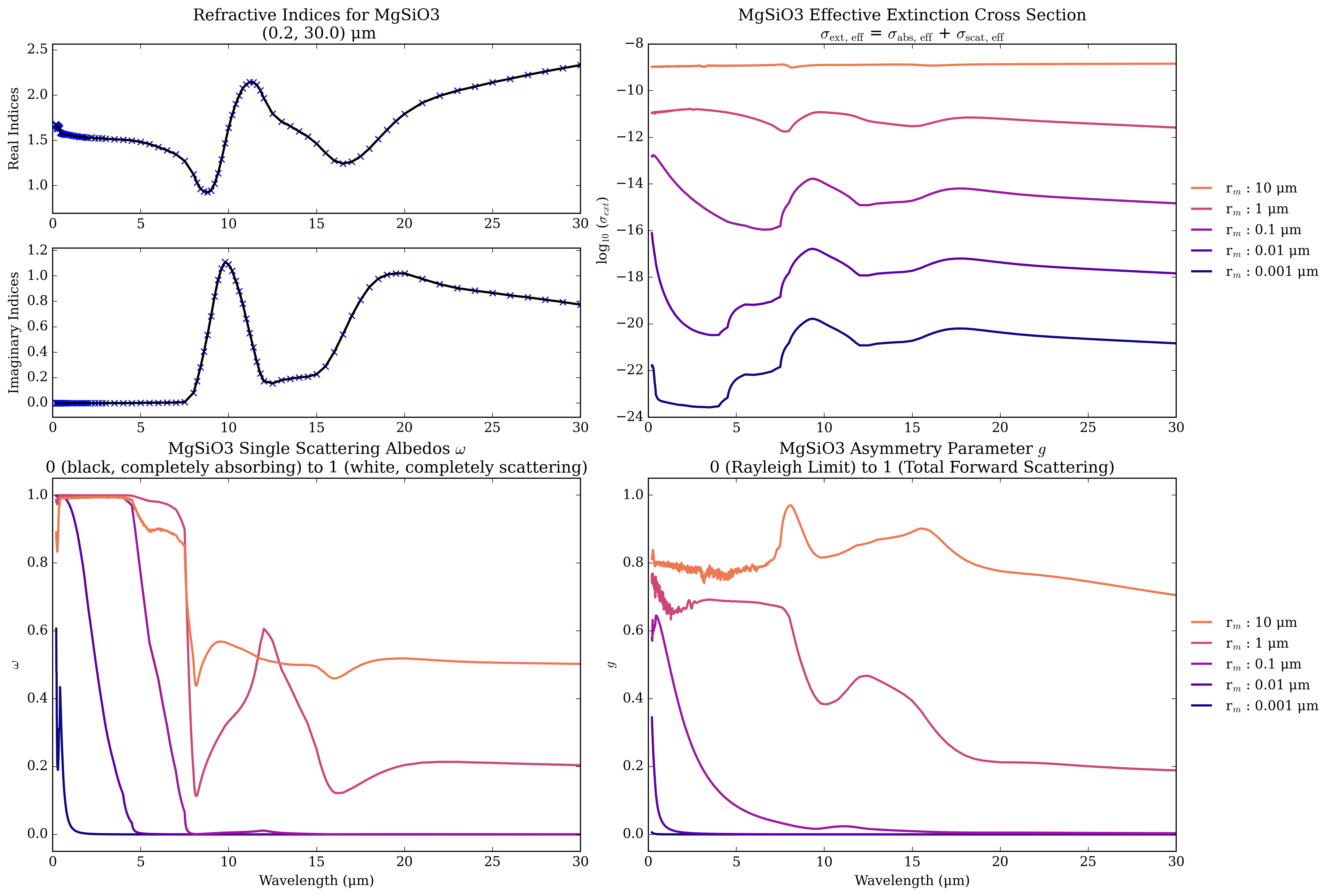
|
\(\hookrightarrow\) Link |
\(\hookrightarrow\) DOCCD Link \(\hspace{1.0em}\) (MgSiO(3) [2/71 g/ccm]) |
0.2–30 μm |
Natural Crystalline (orthorhombic, biaxial) (no polarization given) + Synthetic Amorphous (glass, isotropic) Silicate pyroxene |
\(\mathrm{MgSiO_3}\) |
Enstatite (MgSiO3_amorph) |
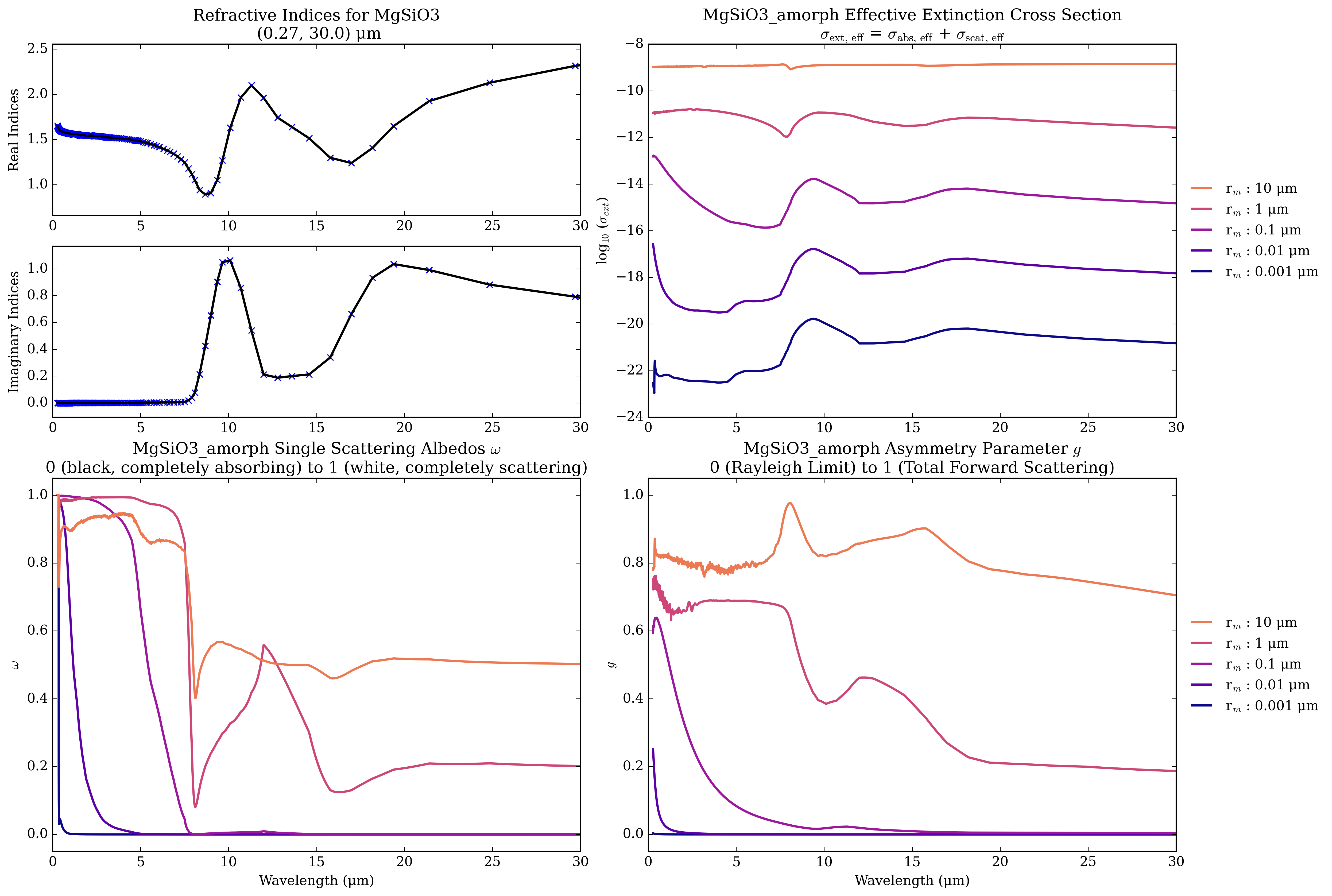
|
0.27–30 μm |
Amorphous Enstatite Thin Film (isotropic) + ‘Astronomical’ Silicate (observation derived) + Crystalline Synthetic Forsterite (E||a + E||c) Refractive indices from 0.06-62 μm, interpolated to fit EGP grid (0.26-227 μm) Silicate pyroxene |
||
\(\mathrm{MgSiO_3}\) |
Enstatite (MgSiO3_amorph_glass) |
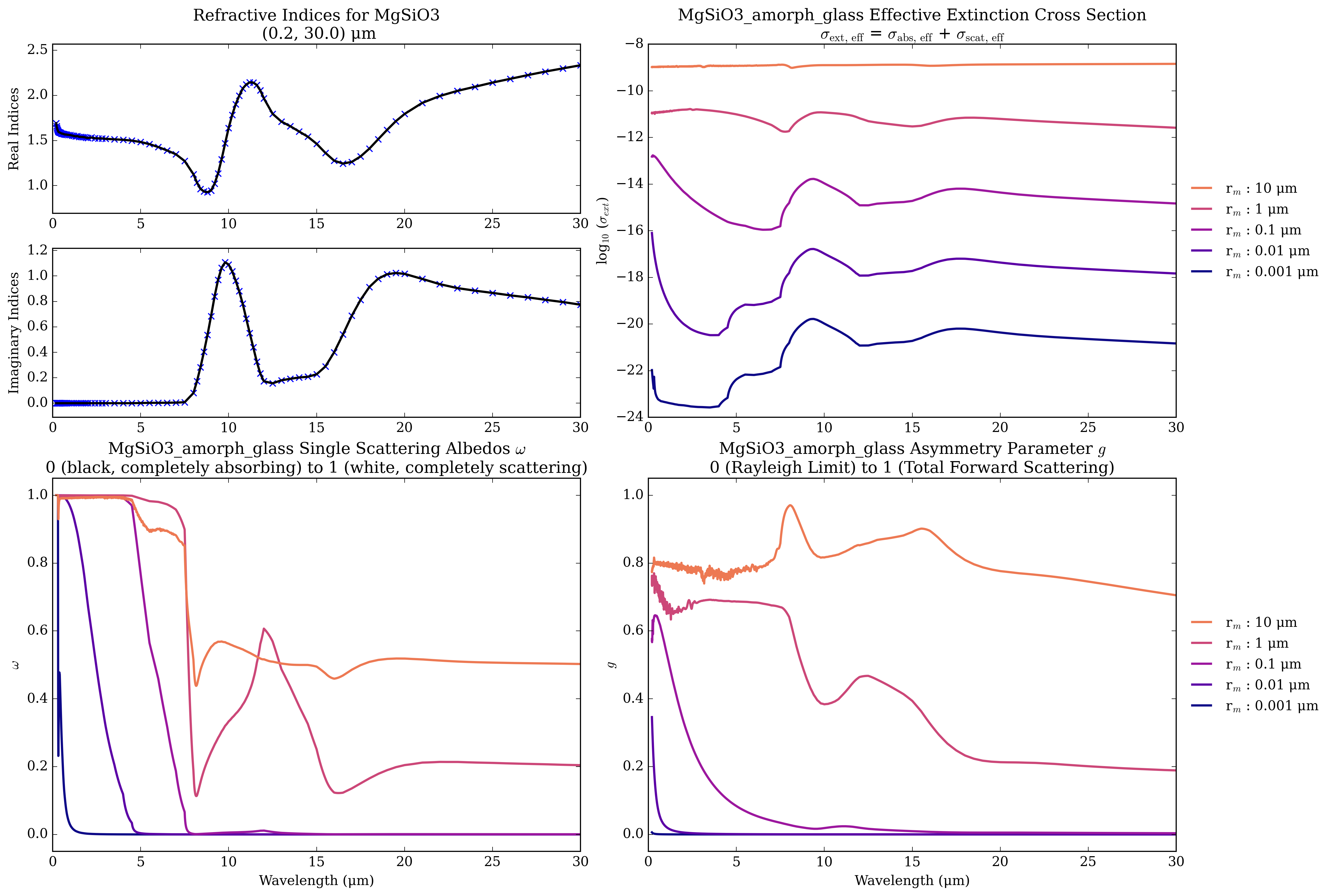
|
\(\hookrightarrow\) GitHub |
\(\hookrightarrow\) DOCCD Link \(\hspace{1.0em}\) (MgSiO(3) [2/71 g/ccm]) |
0.2–30 μm |
Amorphous (glass, isotropic) Synthetic Silicate pyroxene |
\(\mathrm{MgSiO_3}\) |
Enstatite (MgSiO3_sol_gel) |
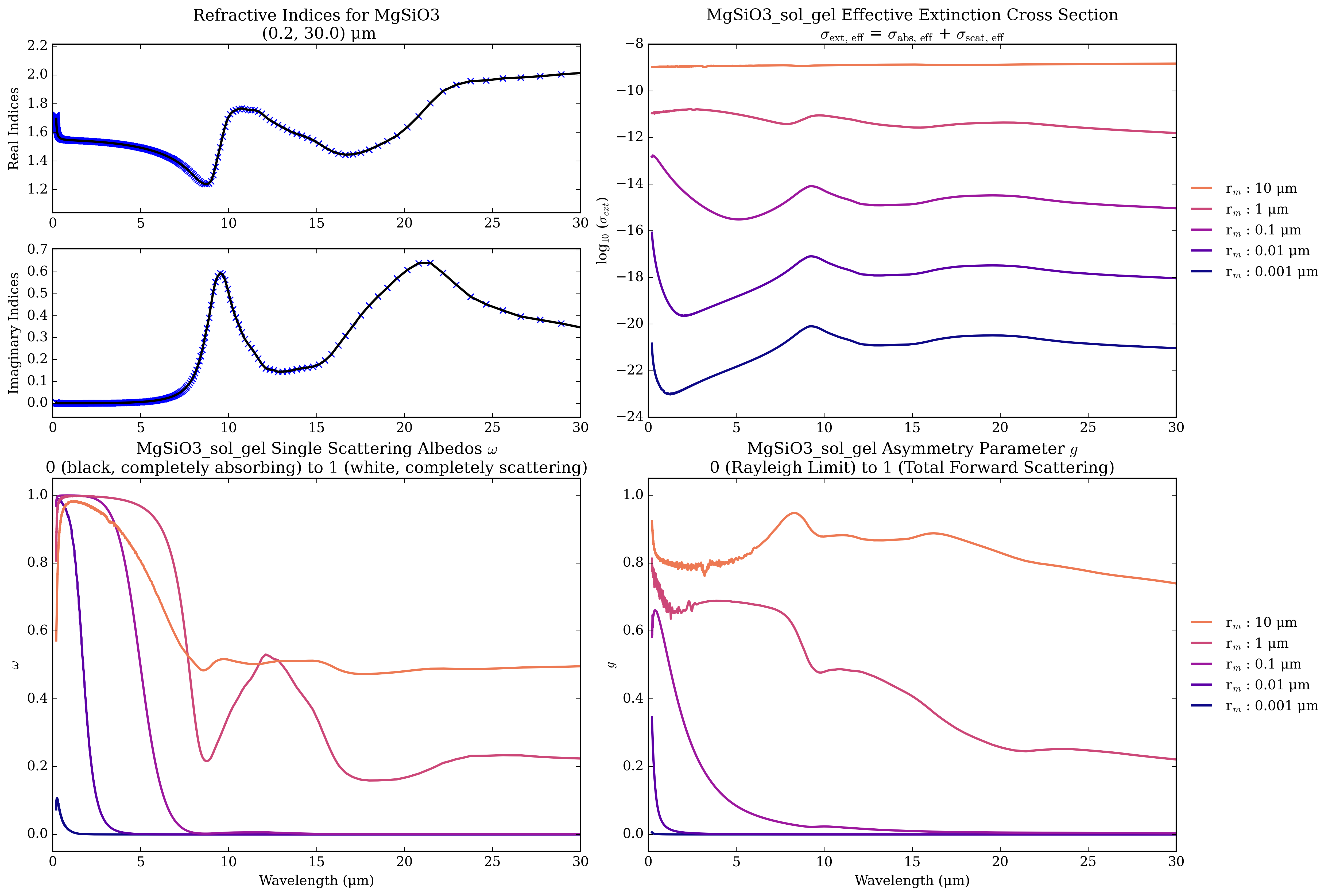
|
\(\hookrightarrow\) GitHub |
\(\hookrightarrow\) DOCCD Link \(\hspace{1.0em}\) (MgSiO(3)) |
0.2–30 μm |
Amorphous Sol Gel (synthetic, isotropic) Silicate pyroxene |
\(\mathrm{MgSiO_3}\) |
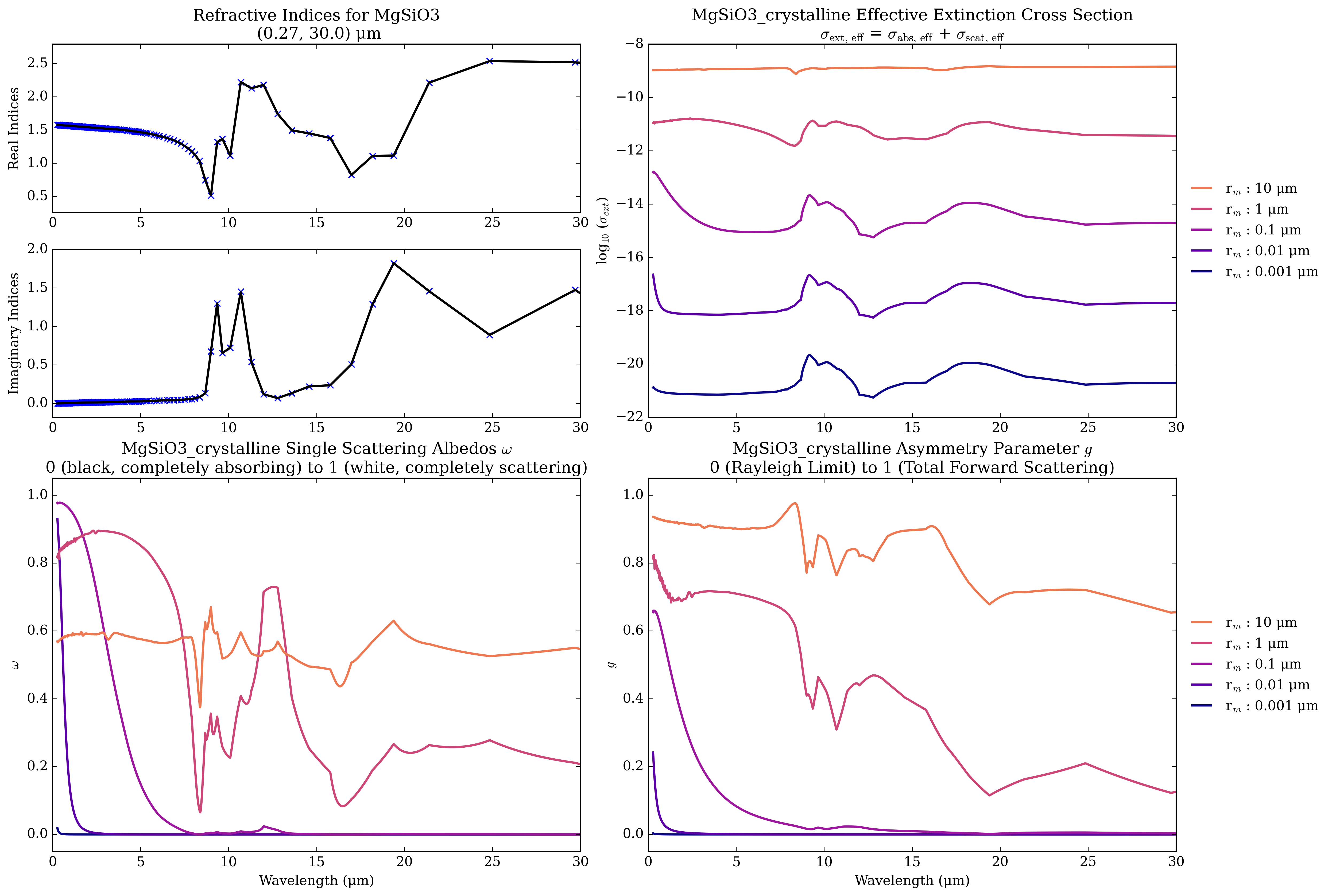
Ortho-Enstatite (MgSiO3_crystalline) |
|
\(\hookrightarrow\) DOCCD Link \(\hspace{1.0em}\) (Enstatite (natural)) |
0.27–30 μm |
Crystalline (Orthorhombic, biaxial) Natural crystal with some talc formations Each polarization (E||c,b,a) averaged Refractive indices from 2-99 μm, interpolated to fit EGP grid (0.26-227 μm) Silicate pyroxene |
|
\(\mathrm{Mg_{0.4}Fe_{0.6}SiO_3}\) |
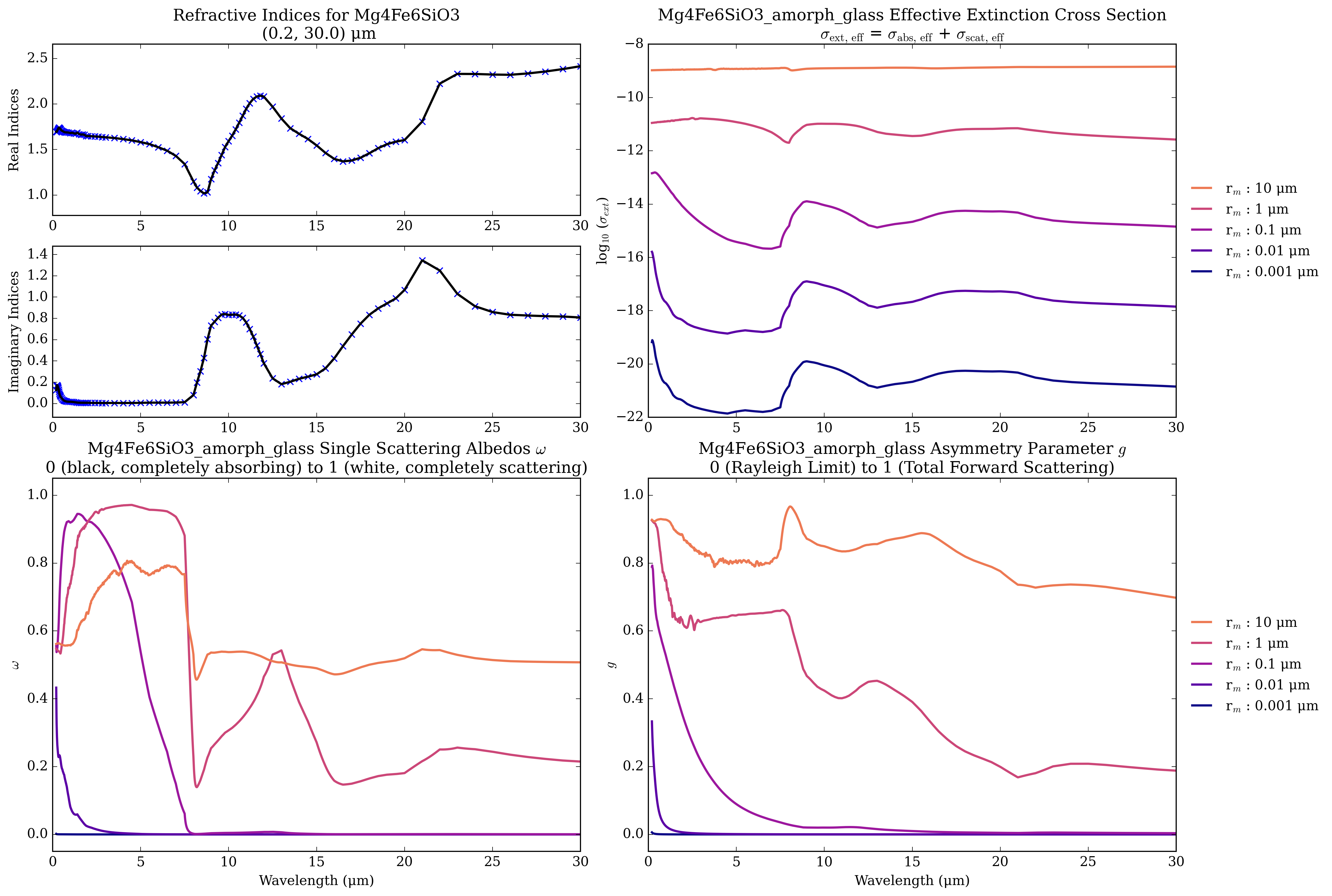
Pyroxene (Mg4Fe6SiO3_amorph_glass) |
|
\(\hookrightarrow\) GitHub |
\(\hookrightarrow\) DOCCD Link \(\hspace{1.0em}\) (Mg(0.4)Fe(0.6)SIO(3)) |
0.2–30 μm |
Amorphous (glass, isotropic) Synthetic Silicate pyroxene |
\(\mathrm{Mg_{0.5}Fe_{0.5}SiO_3}\) |
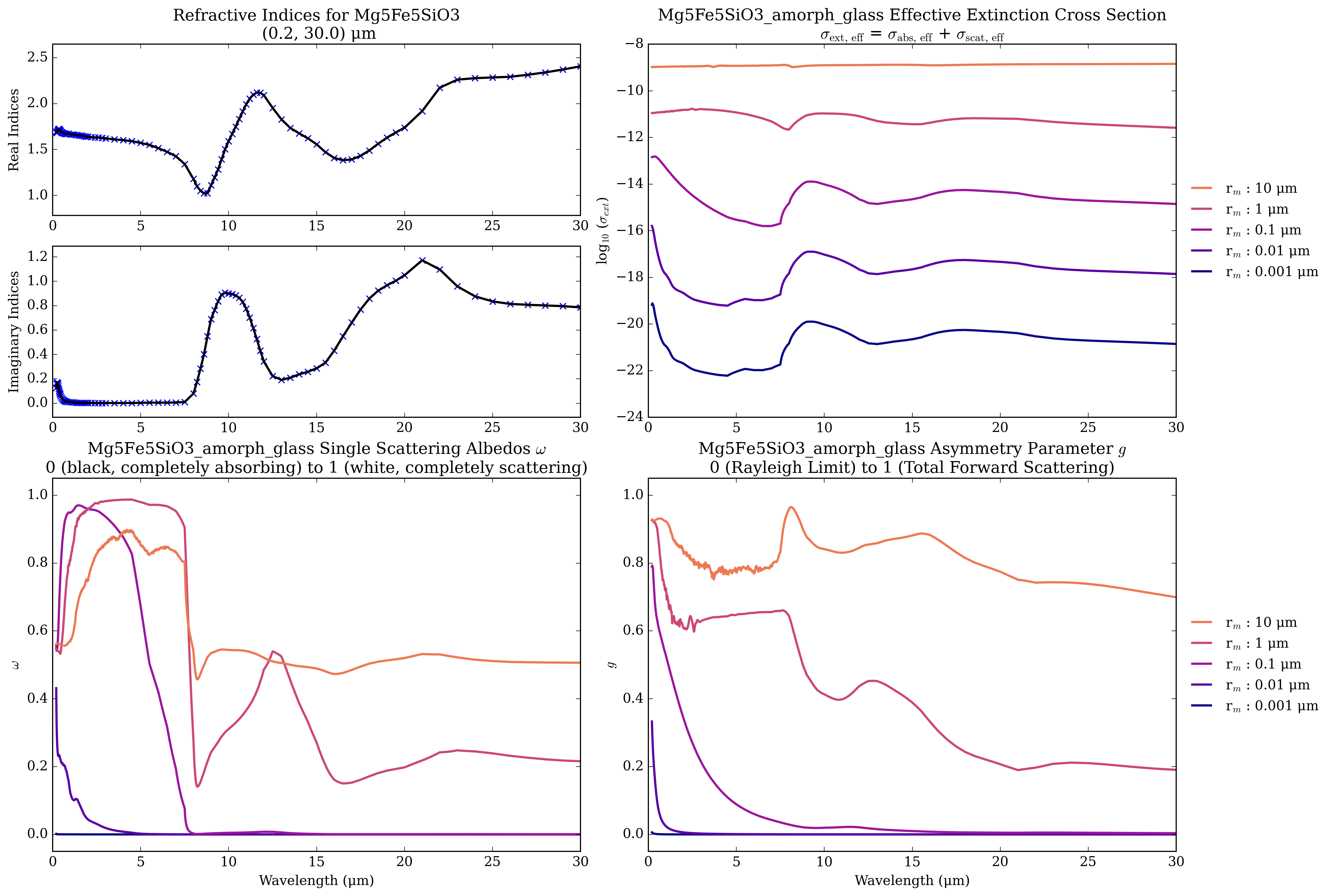
Pyroxene (Mg5Fe5SiO3_amorph_glass) |
|
\(\hookrightarrow\) GitHub |
\(\hookrightarrow\) DOCCD Link \(\hspace{1.0em}\) (Mg(0.5)Fe(0.5)SIO(3) [3.2 g/ccm]) |
0.2–30 μm |
Amorphous (glass, isotropic) Synthetic Silicate pyroxene |
\(\mathrm{Mg_{0.8}Fe_{0.2}SiO_3}\) |
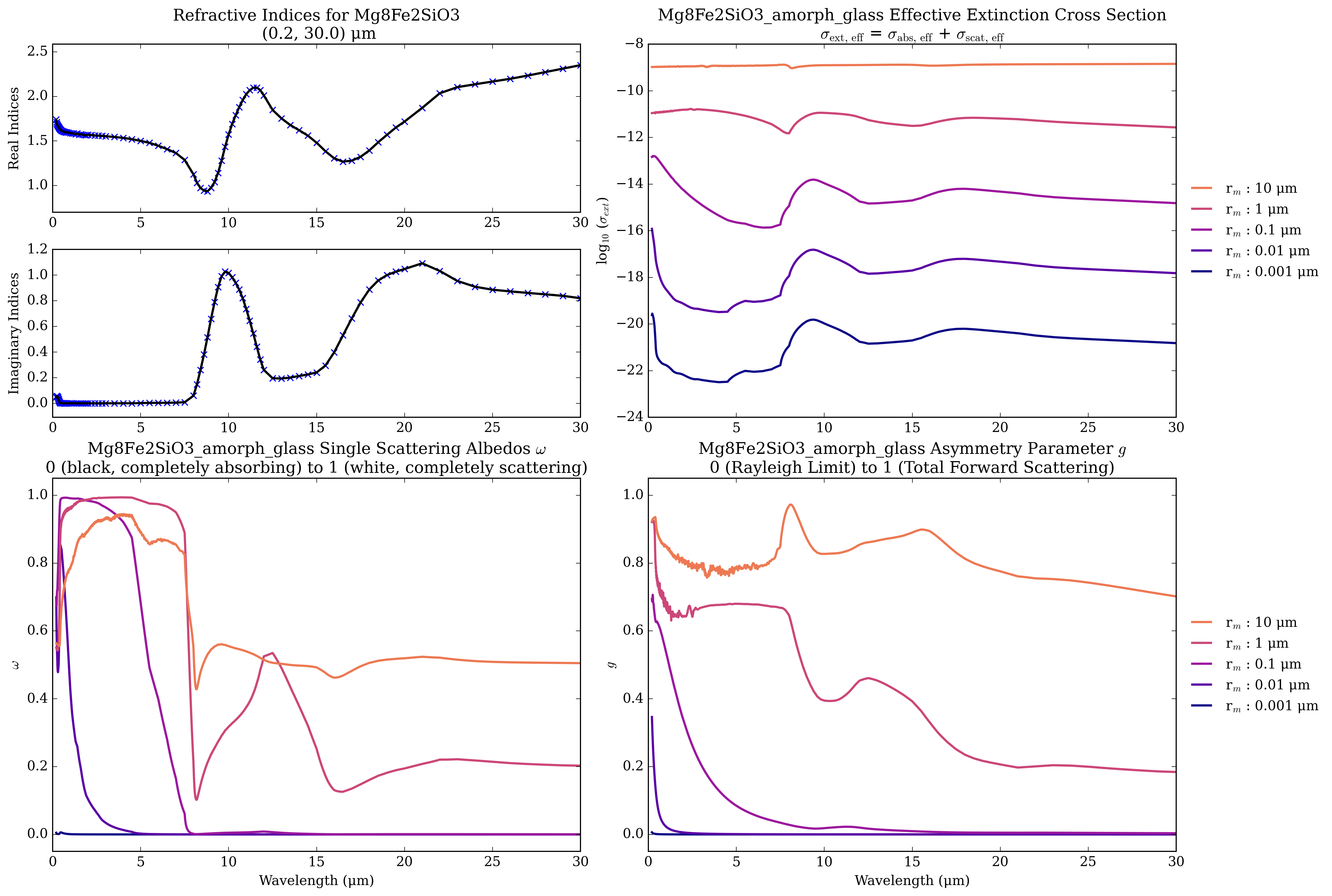
Pyroxene (Mg8Fe2SiO3_amorph_glass) |
|
\(\hookrightarrow\) GitHub |
\(\hookrightarrow\) DOCCD Link \(\hspace{1.0em}\) (Mg(0.5)Fe(0.5)SIO(3) [3.2 g/ccm]) |
0.2–30 μm |
Amorphous (glass, isotropic) Synthetic Silicate pyroxene |
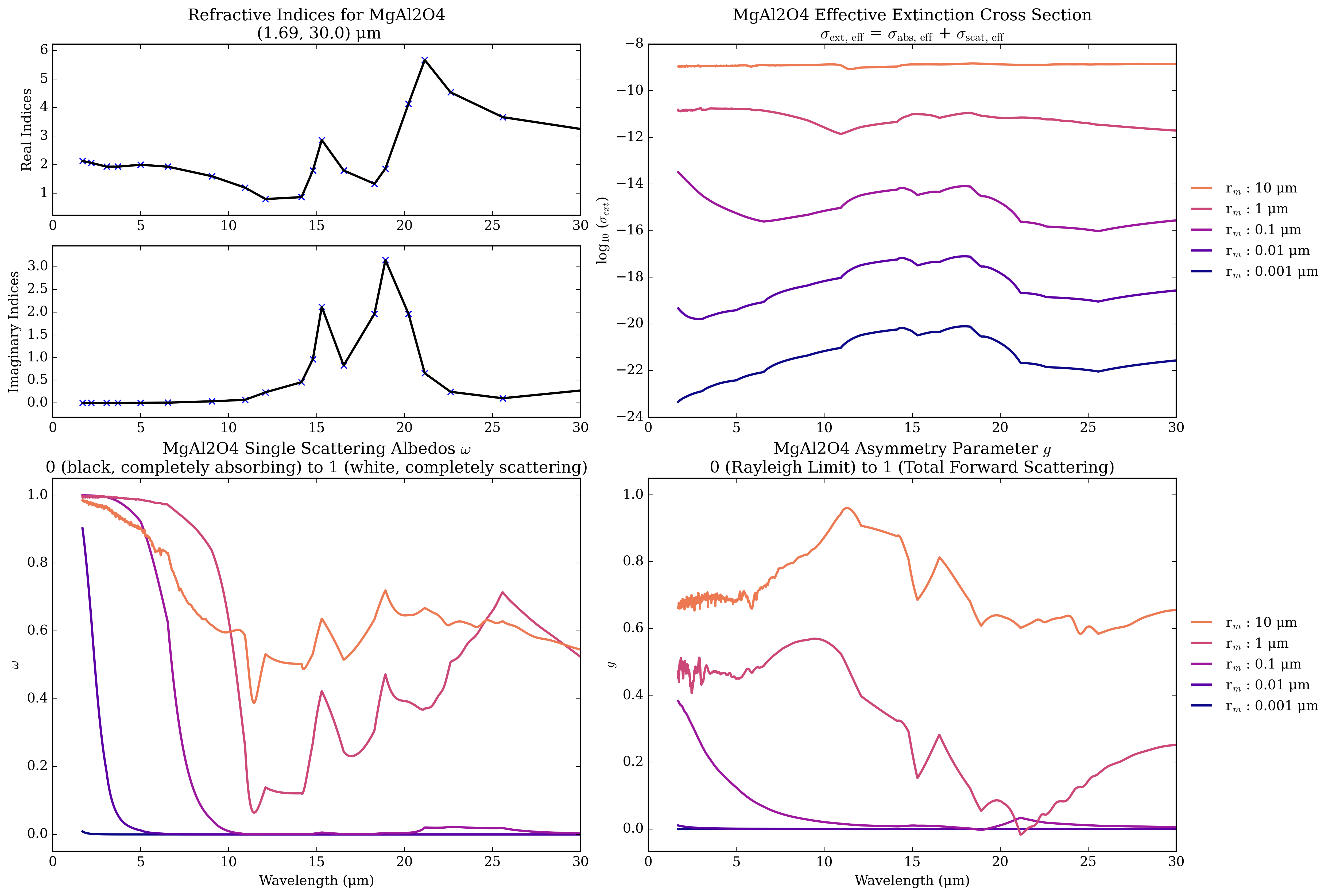
\(\mathrm{MgAl_2O_4}\) |
Spinel (MgAl2O4) |
|
\(\hookrightarrow\) Link |
\(\hookrightarrow\) DOCCD Link \(\hspace{1.0em}\) (Natural Mg-spinel) |
1.69–30 μm |
Crystalline (cubic, isotropic) Natural (\(\mathrm{Mg_{1.02}Al_{1.93}Fe_{0.01}Cr_{0.01}O_4}\)) Annealed at 1223K for one hour, induces a disordered phase transition |
\(\mathrm{\textbf{Silica}}\) |
||||||
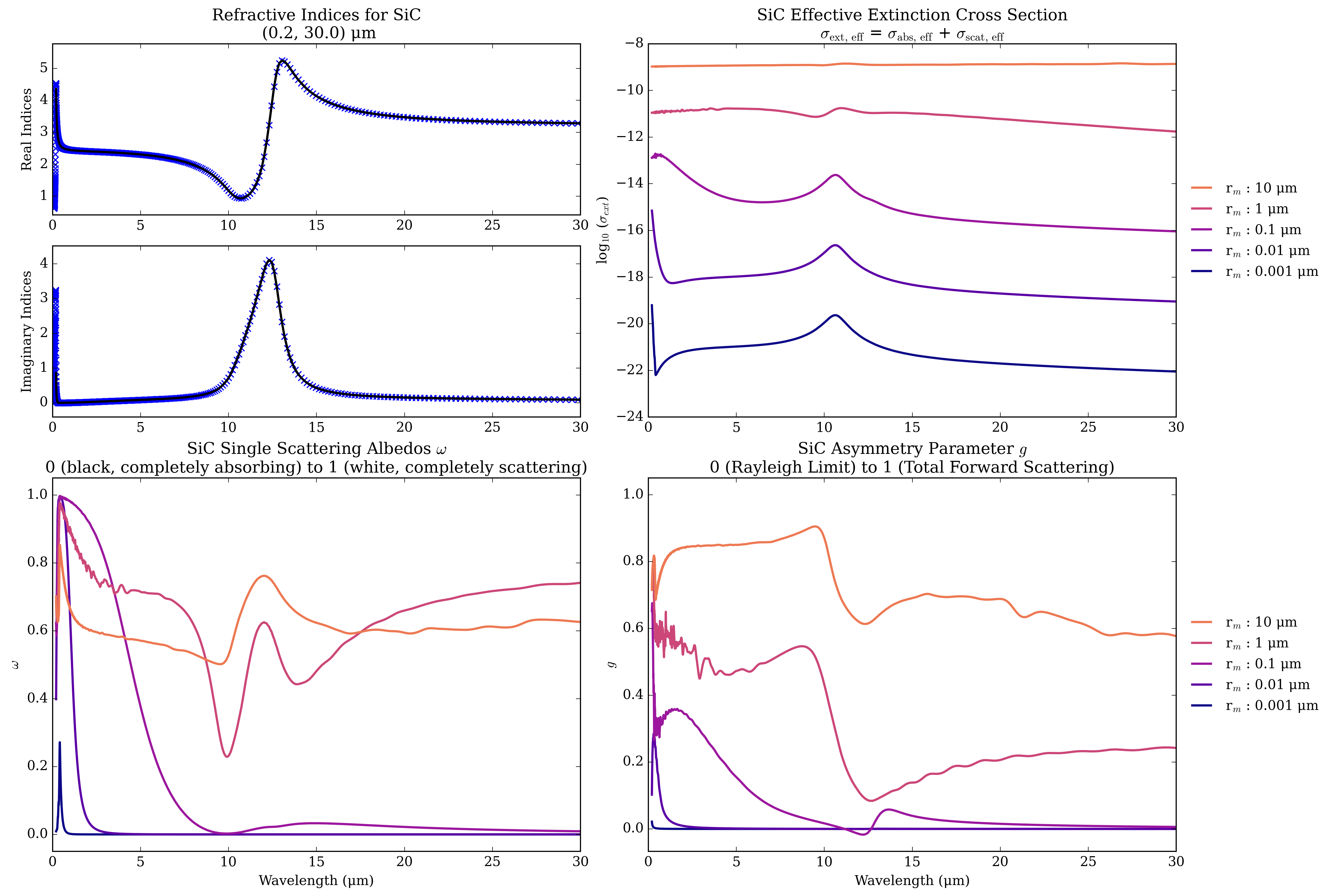
\(\mathrm{SiC}\) |
Moissanite / \(\alpha\) Carborundum (SiC) |
|
\(\hookrightarrow\) GitHub |
0.2–30 μm |
Crystalline (cubic, isotropic). Lab data + Dampled Oscillator Fit |
|
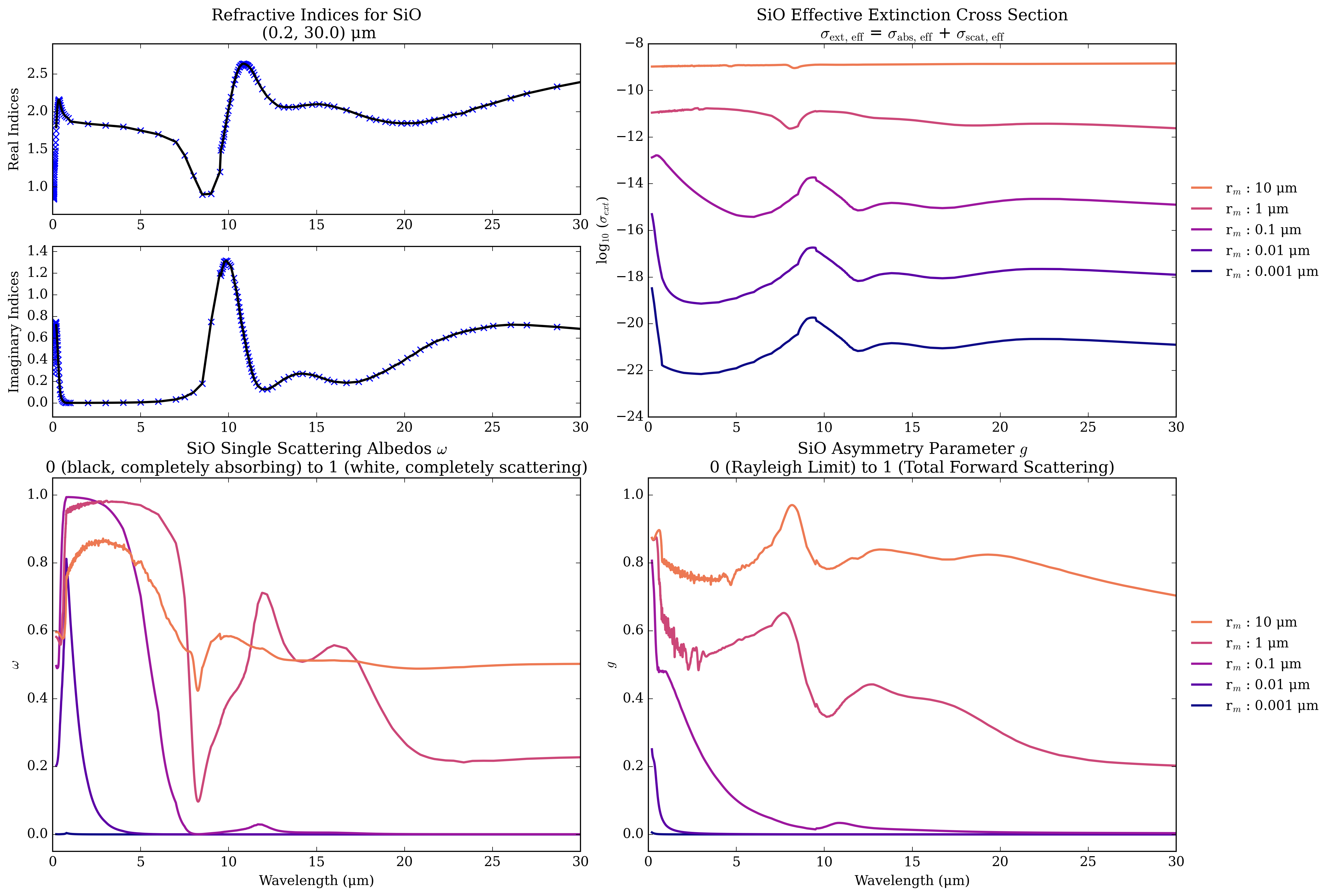
\(\mathrm{SiO}\) |
Silicon Monoxide (SiO) |
|
\(\hookrightarrow\) GitHub |
0.2–30 μm |
Amorphous (glass, isotropic) Palik Compilation + Thin Film KH18 filled empty Palik entries with spline interpolation |
|
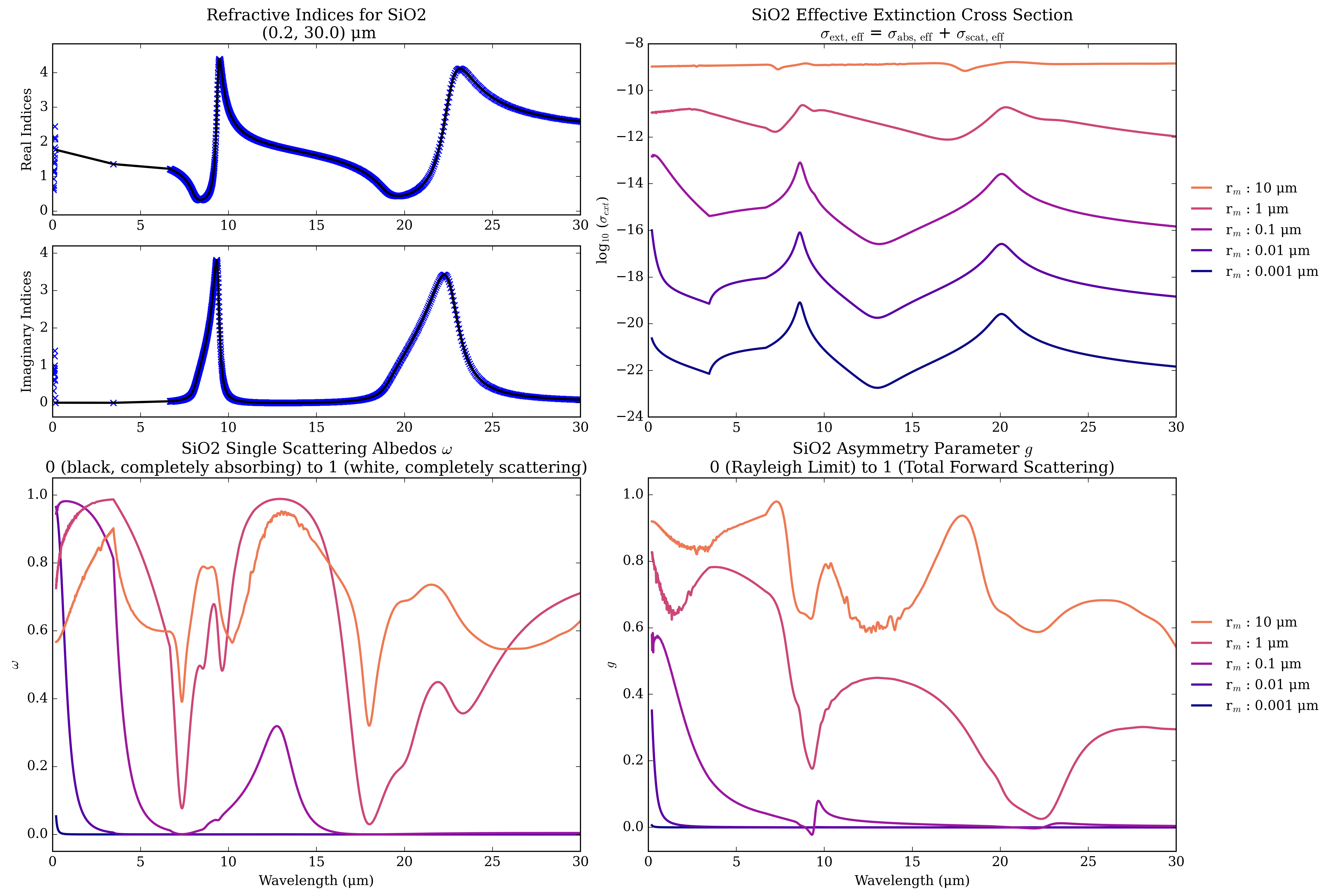
\(\mathrm{SiO_2}\) |
\(\alpha+\beta\) Quartz (SiO2) |
|
\(\hookrightarrow\) Link |
Palik (1985) (Vol 1, Sec 34) (C) \(\hookrightarrow\) DOCCD Link \(\hspace{1.0em}\) (SiO2 at 928K, E||c) |
0.2–30 μm |
Short wavelengths is \(\alpha\) Quartz (crystalline, trigonal, uniaxial) Infrared wavelengths is \(\beta\) Quartz (crystalline, hexagonal, uniaxial) 928K, Extraordinary (E||c) ray was used for \(\beta\) Quartz |
\(\mathrm{SiO_2}\) |
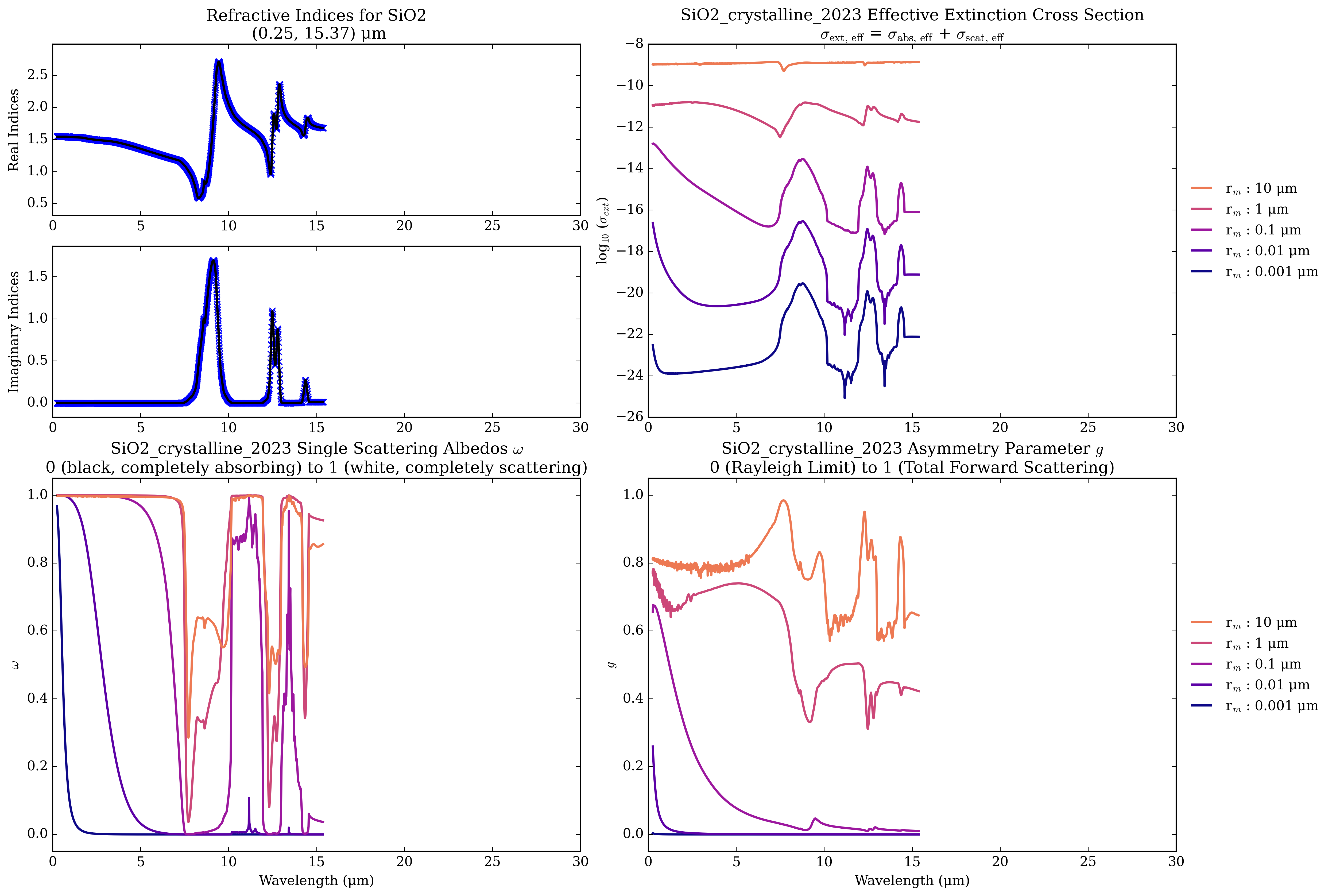
\(\alpha\) Quartz (SiO2_crystalline_2023) |
|
\(\hookrightarrow\) GitHub |
0.25–15.37 μm |
Crystalline (trigonal, uniaxial) Airborne quartz particles, random orientation |
|
\(\mathrm{SiO_2}\) |
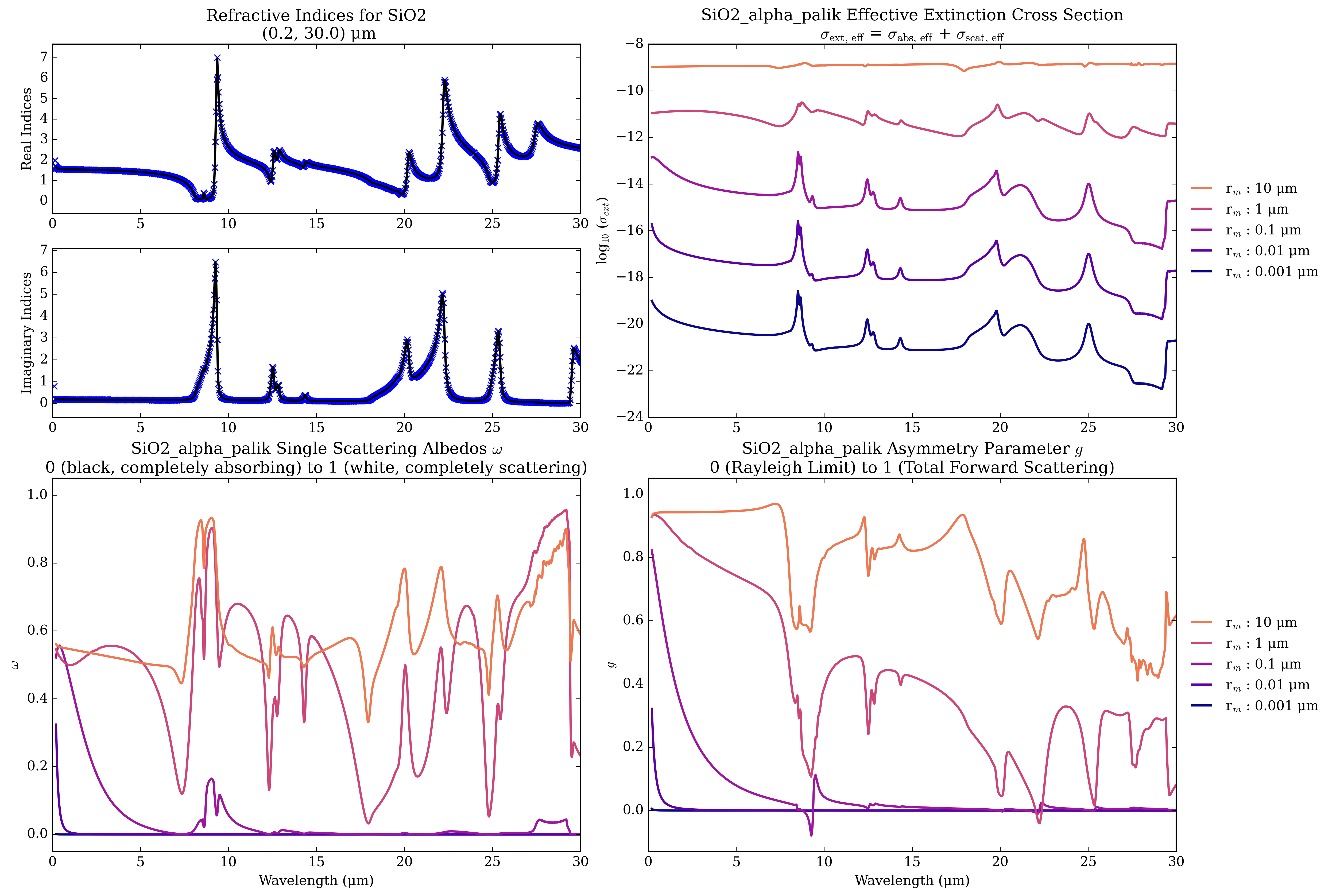
\(\alpha\) Quartz (SiO2_alpha_palik) |
|
\(\hookrightarrow\) GitHub |
0.2–30 μm |
Crystalline (trigonal, uniaxial) Variety of lab sources Kramers-Kronig analysis was utilized to fill in empty Palik entries \(\hookrightarrow\) pyElli (Kramers-Kronig code) Indices averaged by polarization (2/3 Ordinary + 1/3 Extraordinary) |
|
\(\mathrm{SiO_2}\) |
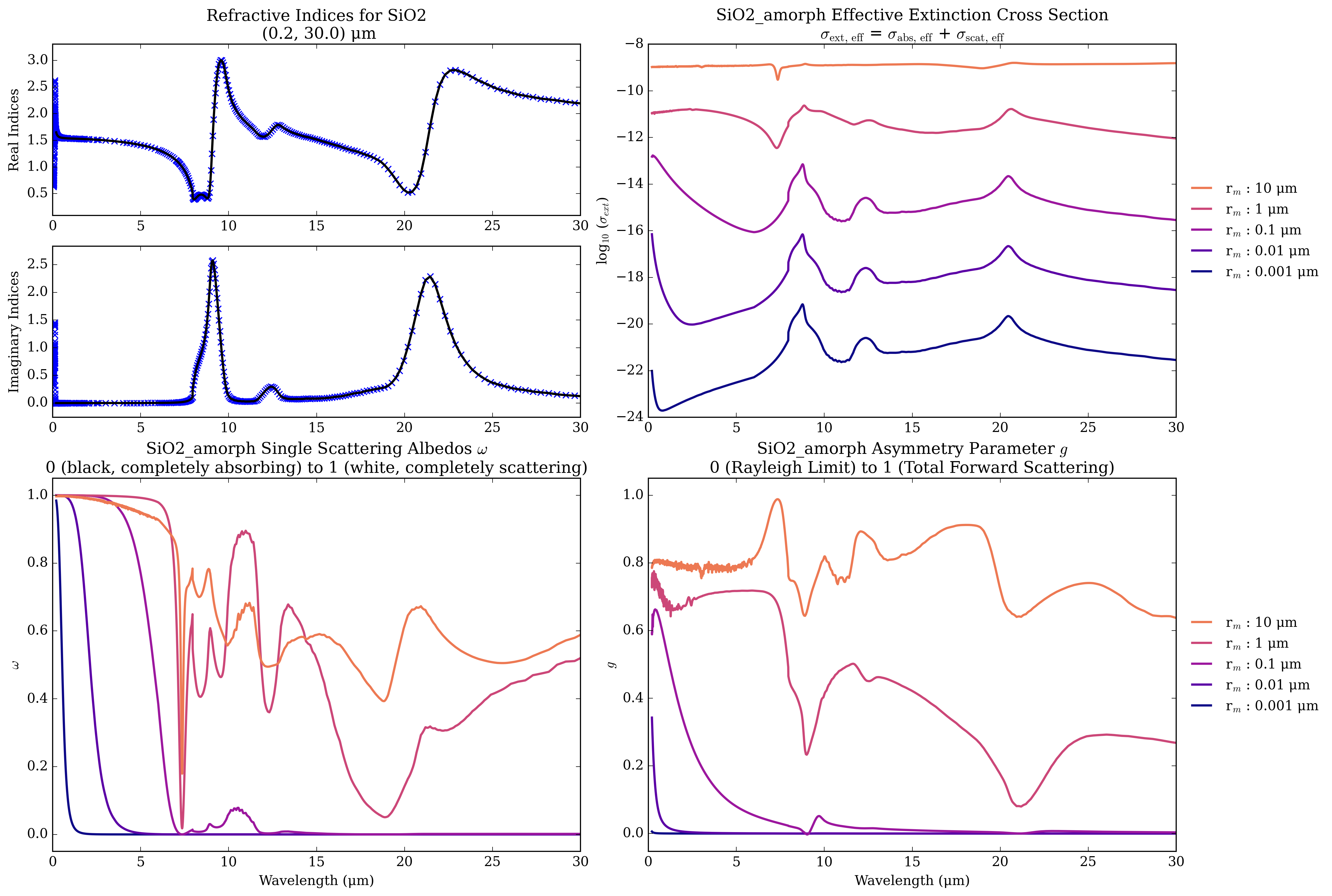
\(\alpha\) Quartz + Silica Glass (SiO2_amorph) |
|
\(\hookrightarrow\) GitHub |
Palik (1985) (Vol 1, Sec 34) (C) \(\hookrightarrow\) DOCCD Link \(\hspace{1.0em}\) (Amorphous SiO2, 300K) |
0.2–30 μm |
Short wavelengths is \(\alpha\) Quartz (crystalline,trigonal,uniaxial) Long wavelengths is amorphous silica (glass, isotropic) |
\(\mathrm{SiO_2}\) |
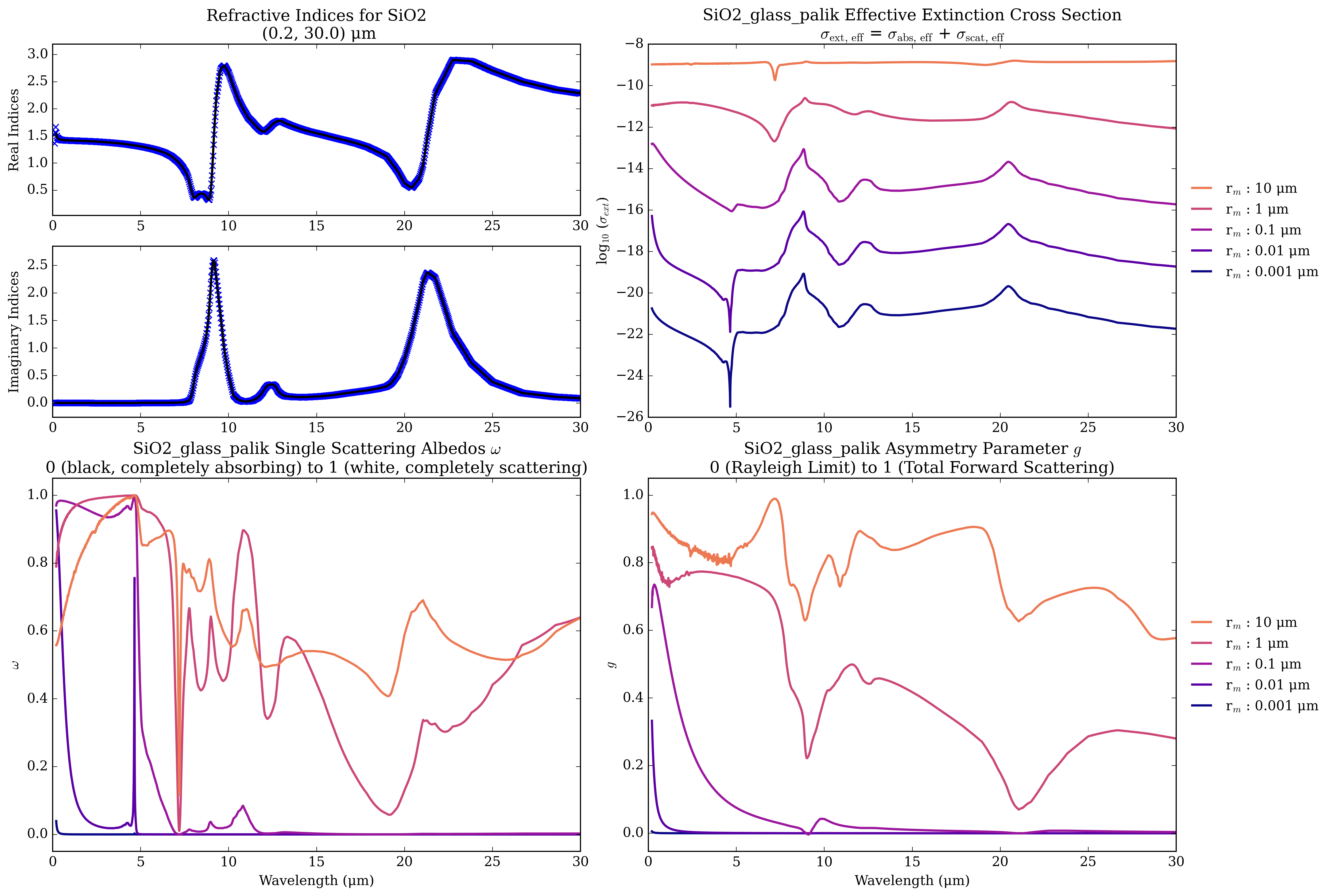
Silica Glass (SiO2_glass_palik) |
|
\(\hookrightarrow\) GitHub |
0.2–30 μm |
Amorphous (glass, isotropic) Kramers-Kronig analysis was utilized to fill in empty Palik entries \(\hookrightarrow\) pyElli (Kramers-Kronig code) |
|
\(\mathrm{\textbf{T-Y Dwarf}}\) |
||||||
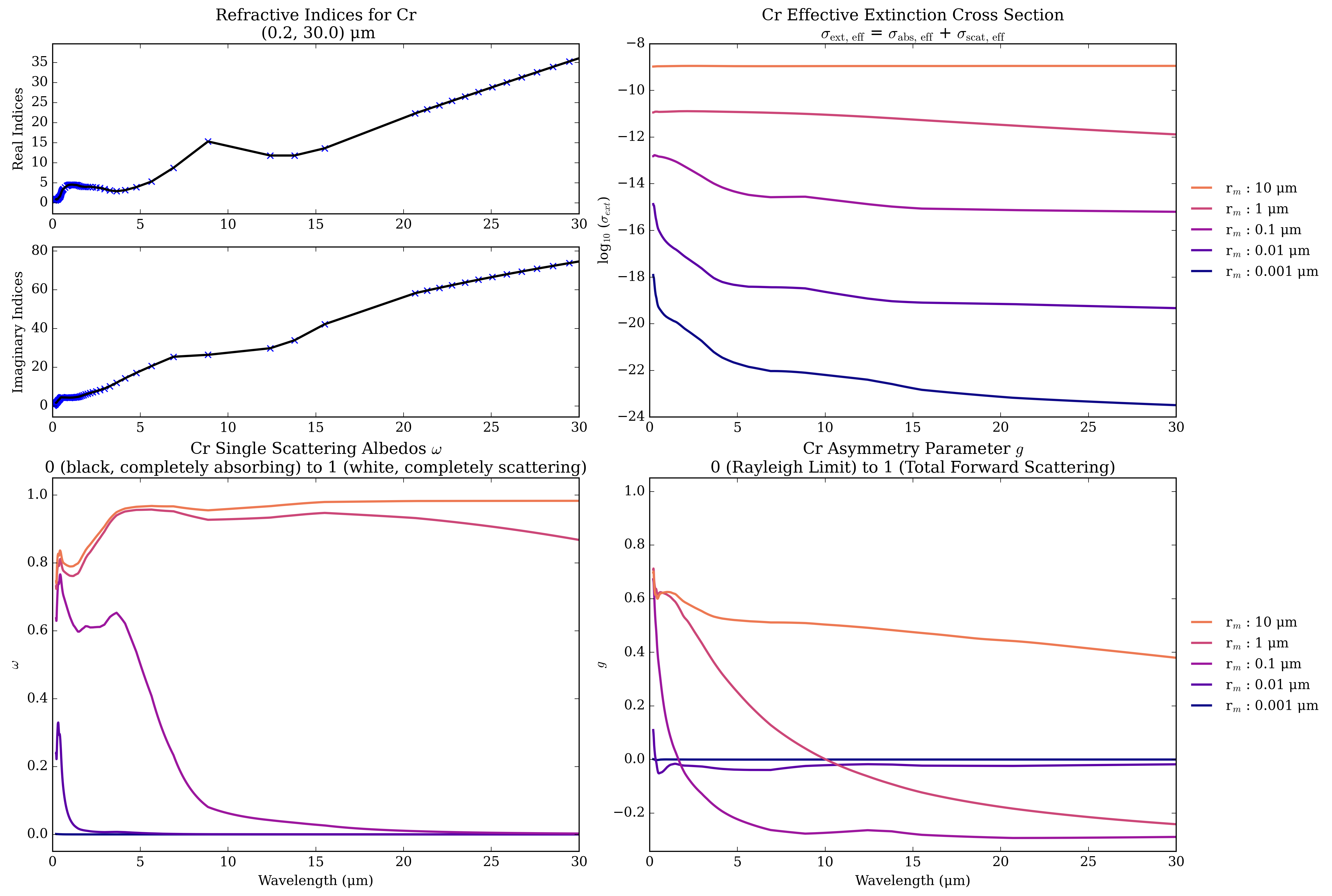
\(\mathrm{Cr}\) |
Chromium (Cr) |
|
\(\hookrightarrow\) GitHub |
0.2–30 μm |
Crystalline (cubic, body centered, isotropic) (technically tetragonal, but not by much) Palik compiled lab data + computed from first principles |
|
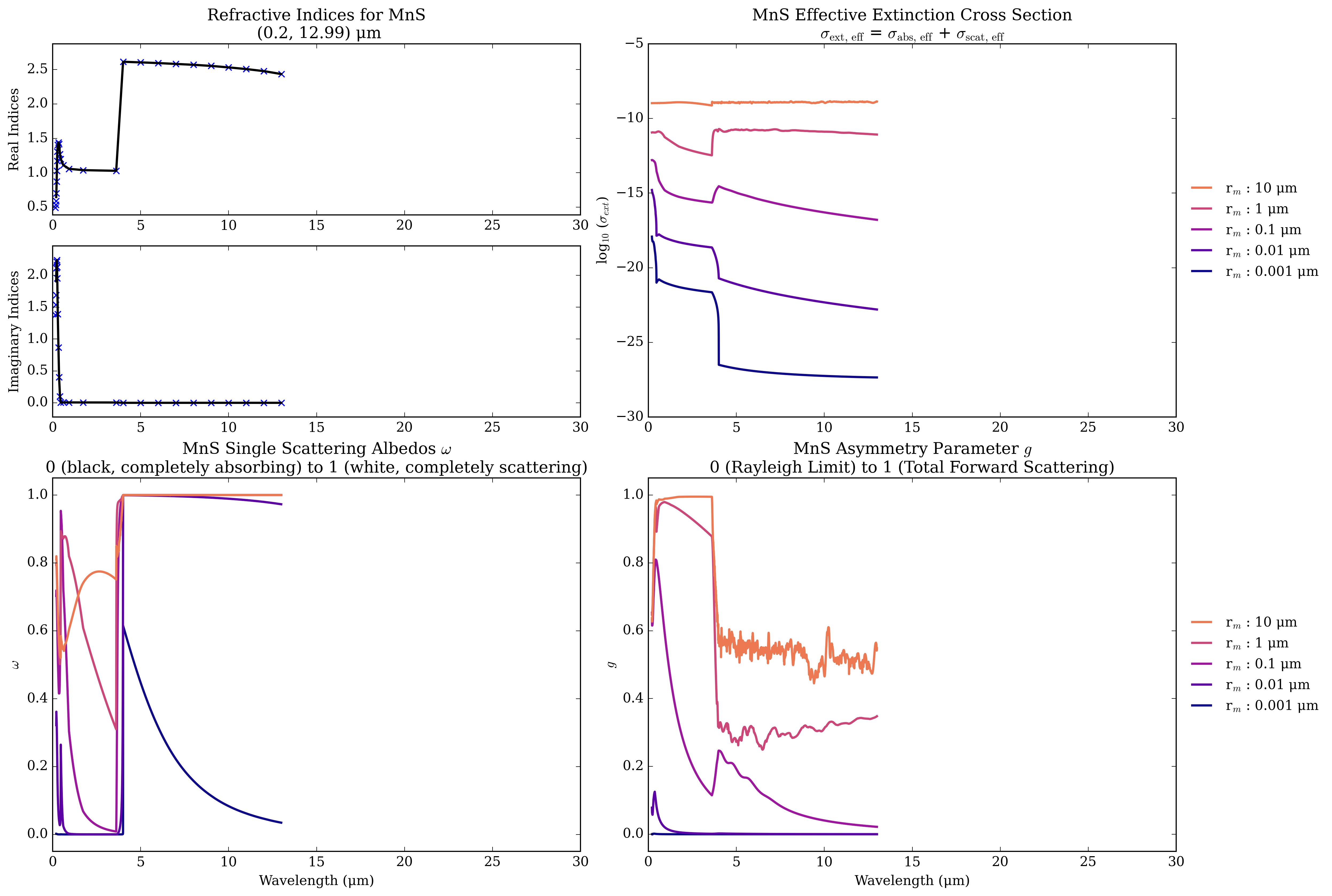
\(\mathrm{MnS}\) |
\(\alpha\) Manganese Sulfide (MnS) |
|
\(\hookrightarrow\) Link |
0.2–13 μm |
Crystalline (cubic, isotropic) Synthetic single crystals |
|
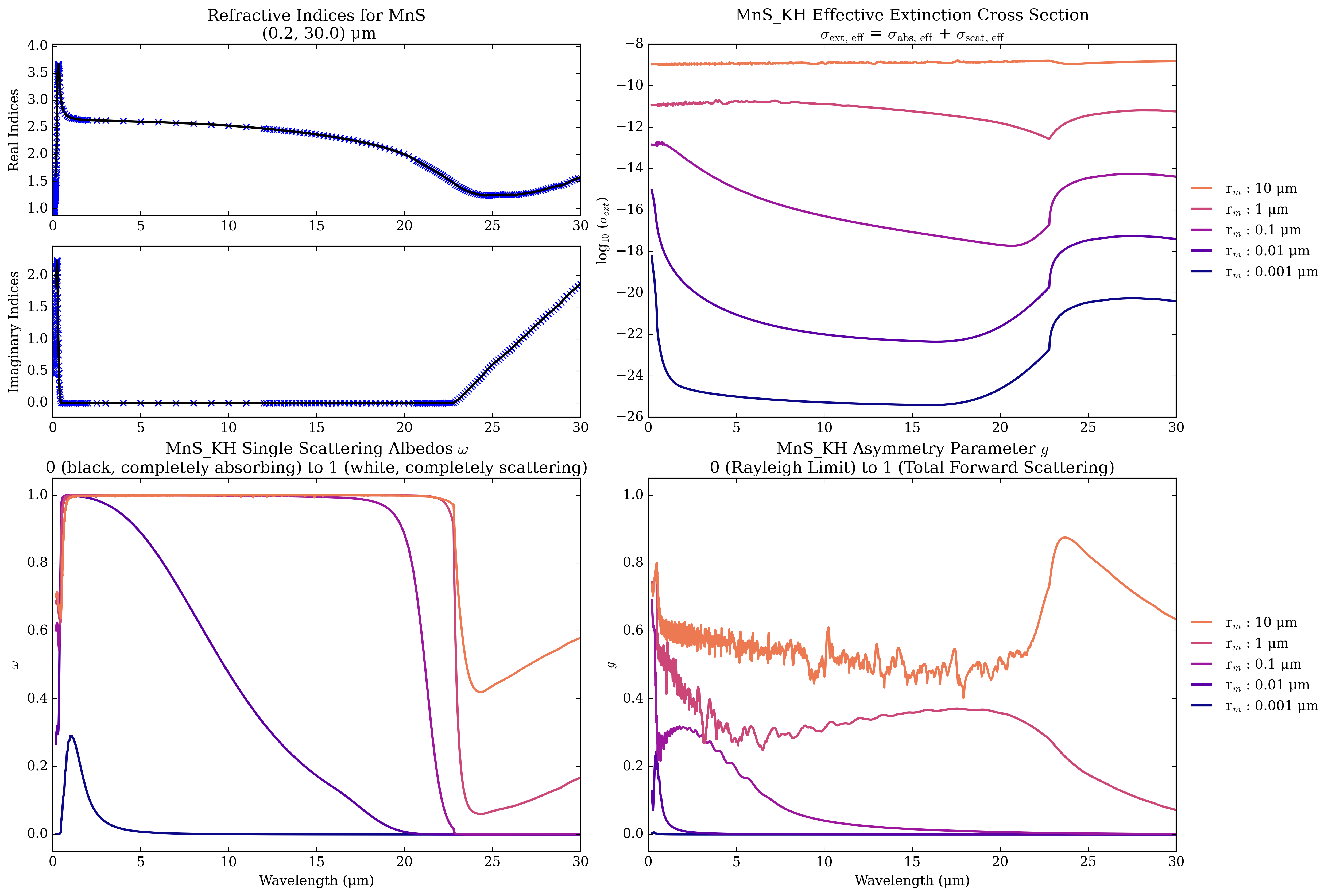
\(\mathrm{MnS}\) |
\(\alpha\) Manganese Sulfide (MnS_KH) |
|
\(\hookrightarrow\) GitHub |
0.2–30 μm |
Crystalline (cubic, isotropic) Synthetic single crystals + \(\mathrm{Na_2S}\) extrapolation |
|
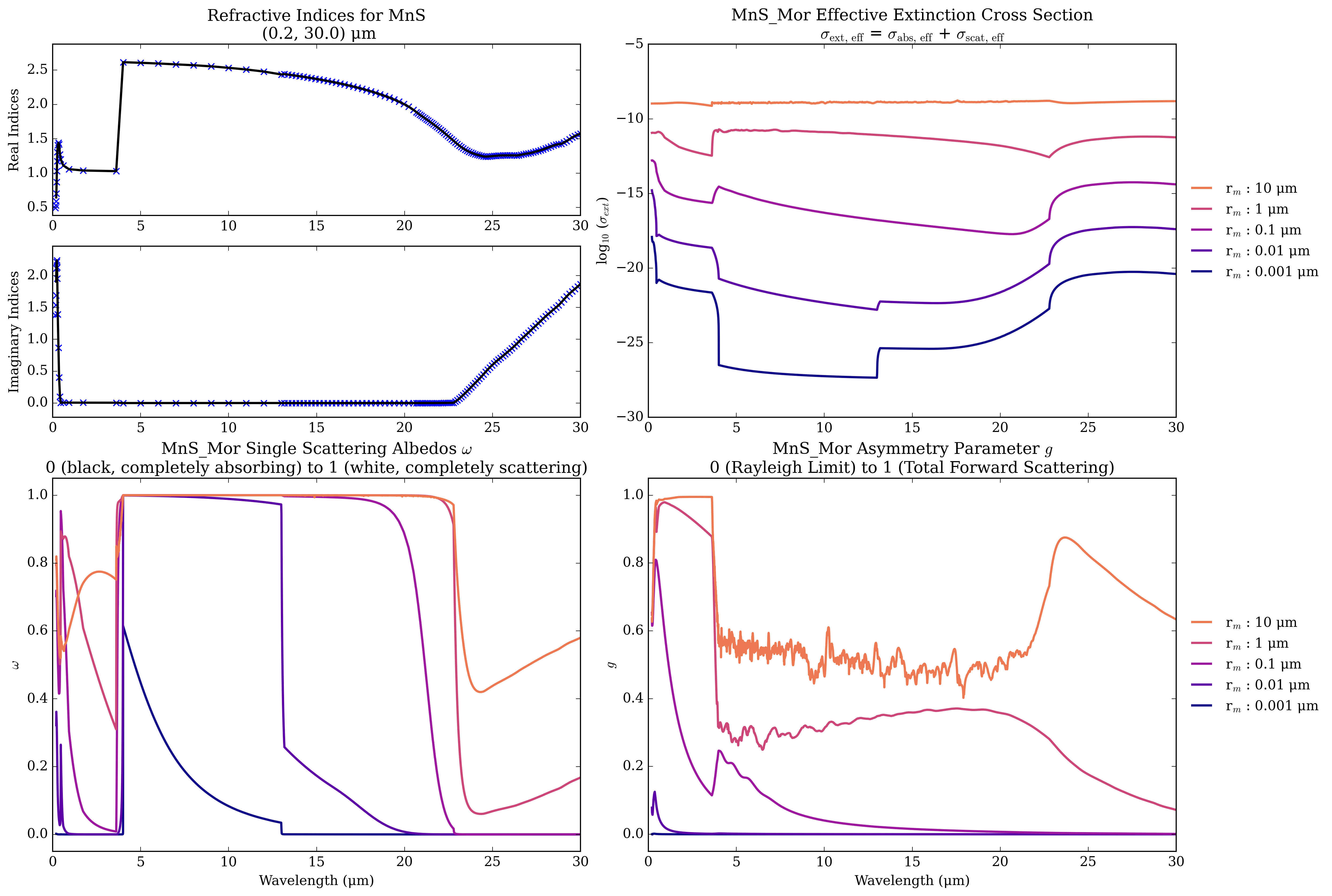
\(\mathrm{MnS}\) |
\(\alpha\) Manganese Sulfide (MnS_Mor) |
|
\(\hookrightarrow\) GitHub |
0.2–30 μm |
Crystalline (cubic, isotropic) Synthetic single crystals + \(\mathrm{Na_2S}\) extrapolation Used WS15 indices to 13 μm, and KH18 from 13-30 μm |
|
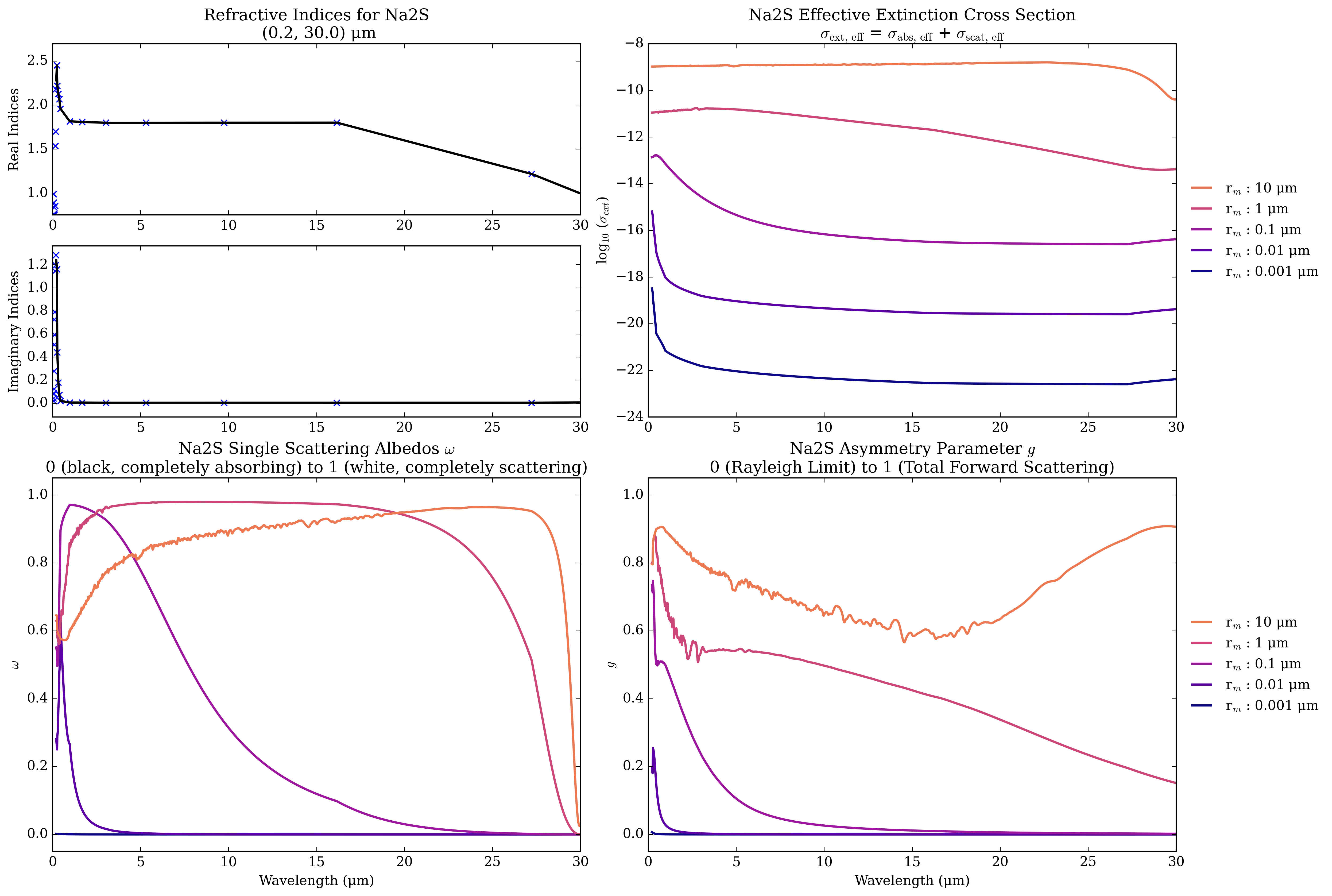
\(\mathrm{Na_2S}\) |
Sodium Sulfide (Na2S) |
|
\(\hookrightarrow\) Link |
0.2–30 μm |
Crystalline (cubic, face centered, isotropic) Compiled by Morley (2012) Synthetic crystal lab data (15K) + computed from first principles |
|
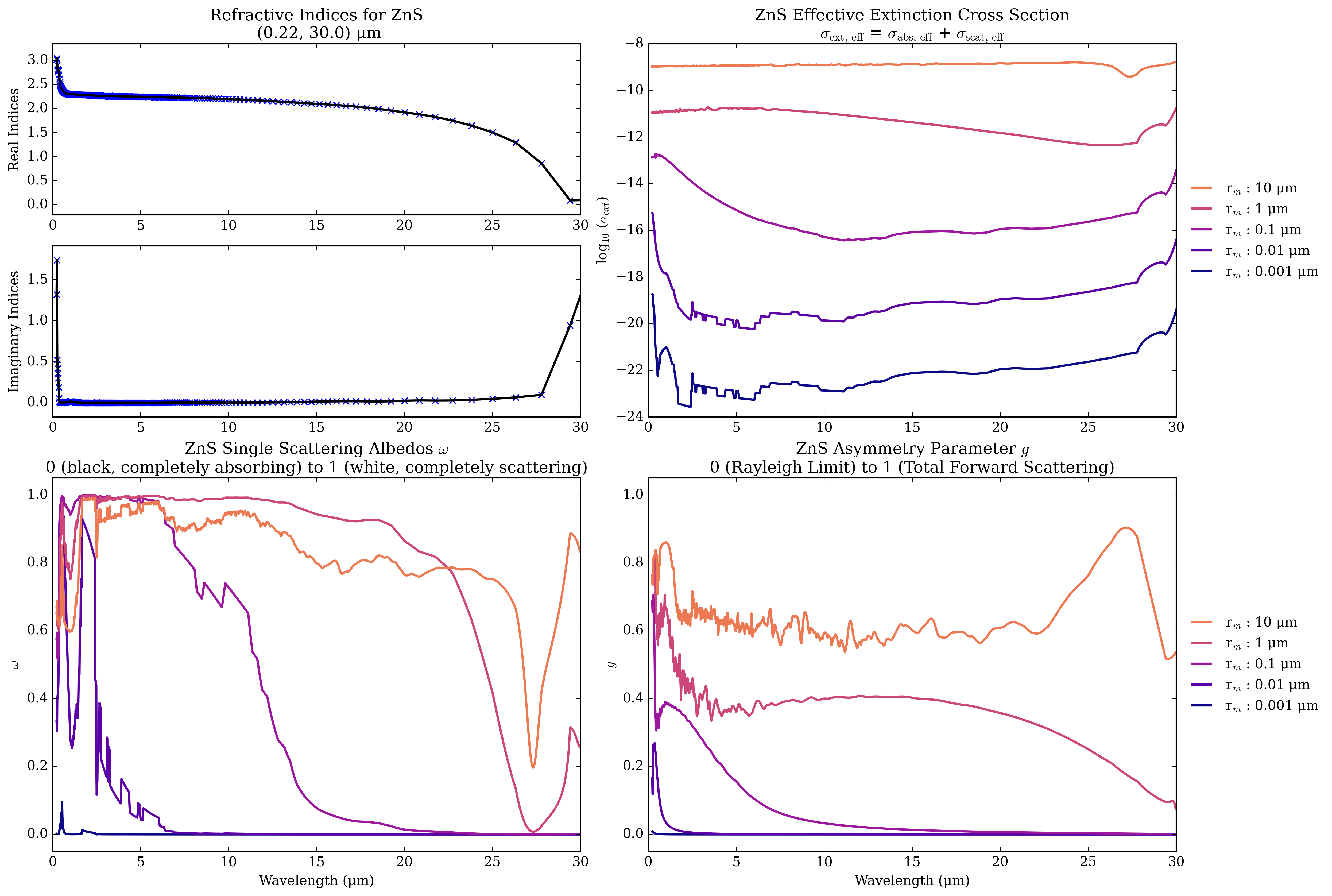
\(\mathrm{ZnS}\) |
Zinc blende / Sphalerite (ZnS) |
|
\(\hookrightarrow\) Link |
0.22–30 μm |
Crystalline (cubic, isotropic) High purity sample |
|
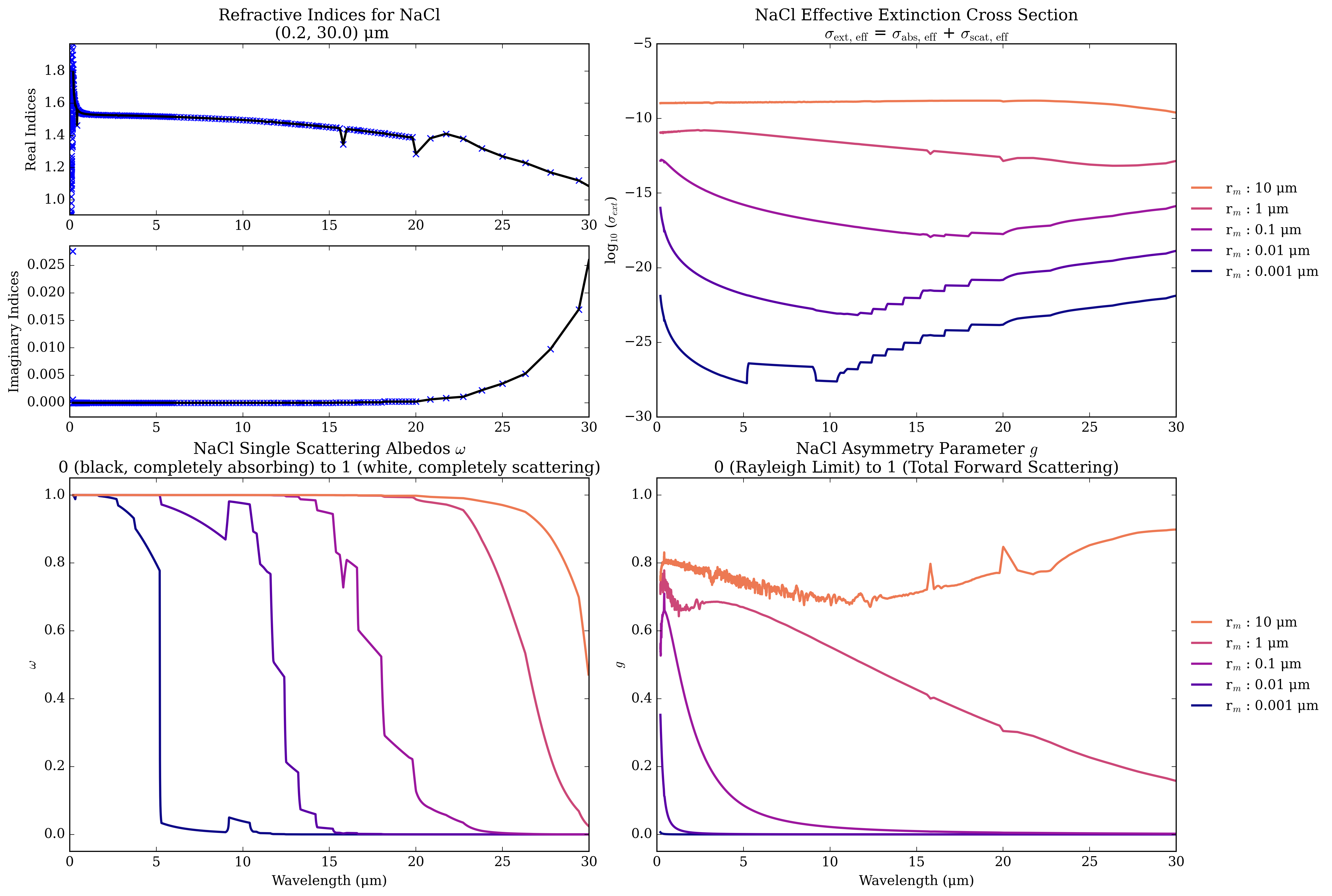
\(\mathrm{NaCl}\) |
Halite / Rock Salt (NaCl) |
|
\(\hookrightarrow\) Link |
0.2–30 μm |
Crystalline (cubic, isotropic) WS15 would assume constant imaginary index to fill in empty Palik entries (causes step-function-like cross section) |
|
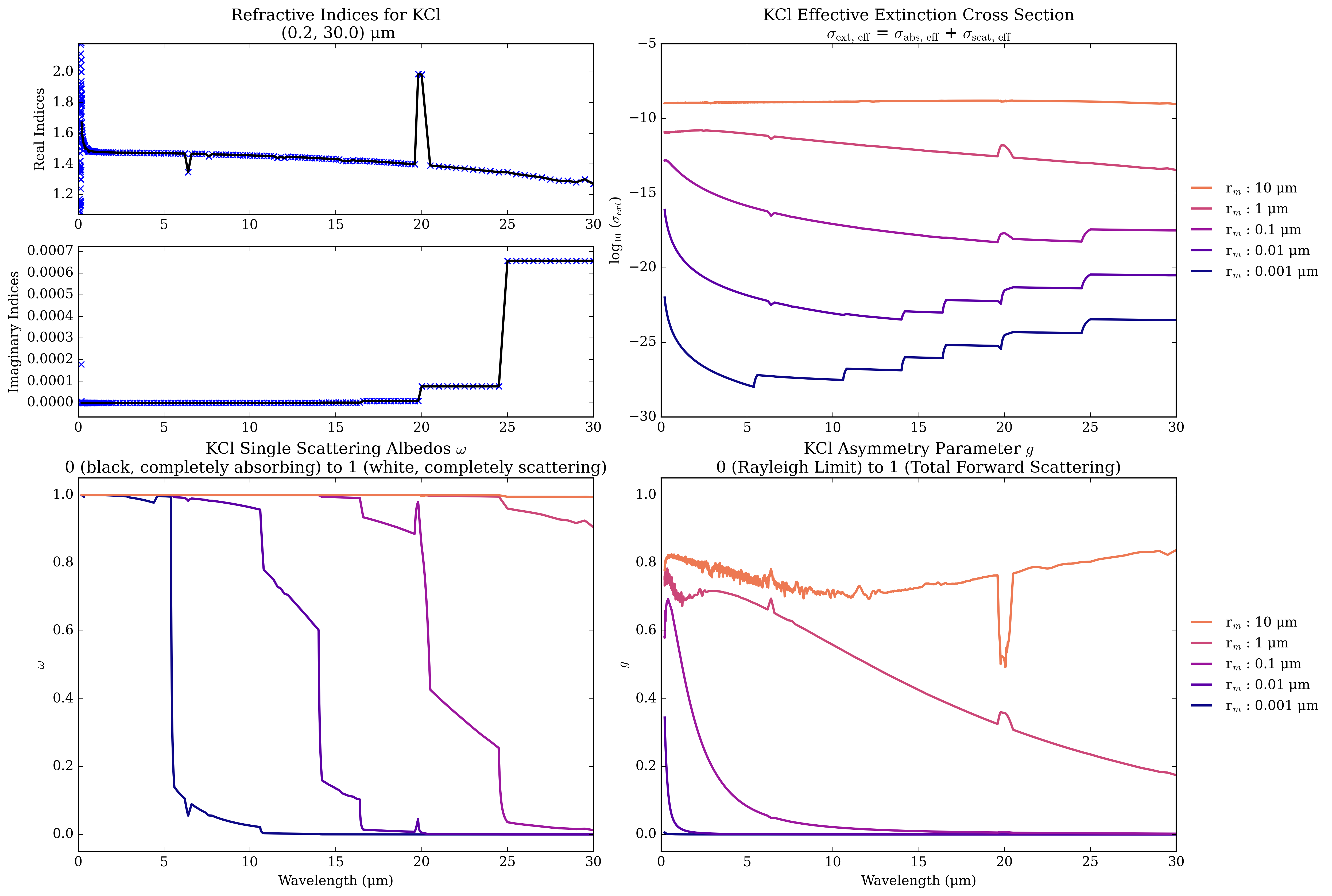
\(\mathrm{KCl}\) |
Sylvite (KCl) |
|
\(\hookrightarrow\) Link |
0.2–30 μm |
Crystalline (cubic, isotropic) WS15 would assume constant imaginary index to fill in empty Palik entries (causes step-function-like cross section) |
|
\(\mathrm{\textbf{Ices}}\) |
||||||
\(\mathrm{NH_4H_2PO_4}\) |
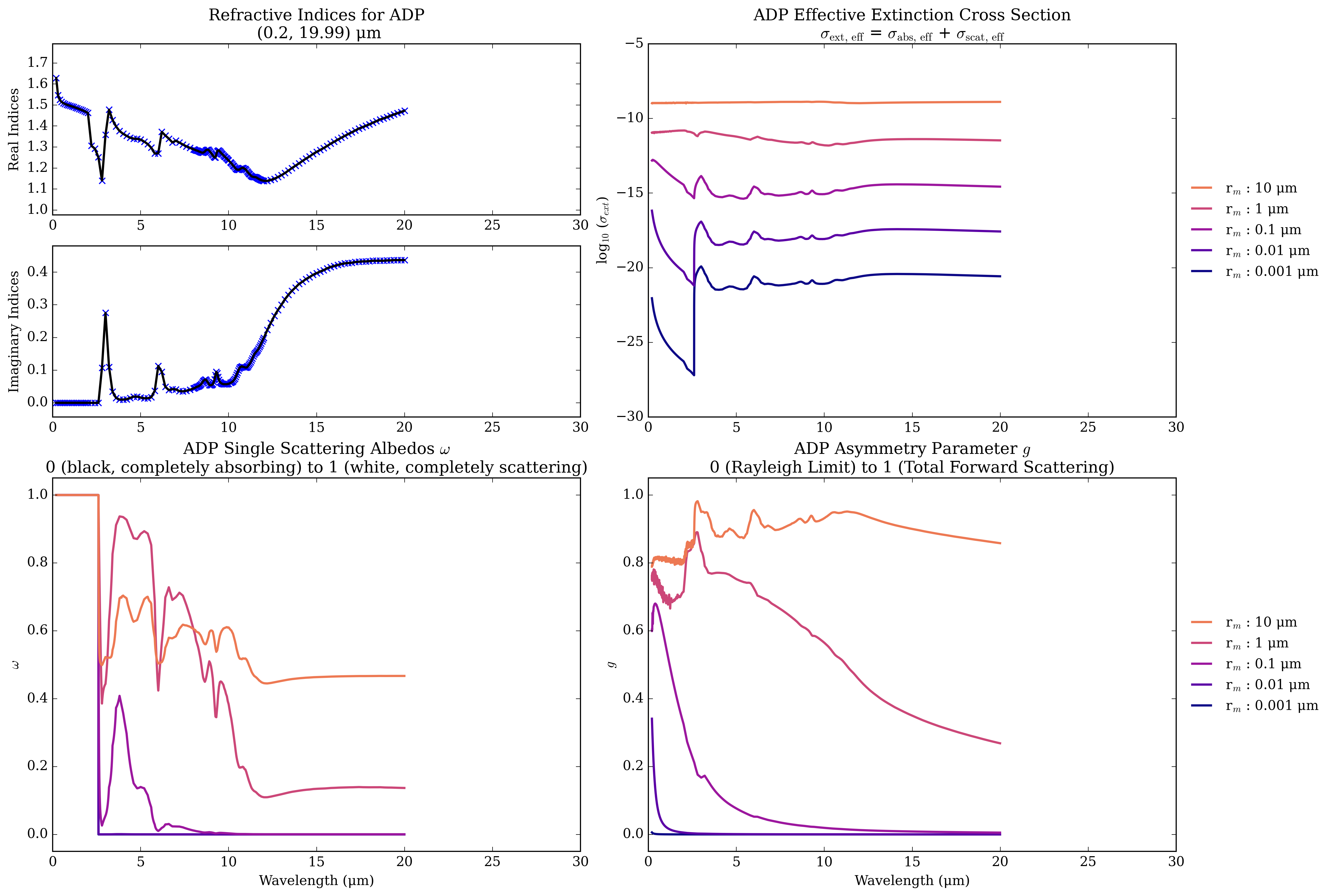
Ammonium Dihydrogen Phosphate (ADP) |
|
\(\hookrightarrow\) GitHub |
0.2–19.99 μm |
Crystalline (tetragonal, uniaxial) + Liquid Synthetic crystal + aqueous solution Crystalline indices averaged by polarization (2/3 Ordinary + 1/3 Extraordinary) |
|
\(\mathrm{H_2O}\) |
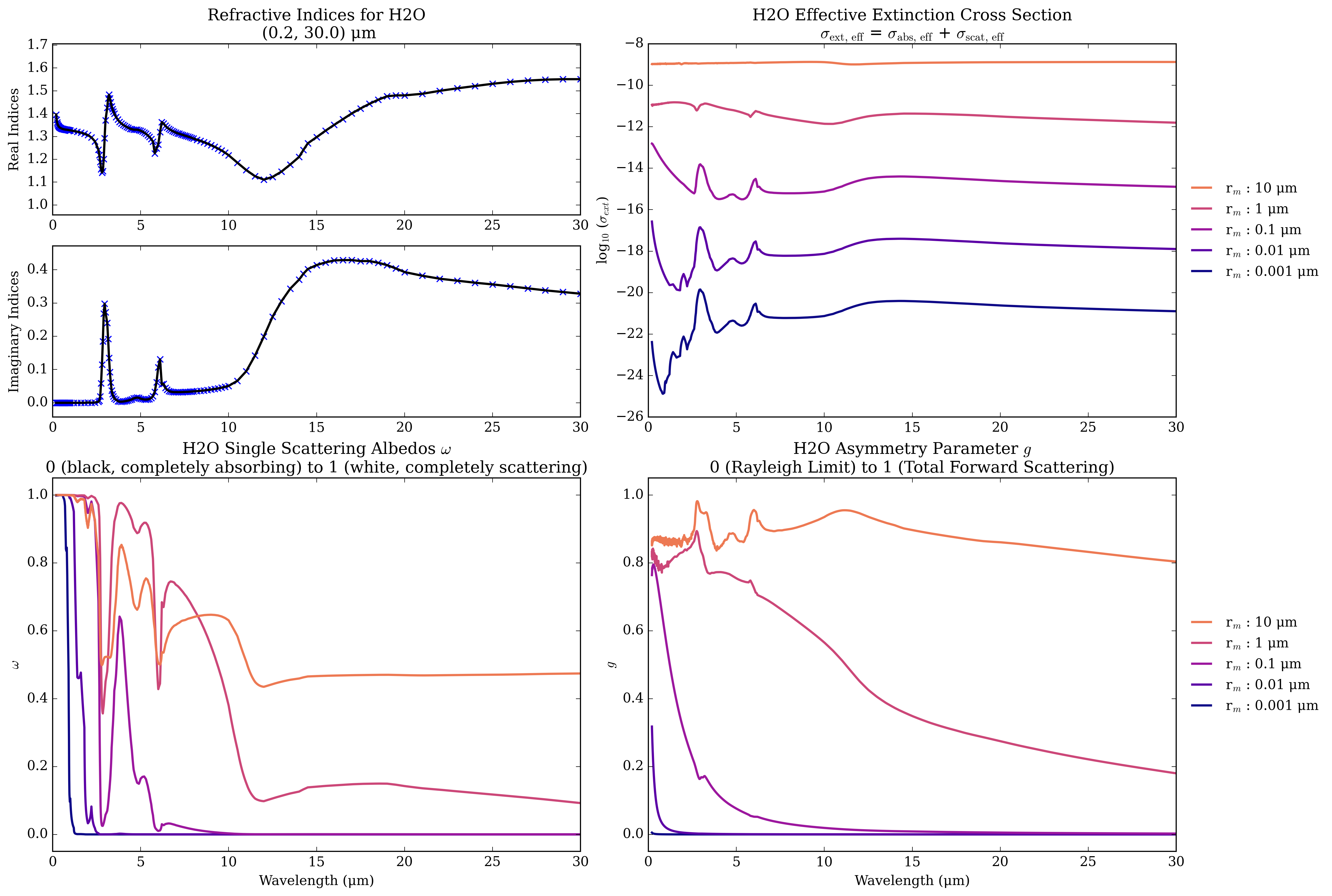
Water (liquid) (H2O) |
|
\(\hookrightarrow\) Link |
0.2–30 μm |
Room temperature (298.5K) liquid water |
|
\(\mathrm{H_2O}\) |
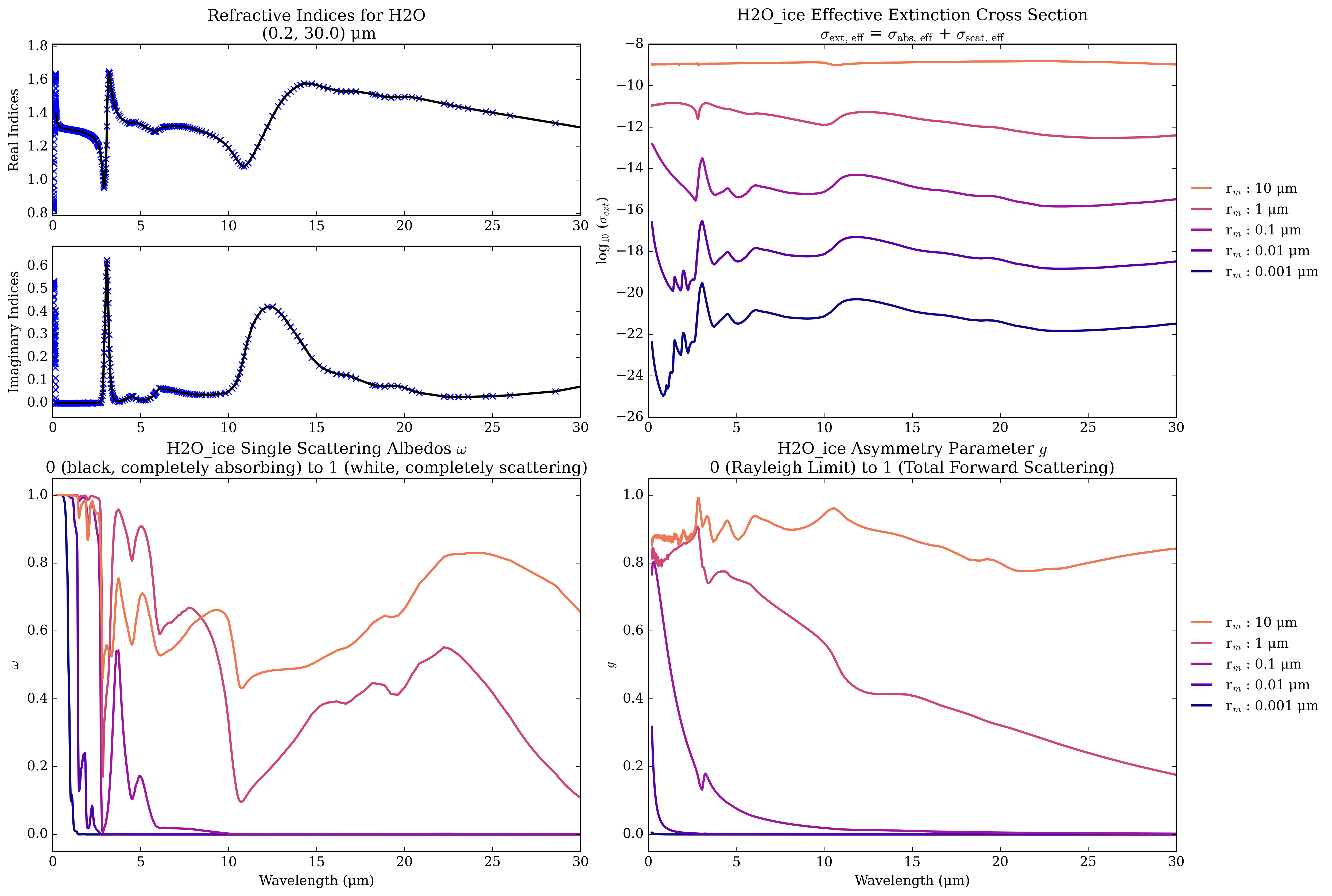
Ice 1h (H2O_ice) |
|
\(\hookrightarrow\) Link |
0.2–30 μm |
Crystalline (hexagonal, uniaxial) (266.15K ice) No ordinary or extraordinary indices listed |
|
\(\mathrm{NH_4SH}\) |
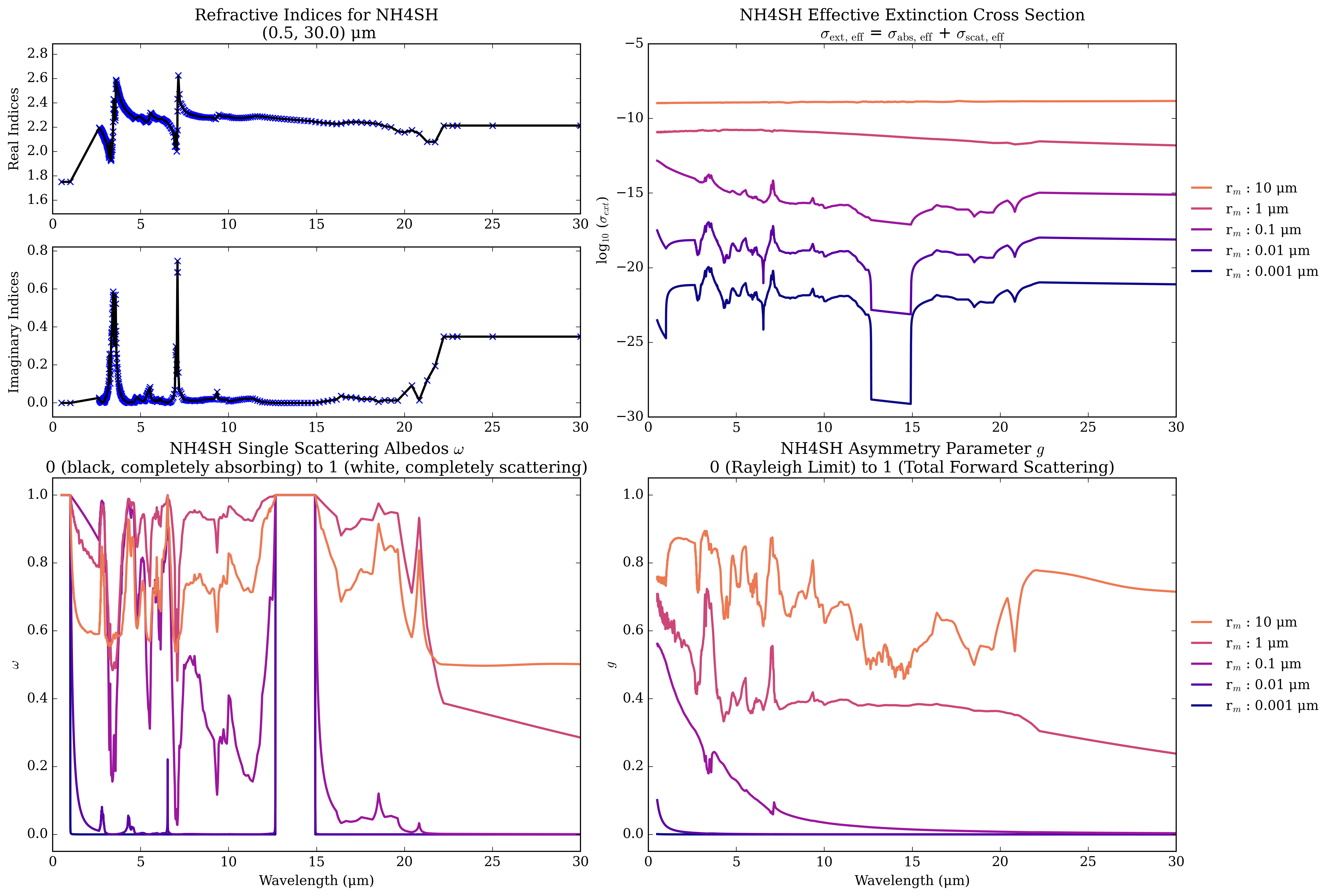
Amonnium Hydrosulfide (NH4SH) |
|
\(\hookrightarrow\) GitHub |
Personal Communication \(\hookrightarrow\) Howett (2007) (C) |
0.5–30 μm |
Crystalline (rhombic, biaxial) (~160K) Unpublished dataset, personal communication. |
\(\mathrm{NH_3}\) |
Amonnia (NH3) |
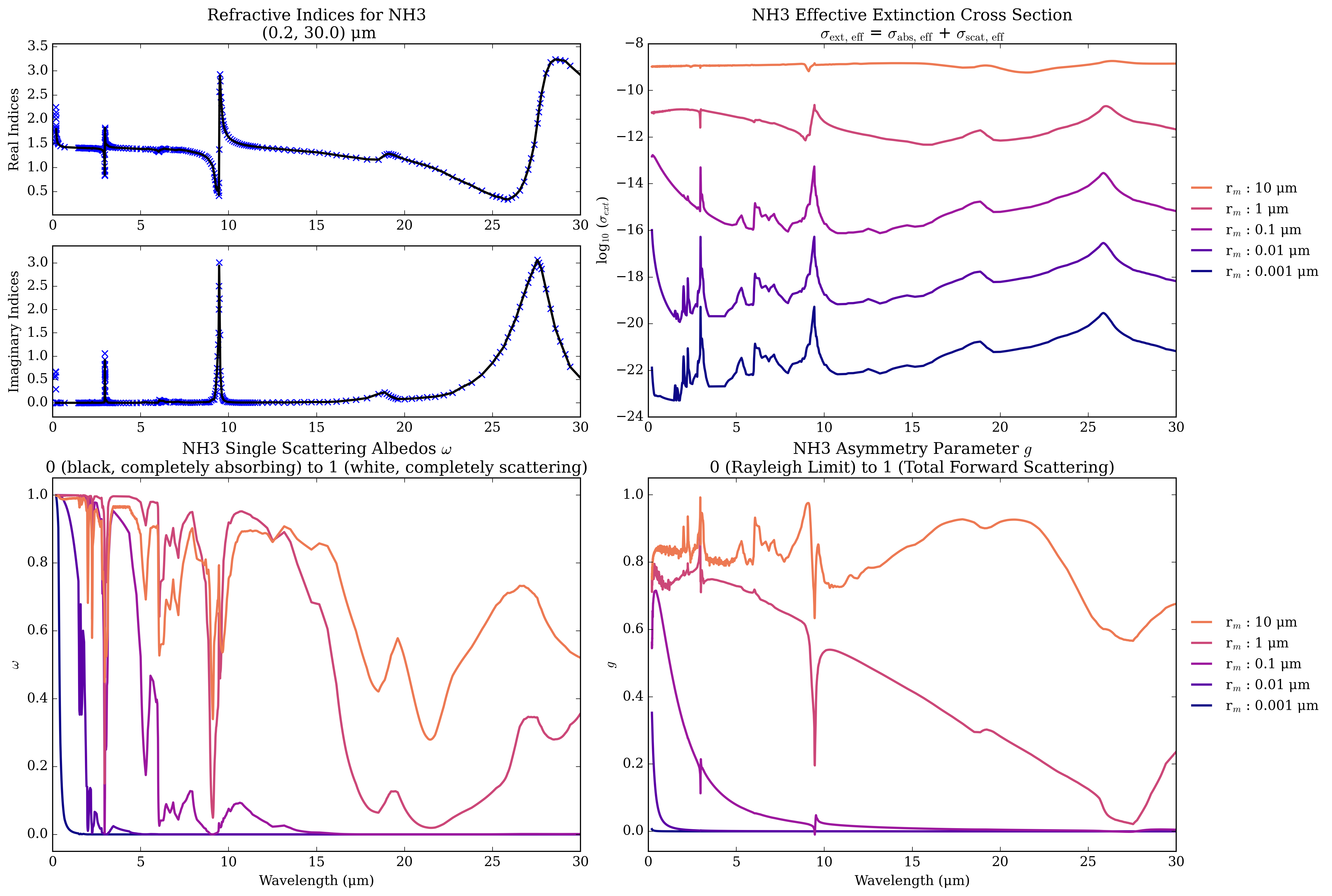
|
\(\hookrightarrow\) Github |
0.2–30 μm |
Crystalline (cubic, isotropic) Synthetic thin film (77-88K) |
|
\(\mathrm{CH_4}\) |
Methane (liquid) (CH4_liquid) |
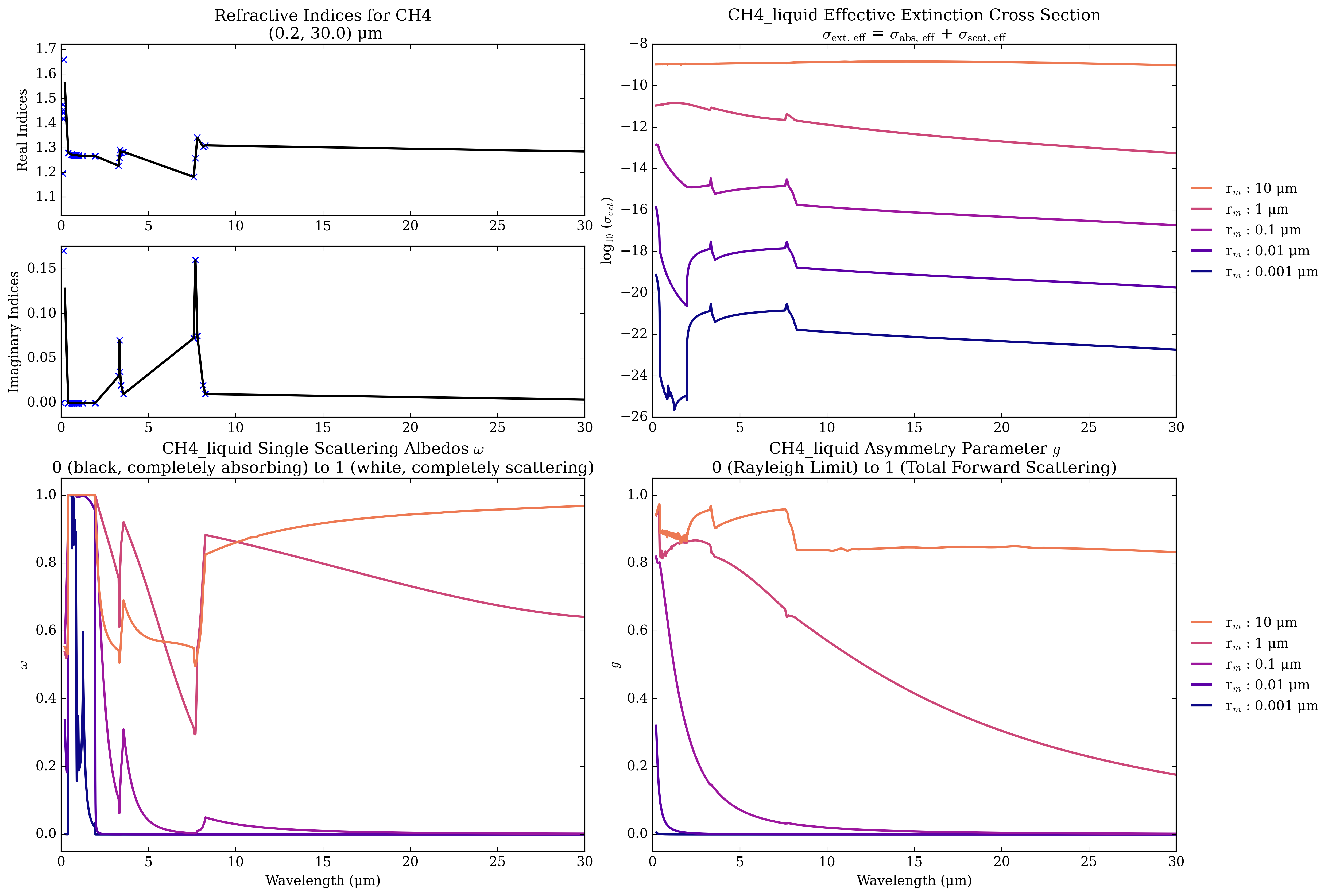
|
\(\hookrightarrow\) Link |
0.2–30 μm |
111K Liquid Methane Refractive index data is sometimes absolute lower or upper limit |
|
\(\mathrm{CH_4}\) |
Methane (solid) (CH4_solid) |
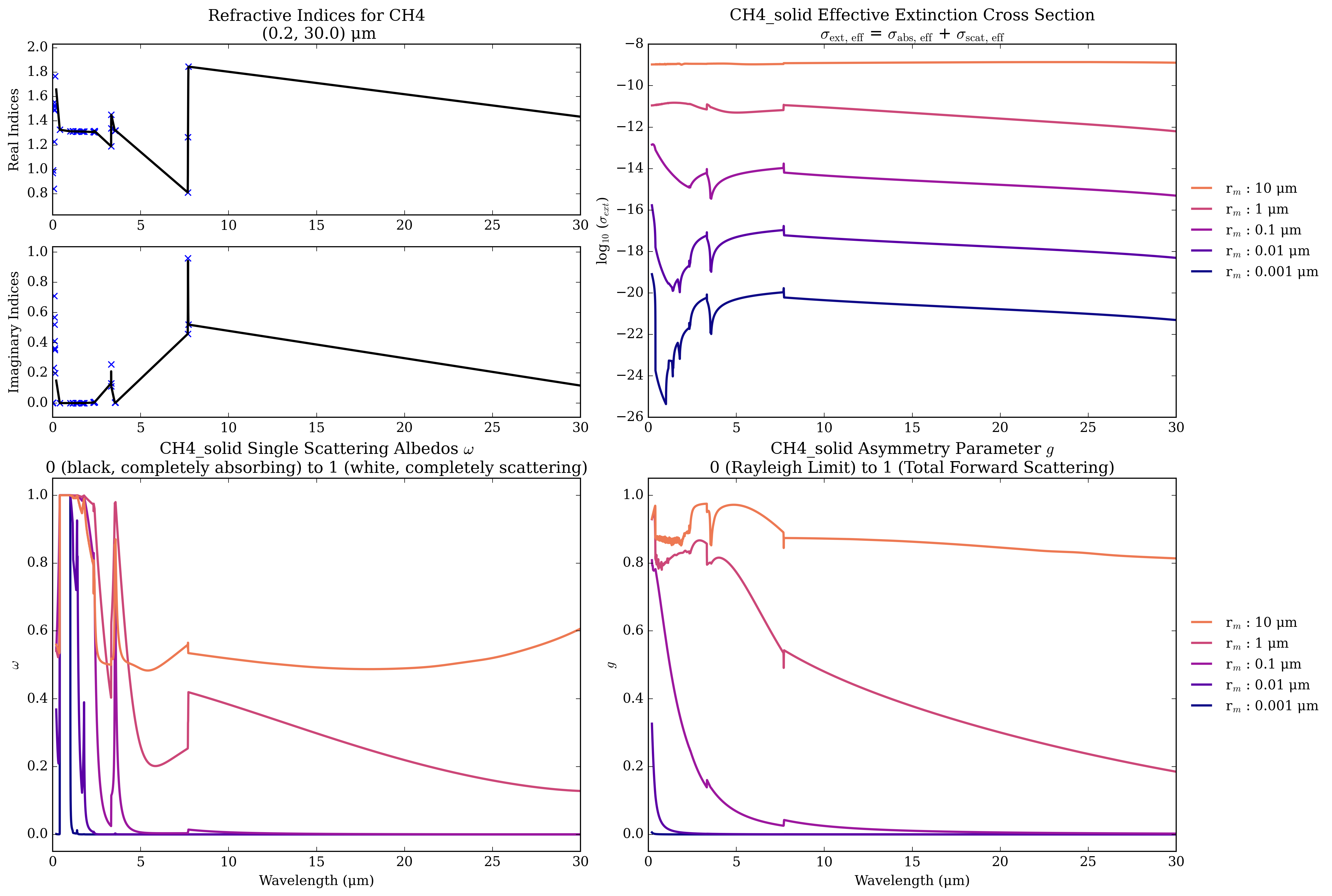
|
\(\hookrightarrow\) Link |
0.2–30 μm |
Crystalline (cubic, isotropic) 90K Solid Methane Refractive index data is sometimes absolute lower or upper limit |
|
Ice Tholins |
Ice Tholins — see notes (IceTholin) |
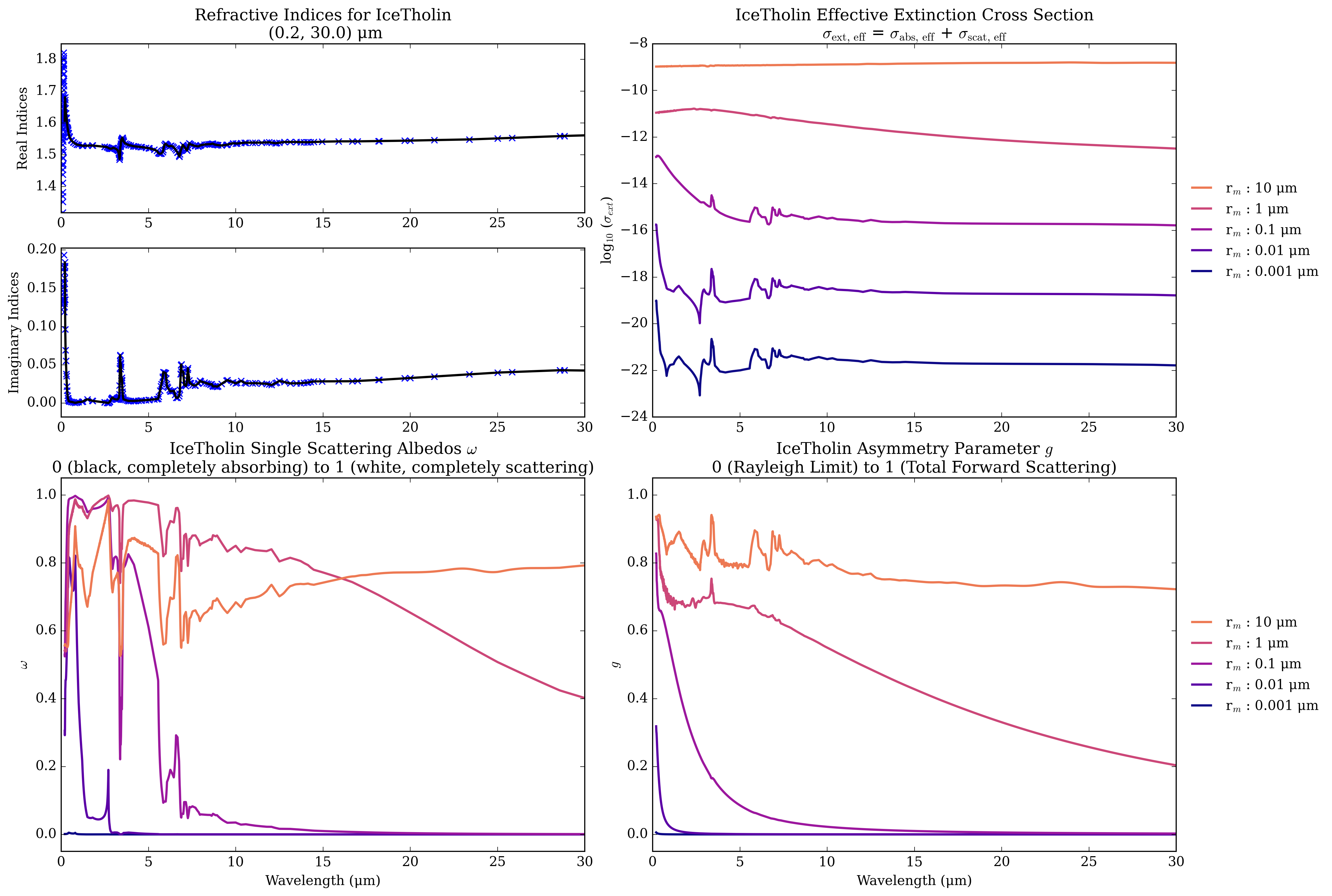
|
\(\hookrightarrow\) GitHub |
0.2–30 μm |
Amorphous (isotropic) \(\mathrm{C_2H_6}\)/\(\mathrm{H_2O}\) (1:6 ratio) irradiation residue (77K) |
|
\(\mathrm{\textbf{Soots and Hazes}}\) |
||||||
\(\mathrm{C}\) |
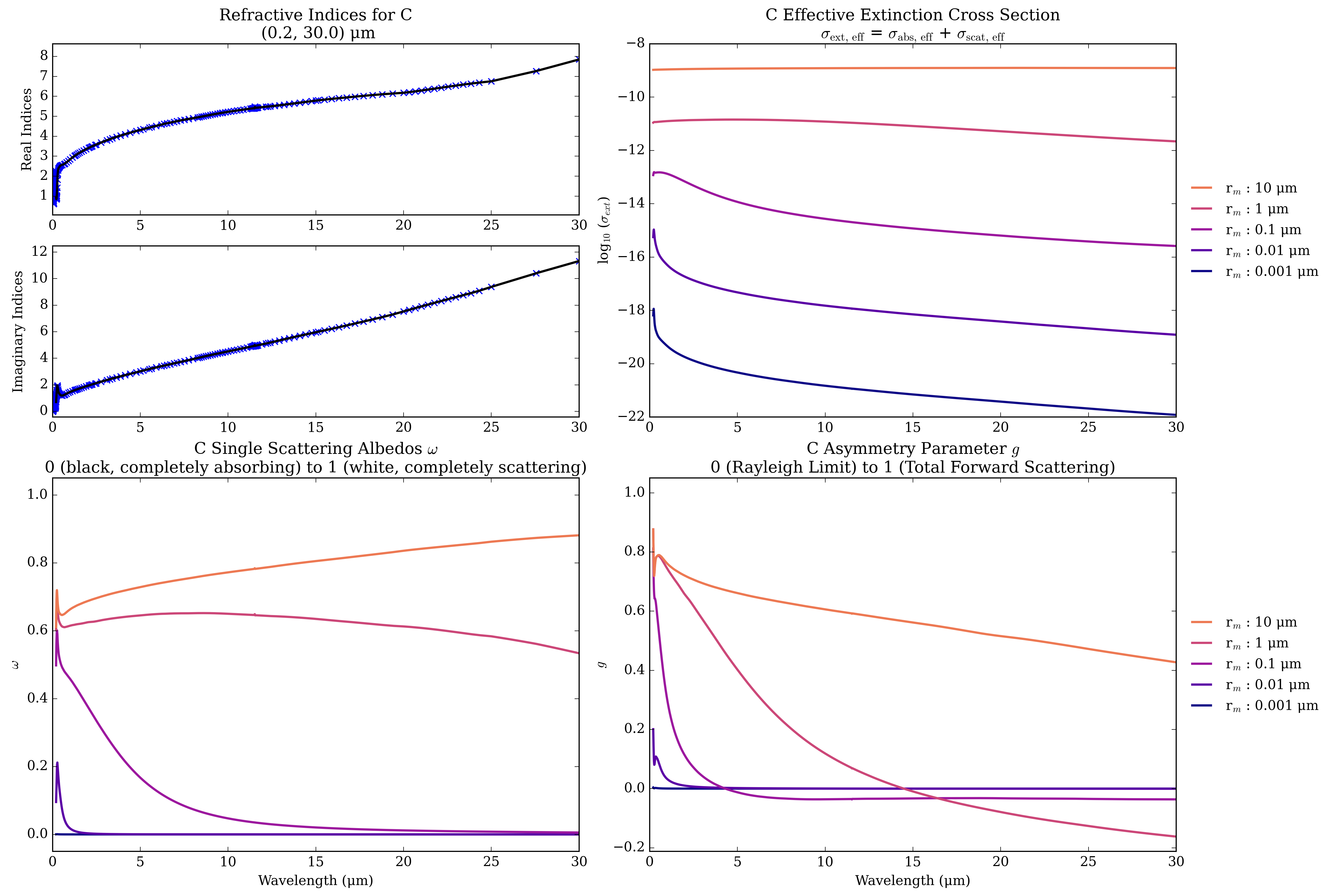
Graphite (C) |
|
\(\hookrightarrow\) GitHub |
0.2–30 μm |
Crystalline (hexagonal, uniaxial) Indices averaged by polarization (2/3 Ordinary + 1/3 Extraordinary) |
|
ExoHaze |
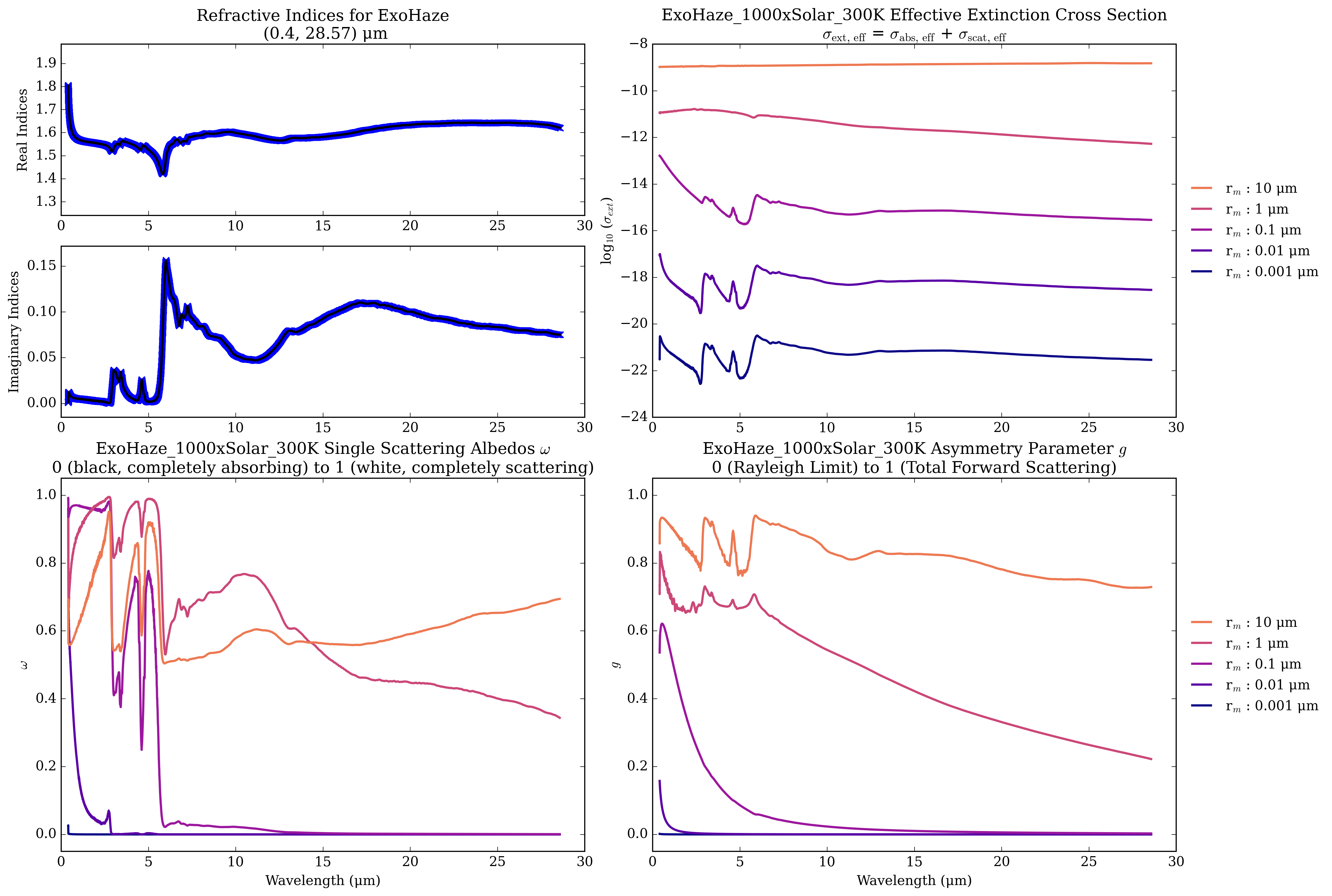
ExoHaze — see notes (ExoHaze_1000xSolar_300K) |
|
\(\hookrightarrow\) GitHub |
0.4–28.6 μm |
Amorphous (isotropic) 66% H2O, 6.6% CH4, 6.5% N2, 4.9% CO2, and 16% He irradiation residue |
|
ExoHaze |
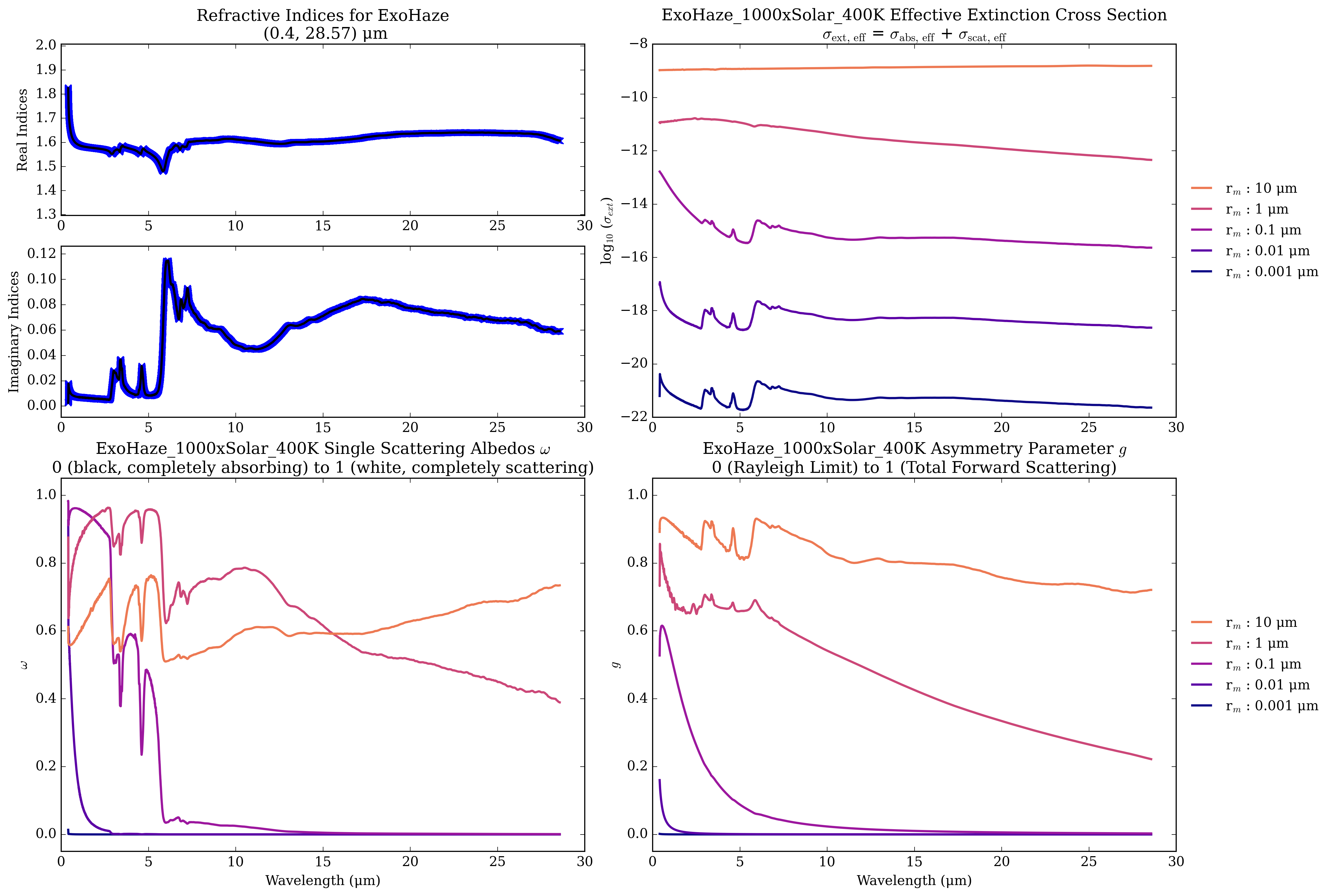
ExoHaze — see notes (ExoHaze_1000xSolar_400K) |
|
\(\hookrightarrow\) GitHub |
0.4–28.6 μm |
Amorphous (isotropic) 56% H2O, 11% CH4, 10% CO2, 6.4% N2, 1.9% H2, and 14.7% He irradiation residue |
|
\(\mathrm{C}\) |
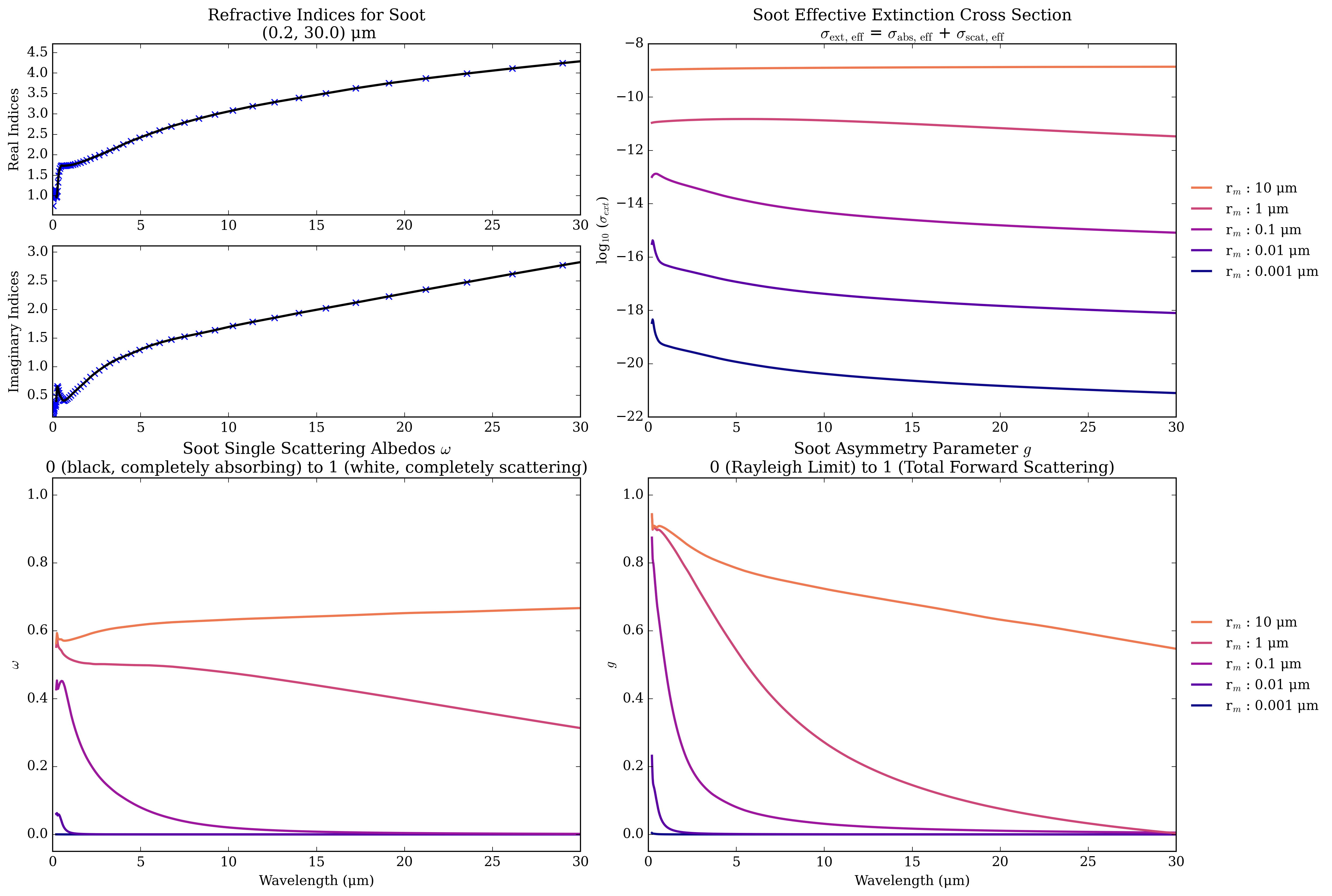
Flame Soot (Soot) |
|
\(\hookrightarrow\) GitHub |
0.2–30 μm |
Amorphous (isotropic) Lavvas & Koskinen (2017) used Kramers-Kronig analysis on extant lab data for soots |
|
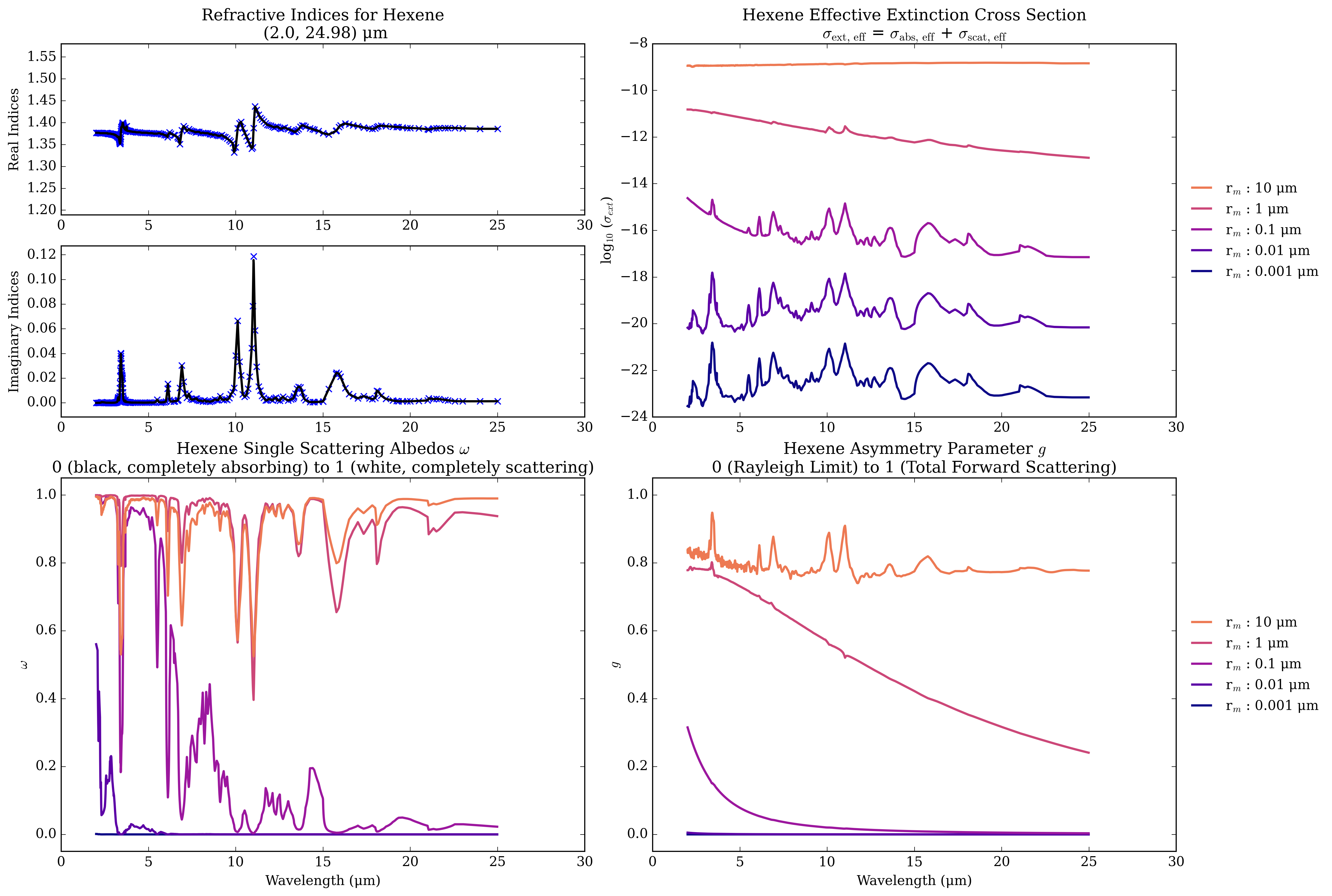
\(\mathrm{C_6H_{12}}\) |
1-Hexene (Hexene) |
|
\(\hookrightarrow\) Link |
2–25 μm |
Liquid (linear alpha olefin) |
|
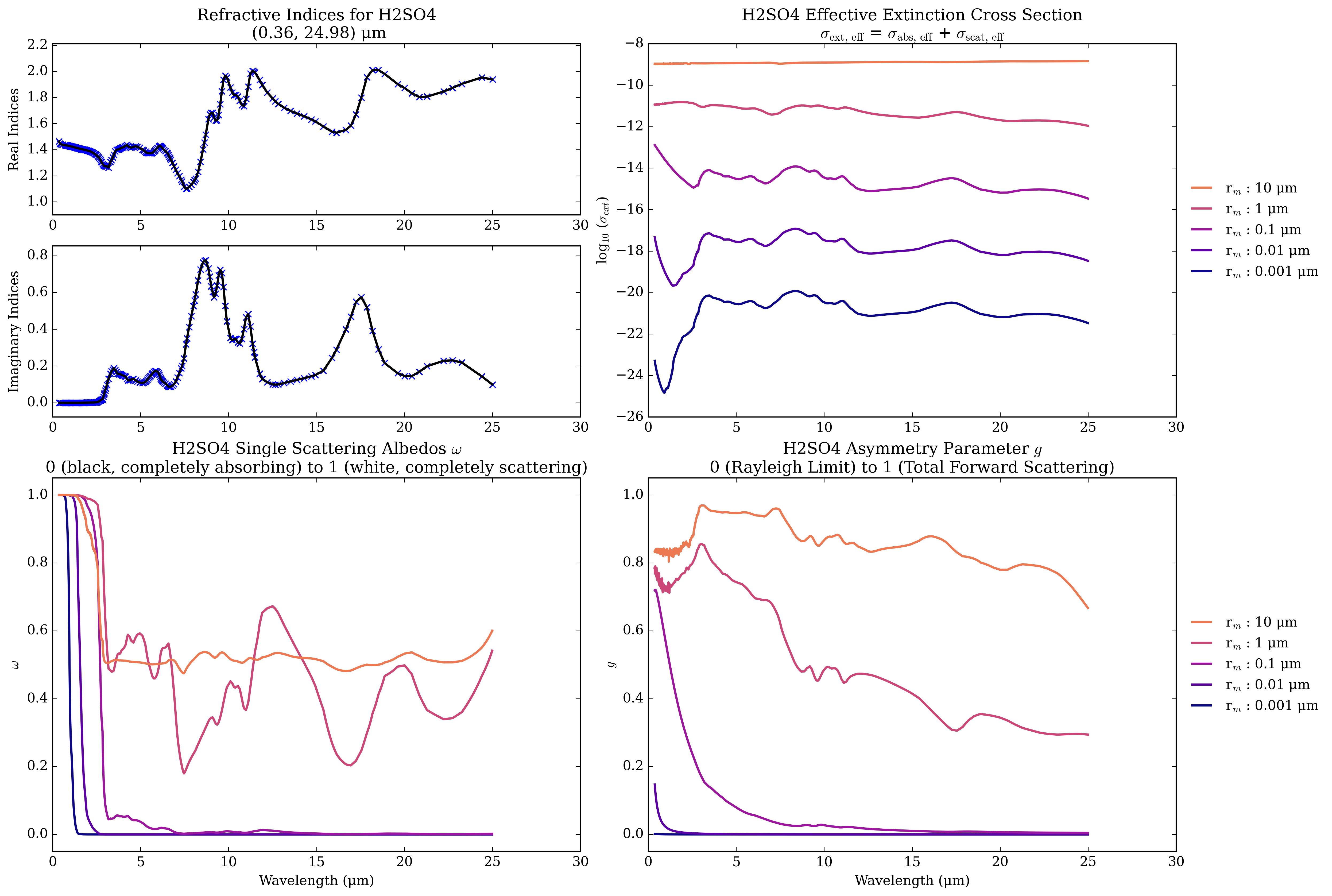
\(\mathrm{H_2SO_4}\) |
Sulfuric Acid (H2SO4) |
|
\(\hookrightarrow\) GitHub |
0.36–24.98 μm |
Liquid (300K, 84.5% solution) 0.702-0.360 μm imaginary indices fit with an exponent 2.564-2.770 μm fit with an exponent and offset to match data |
|
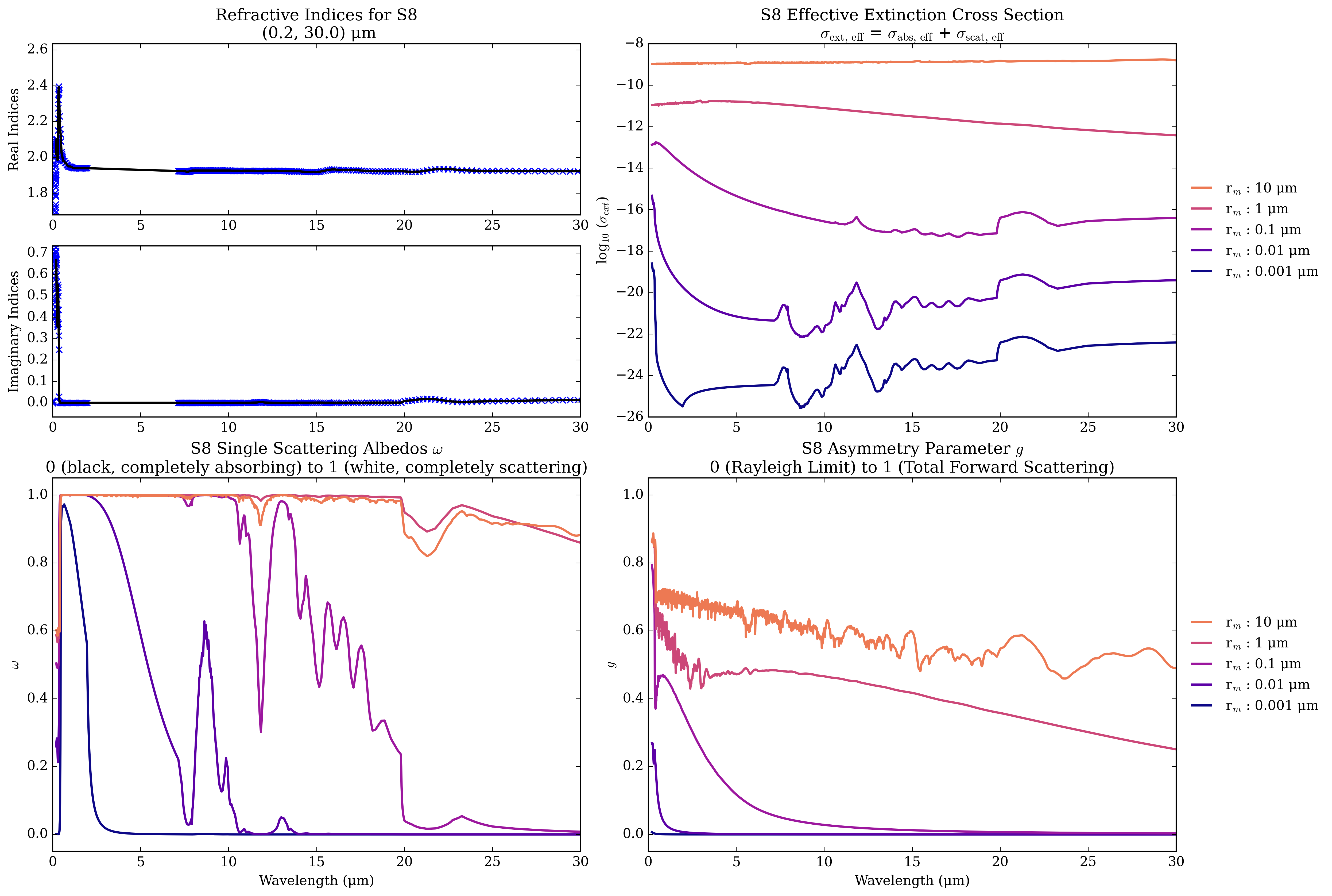
\(\mathrm{S_8}\) |
Cyclo-Octasulfur / Orthorhombic Sulfur / \(\alpha\) Sulfur (S8) |
|
\(\hookrightarrow\) GitHub |
0.2–30 μm |
Crystalline (orthorhombic, biaxial) Palik only records ‘ordinary ray’ (averaged E||a and E||b) |
|
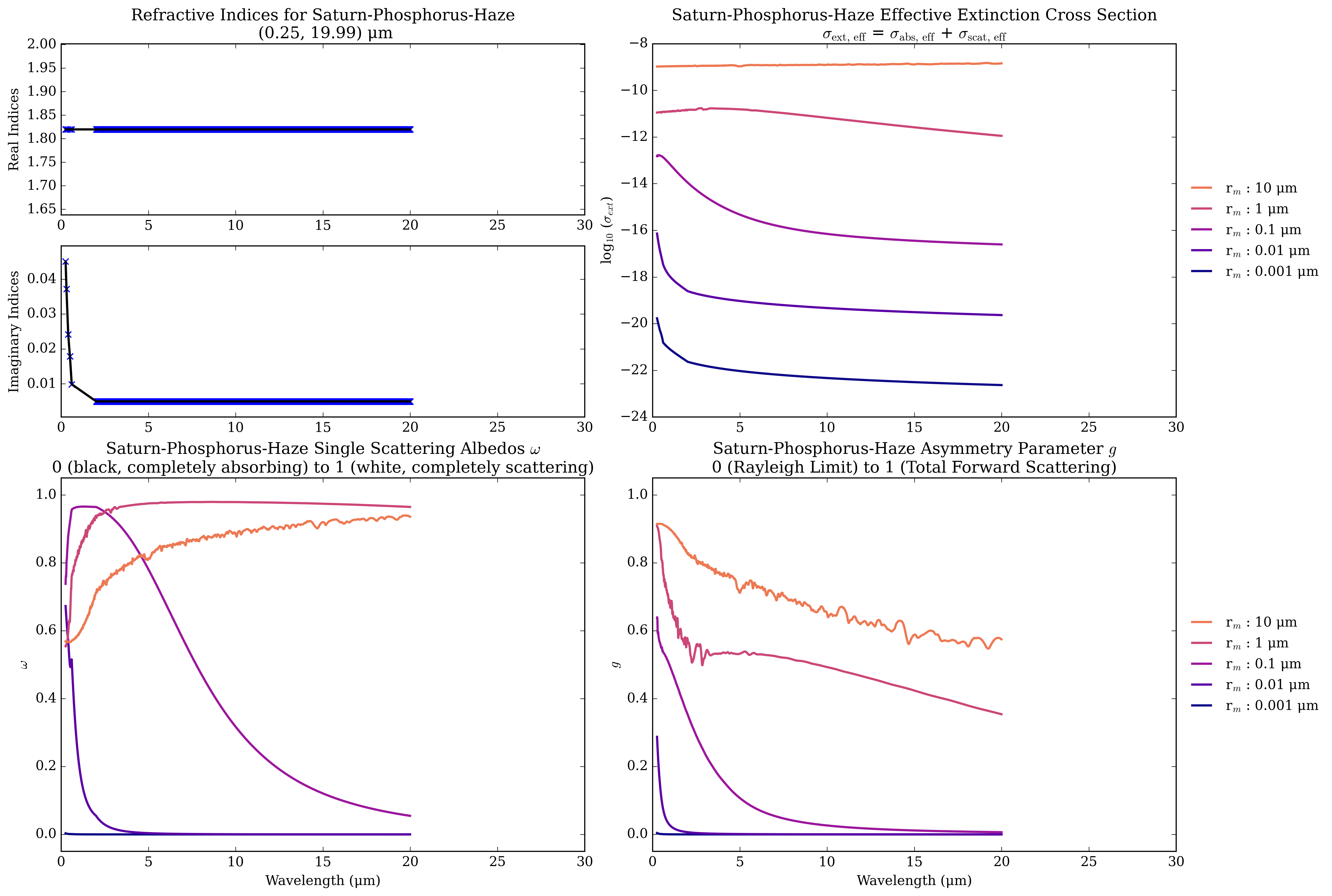
Saturn Haze |
Saturn Phosphorus Haze — see notes (Saturn-Phosphorus-Haze) |
|
\(\hookrightarrow\) GitHub |
0.2–20 μm |
Amorphous (isotropic) Diphosphine haze proxy Imaginary indices from Noy (1981) and Fletcher (2023) Real from Sromovsky (2019) (white phosphorus) |
|
\(\mathrm{C}\) |
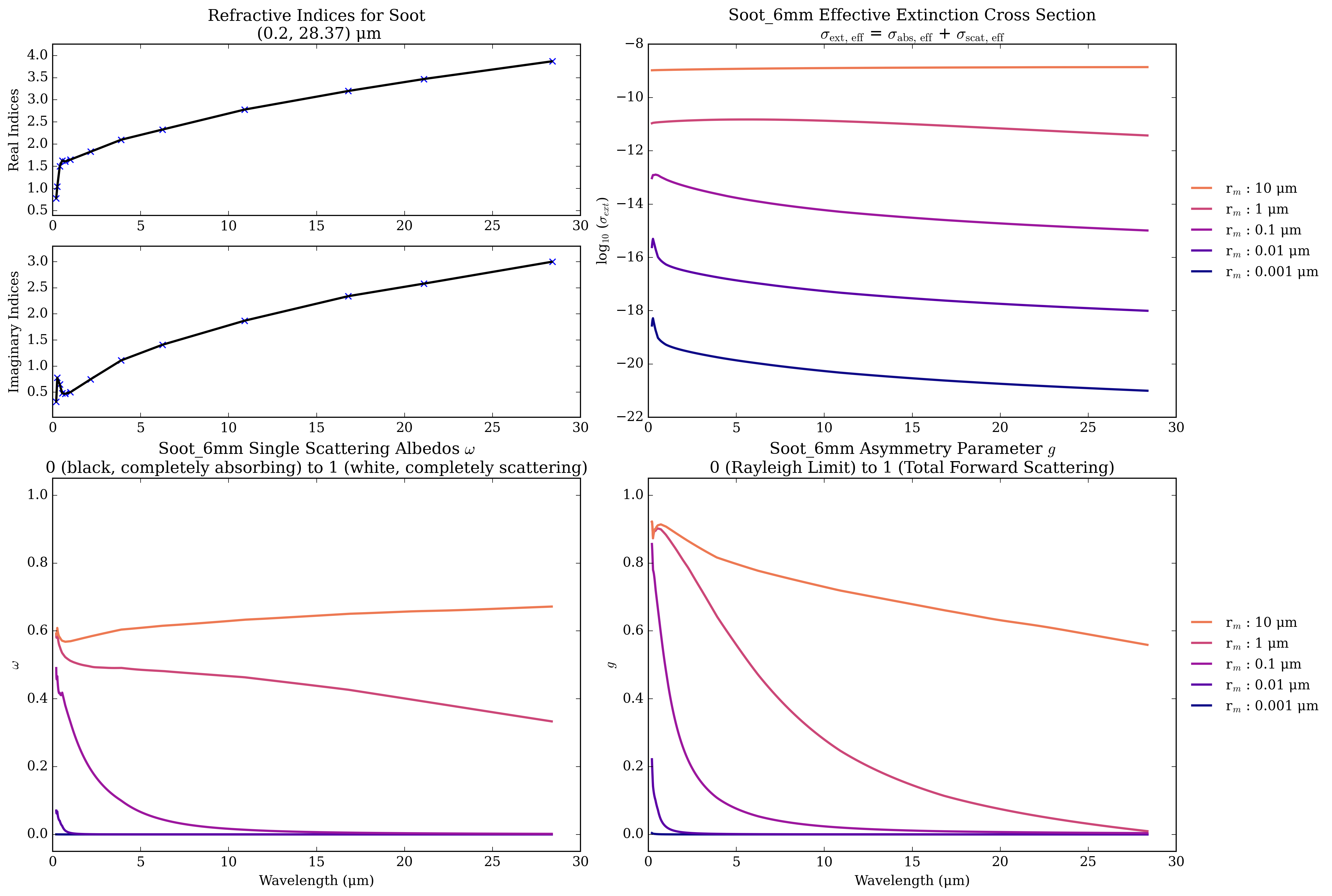
Soot 6mm — see notes (Soot_6mm) |
|
\(\hookrightarrow\) GitHub |
0.2–28.4 μm |
Amorphous (isotropic) Optical indices measured 6mm above burner |
|
Titan Tholin |
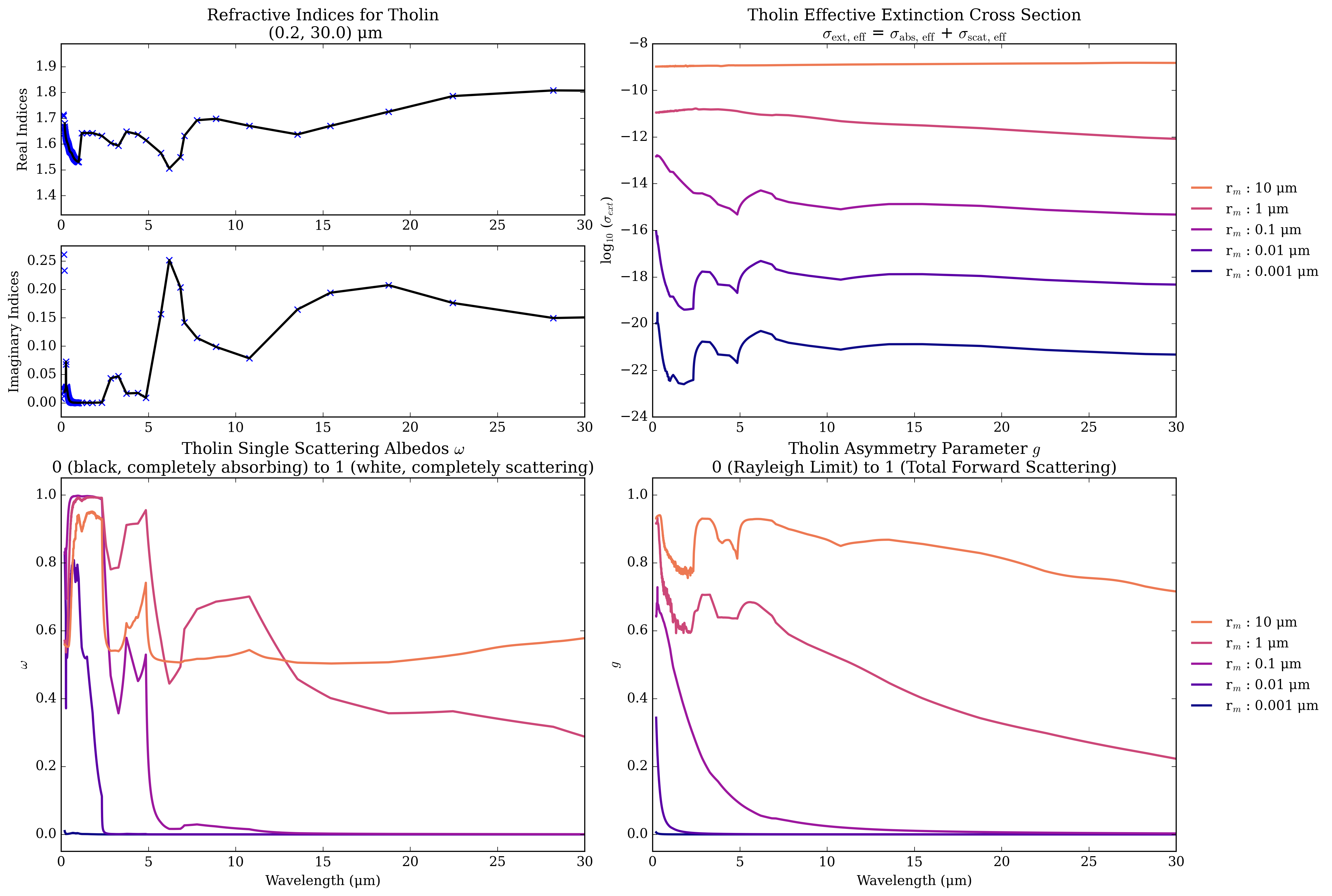
Tholin — see notes (Tholin) |
|
\(\hookrightarrow\) Link |
0.2–30 μm |
Amorphous (isotropic) Both tholin references are \(\mathrm{N2}\) - \(\mathrm{CH_4}\) irradiation residue Khare (1984) is 9:1 and Ramirez (2002) is 9.8:0.2 Ramirez (2002) indices are used from 0.2-0.4 μm due to issues in Khare (1984) |
|
Oxygenated Tholin |
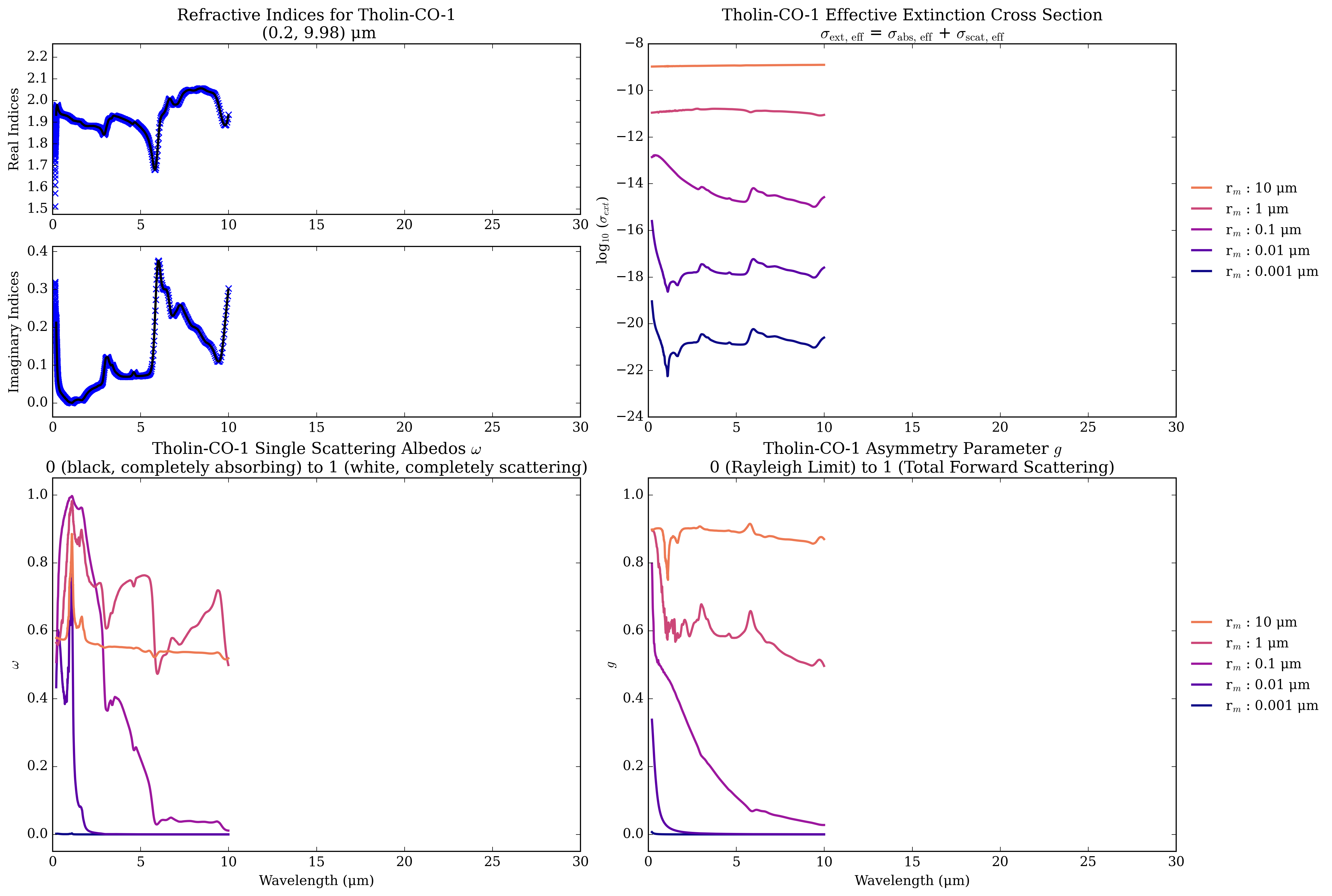
Tholin C/O=1 — see notes (Tholin-CO-1) |
|
\(\hookrightarrow\) GitHub |
0.2–9.99 μm |
Amorphous (isotropic) \(\mathrm{N2}\) - \(\mathrm{CH_4}\) - \(\mathrm{CO_2}\) (C/O = 1, 9:0.5:0.5) irradiation residue |
|
Oxygenated Tholin |
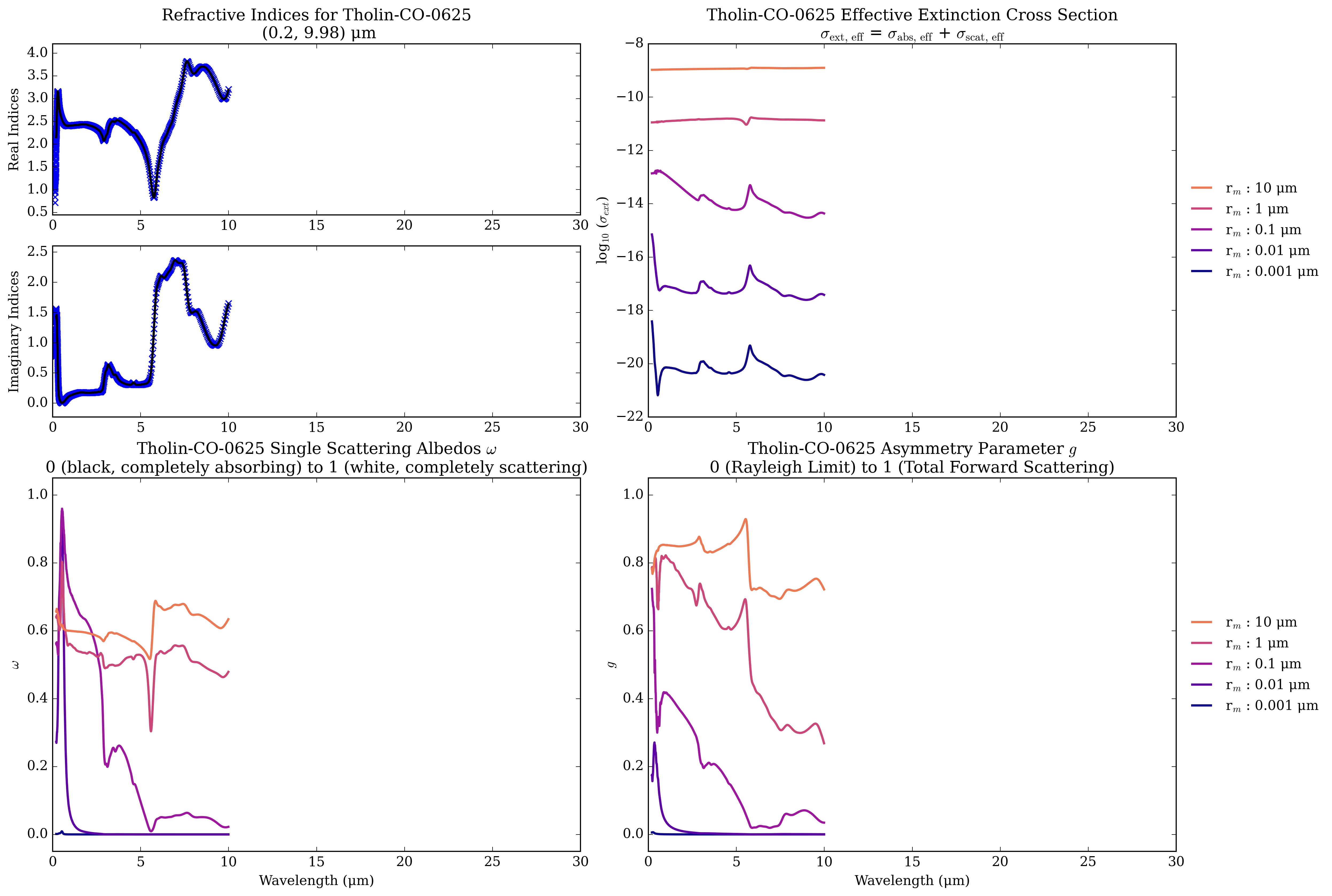
Tholin C/O=0.625 — see notes (Tholin-CO-0625) |
|
\(\hookrightarrow\) GitHub |
0.2–9.99 μm |
Amorphous (isotropic) \(\mathrm{N2}\) - \(\mathrm{CH_4}\) - \(\mathrm{CO_2}\) (C/O = 0.625, 9:0.8:0.2) irradiation residue |
(C) refers to references that compile refractive index data (sometimes to supplement their own lab data). See Aerosol-Database-Readme.txt for more details.
Refractive indices are room temperature unless specifically noted.
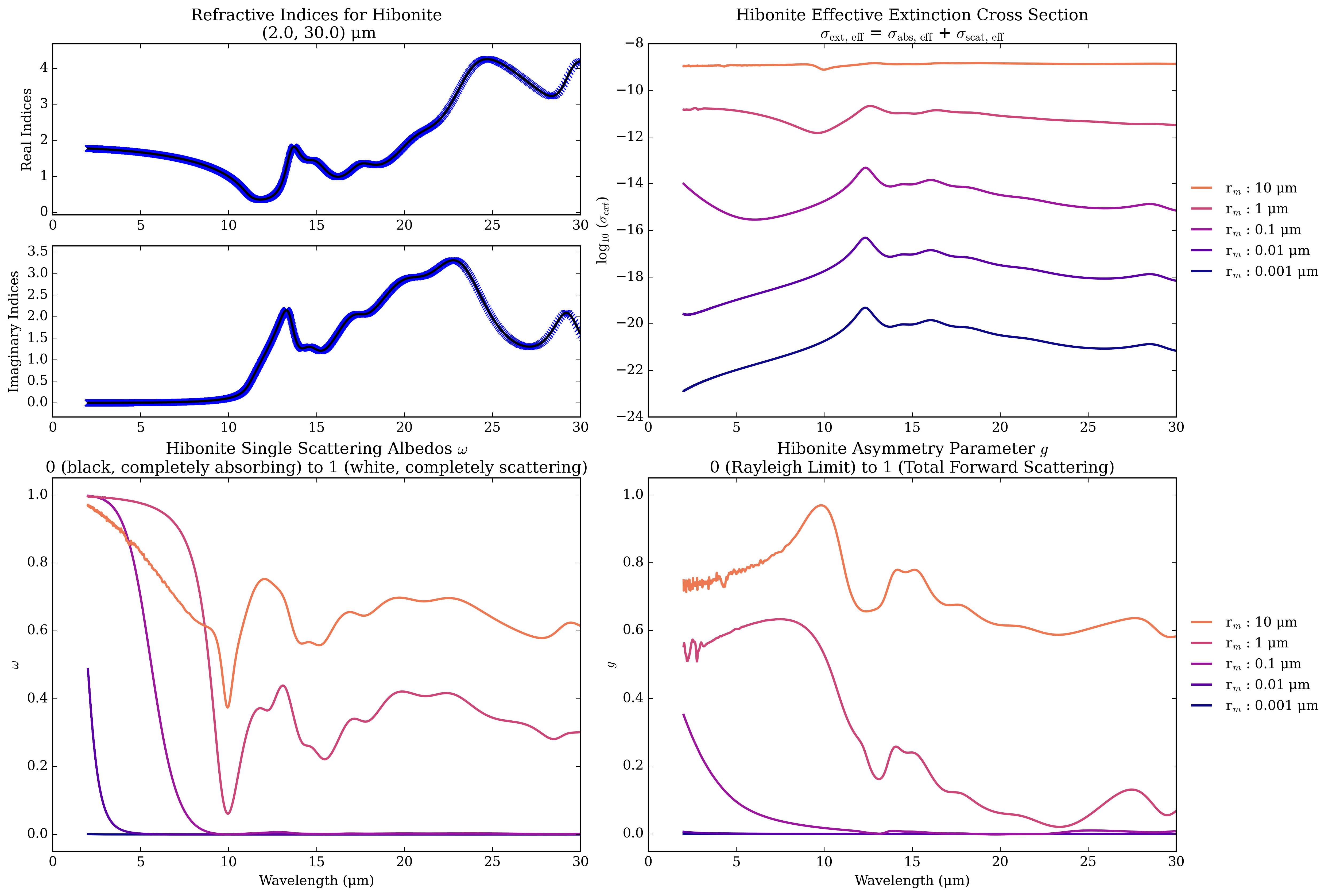
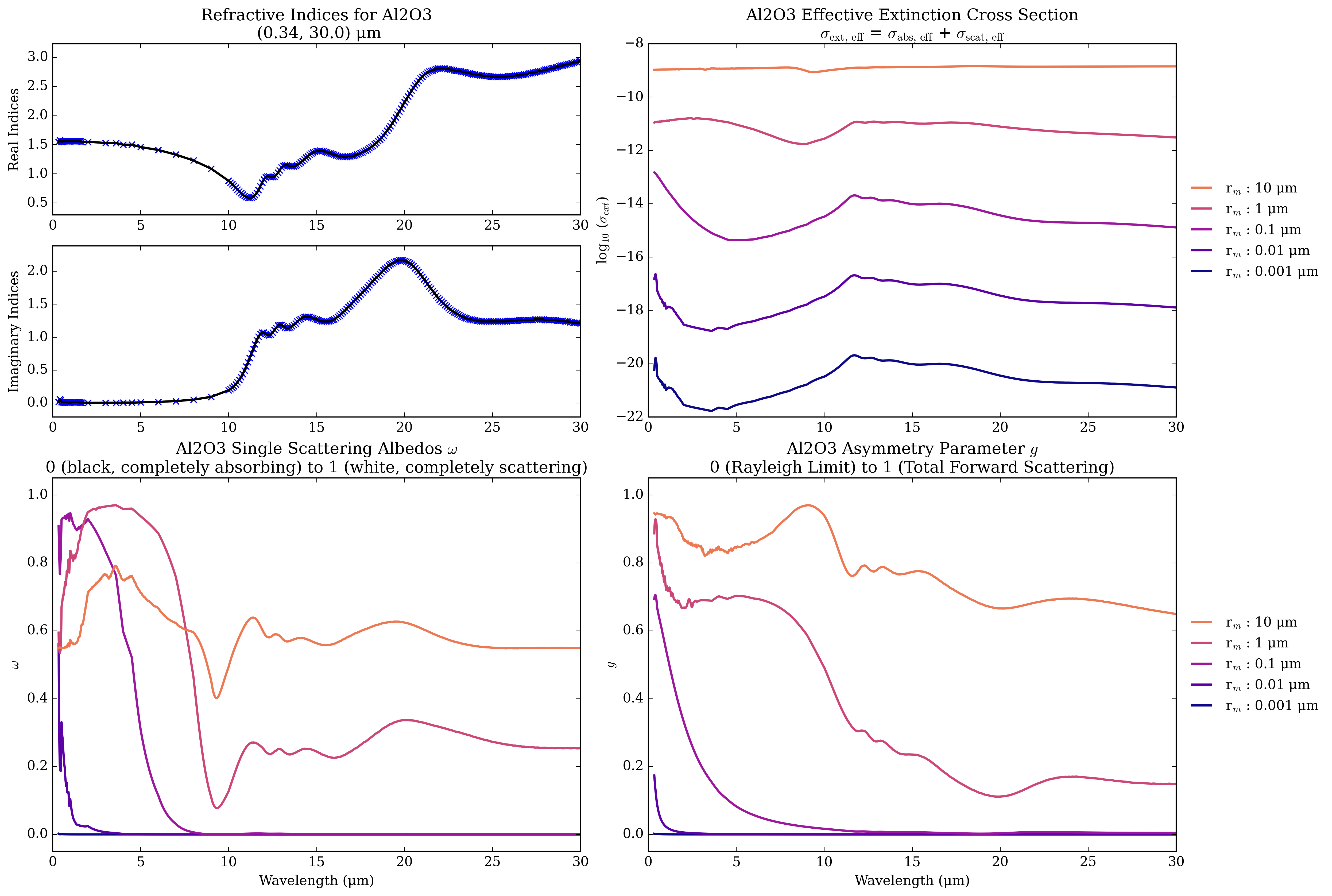
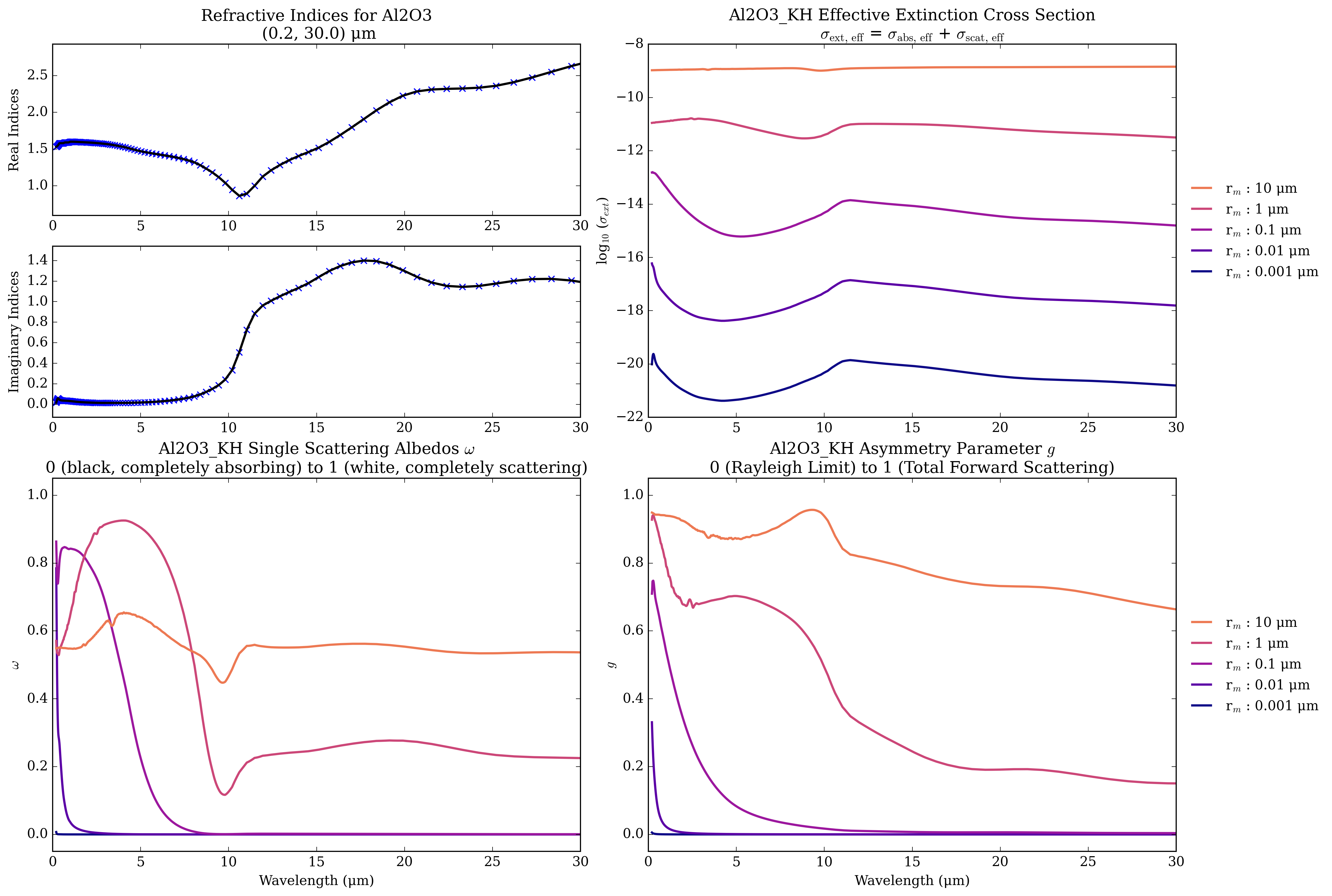
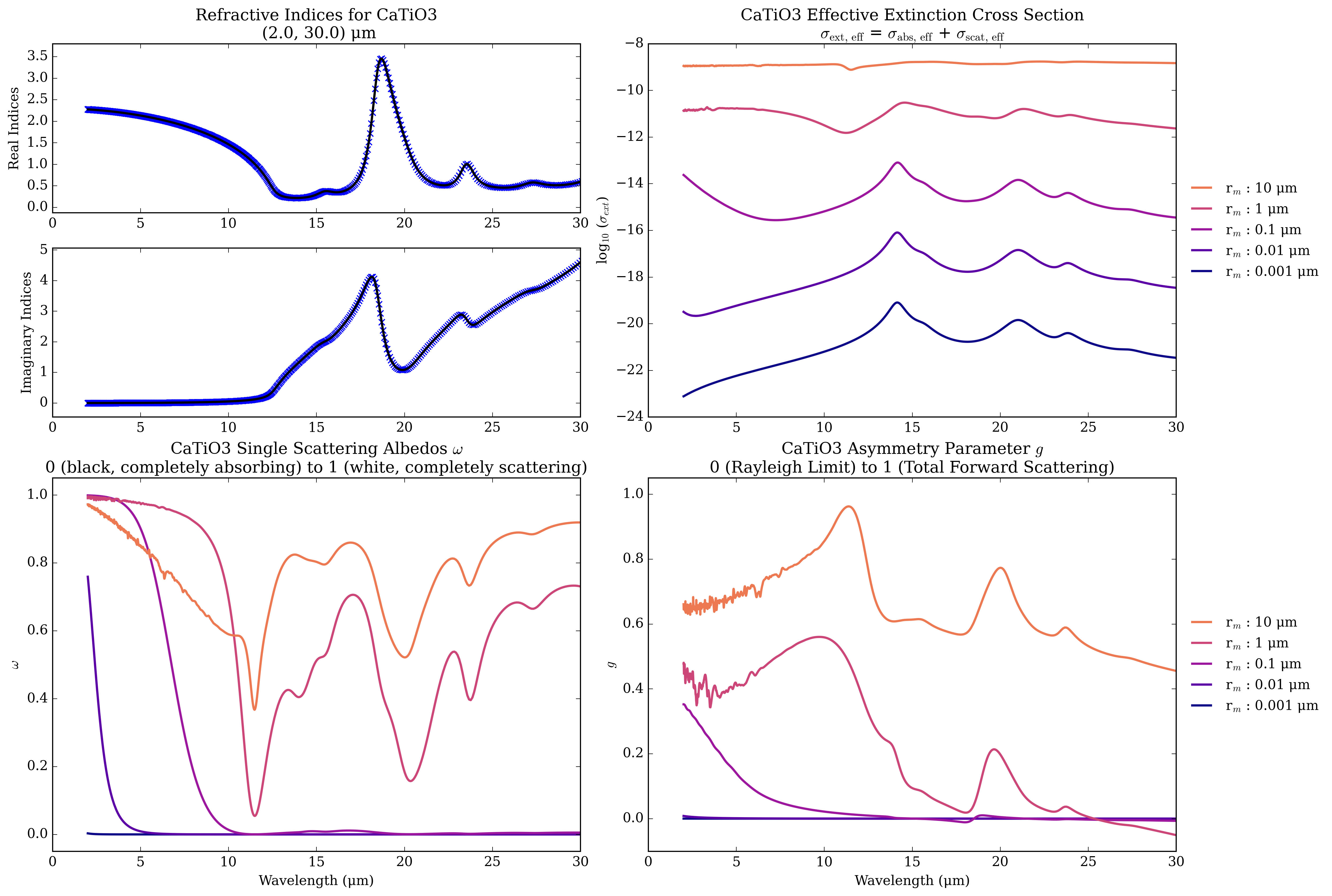
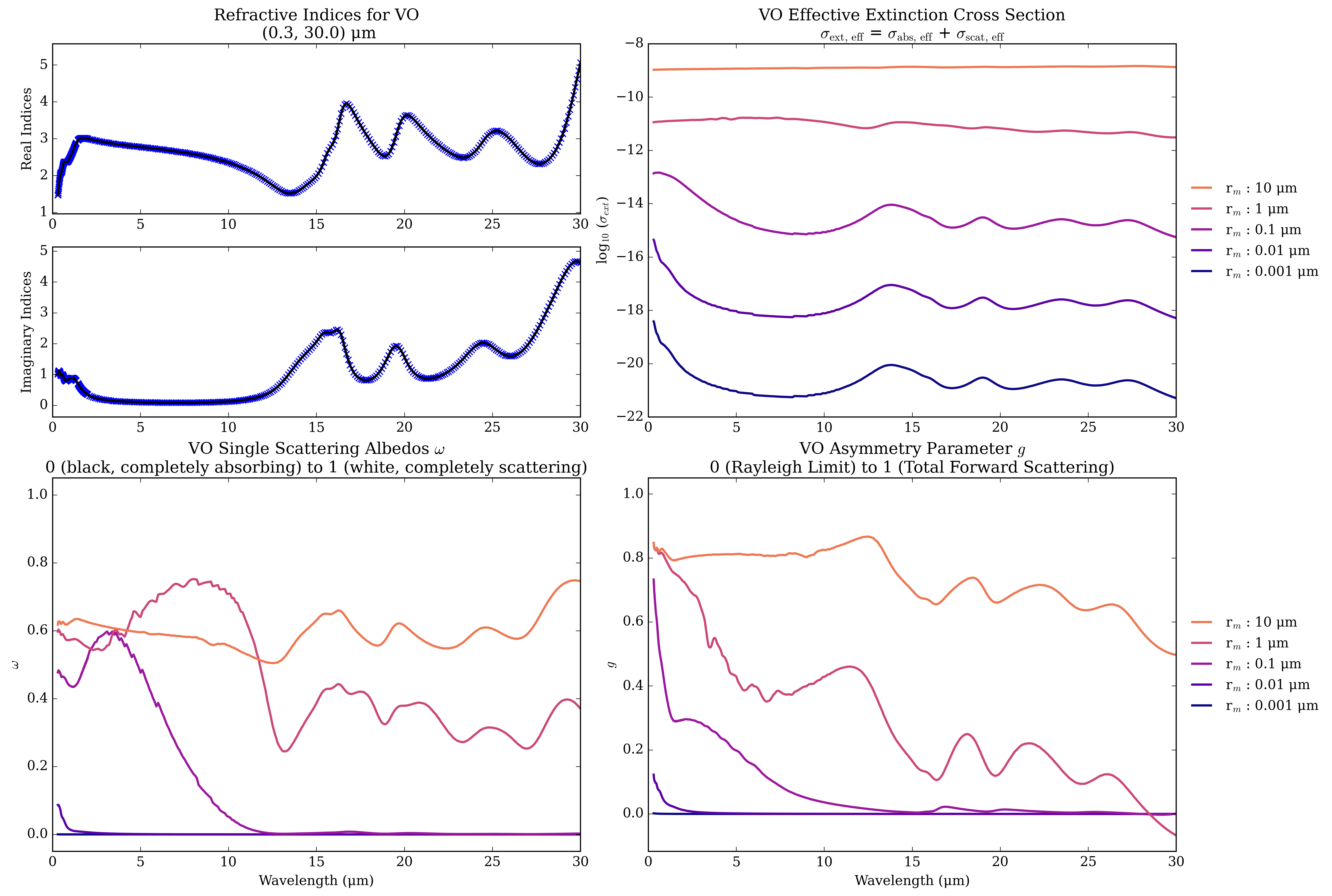
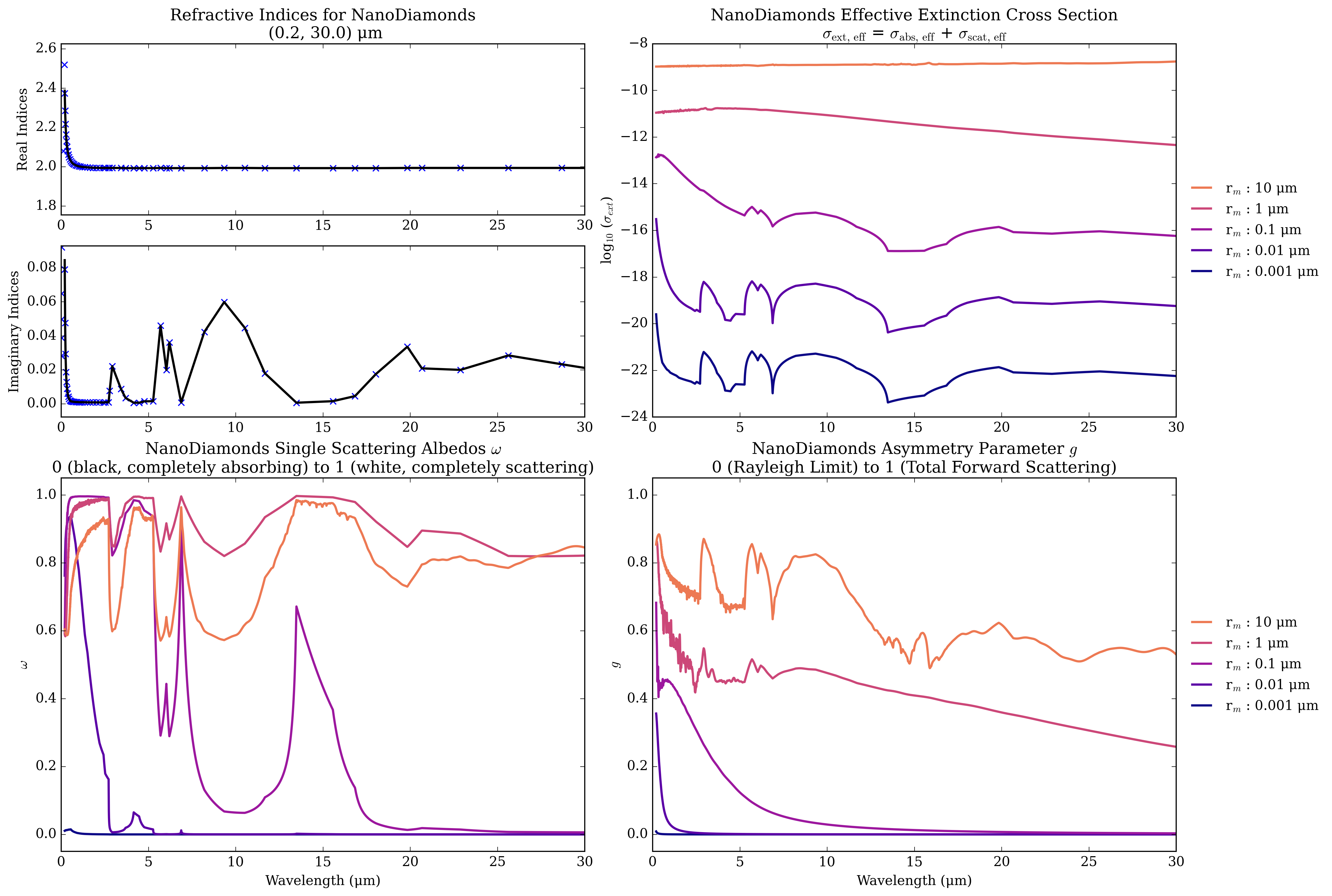
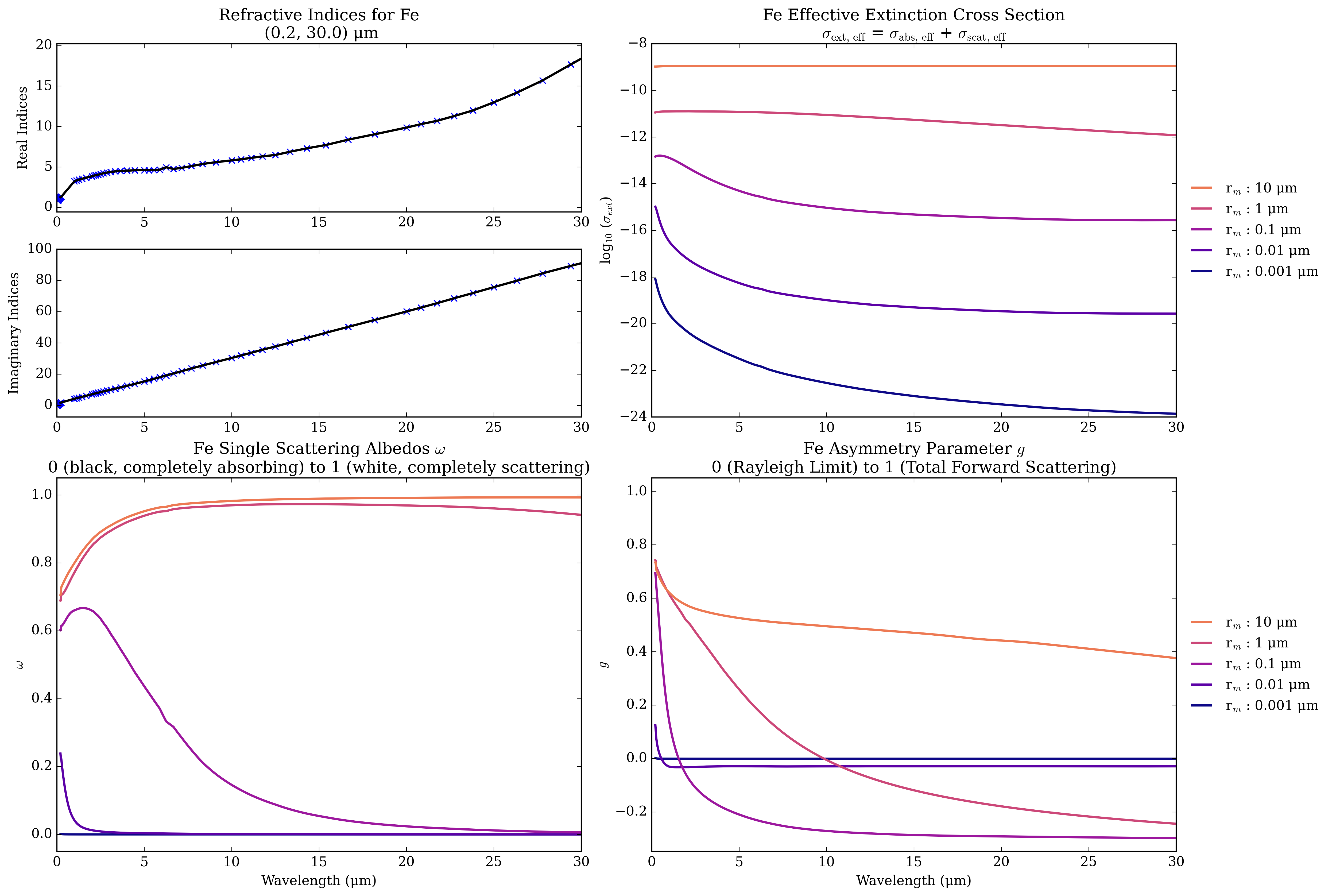
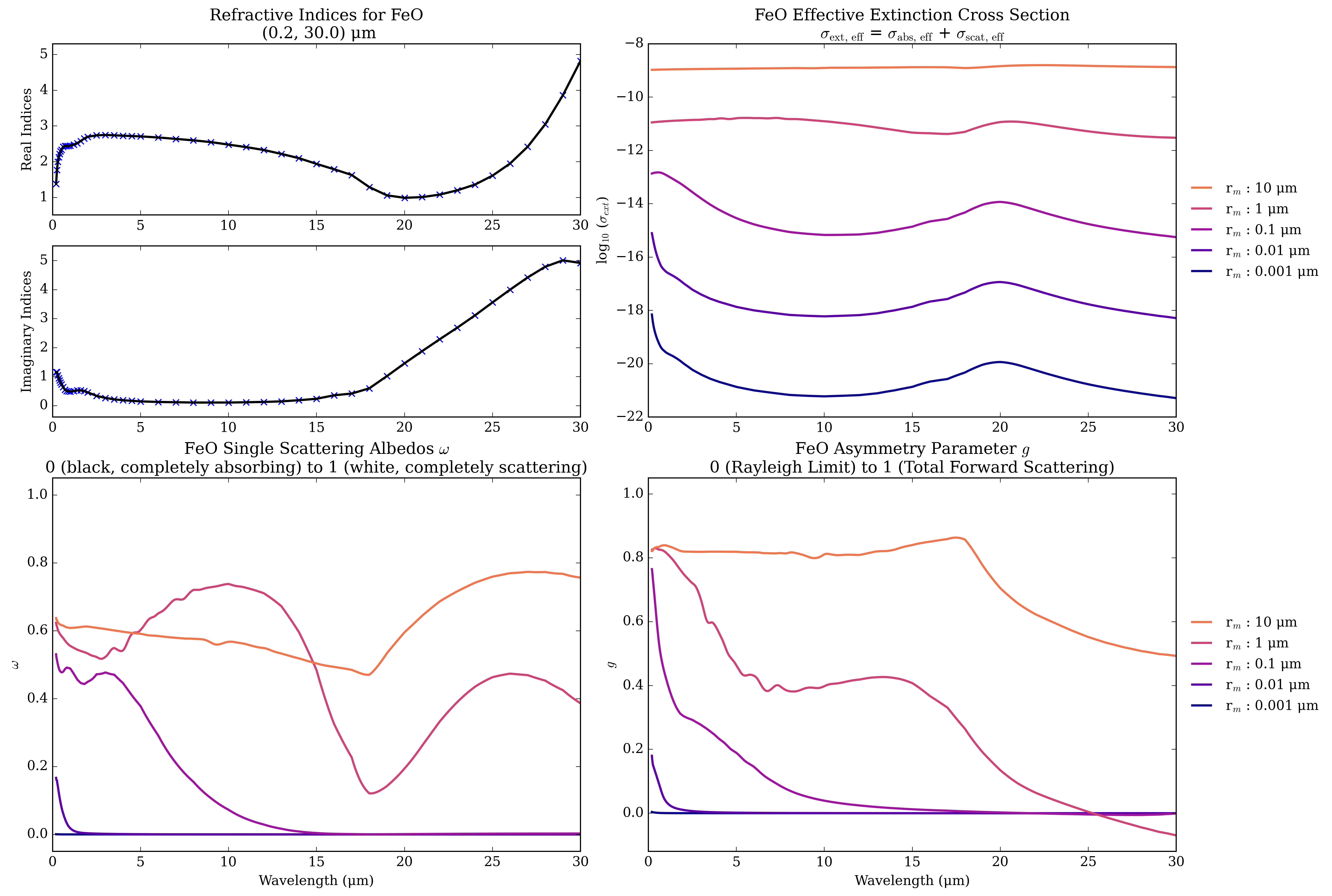
Plots display refractive indices (real and imaginary) (x represents actual refractive indices, line is interpolated), effective extinction cross section (combined scattering and absorption) for mean particle sizes (1e-3 to 10 μm) assuming a lognormal particle distribution with a width of 0.5. Median asymmetry parameter and single scattering albedo for mean particle sizes (1e-3 to 10 μm) assuming a lognormal particle distribution with a width of 0.5.
Short summaries on each refractive index paper, as well as when you would expect each aerosol to form with planetary-specific references for each entry and class, are listed in aerosol_database_readme.txt.
Please address any request for new aerosols to: eem85@cornell.edu.
Optional: Aerosol Directionality + Temperature Dependence Database
POSEIDON v1.3.1 includes an optional database of Mie scattering properties for minerals with their directionality and temperature dependent properties. By default, this database is not included in POSEIDON’s input files. You can download it from Zenodo: Optional Aerosol Files.
After downloading the files, please put them in your inputs/opacity folder.
The database and its computation are detailed in full in Mullens et al. (2025) [submitted].
Note that the species in this table cannot be used in conjunction with the normal aerosol database in a forward model.
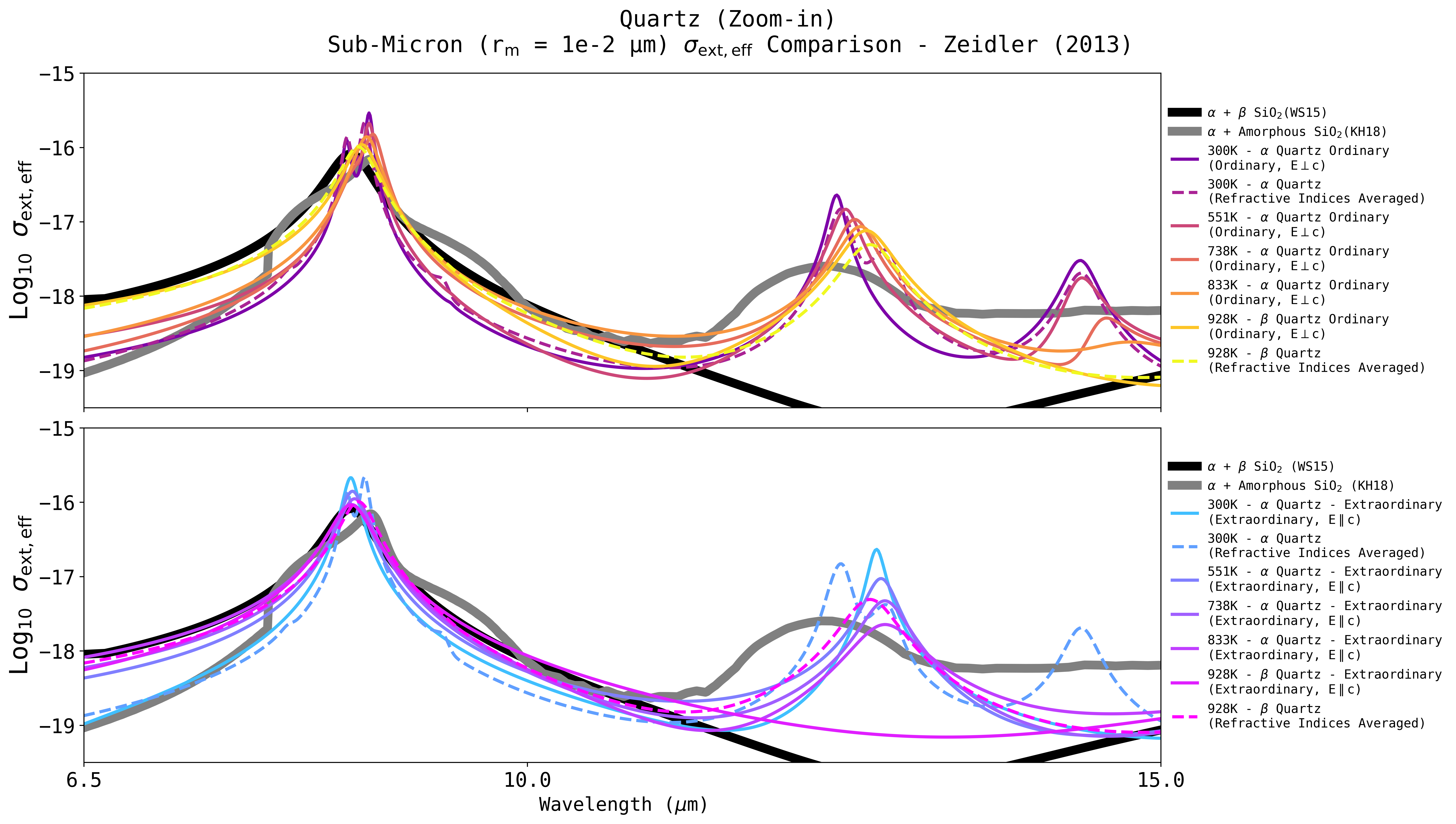
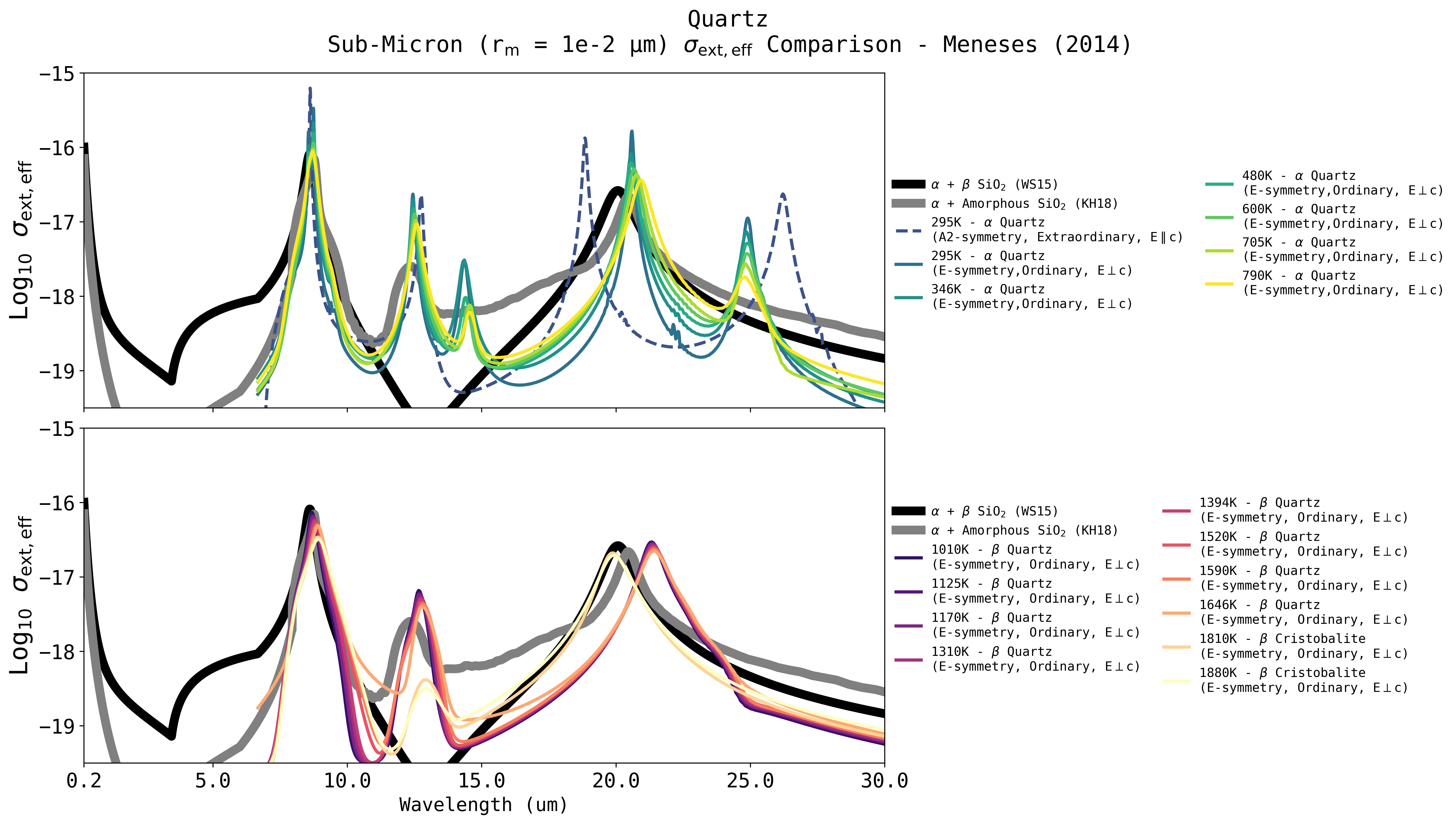
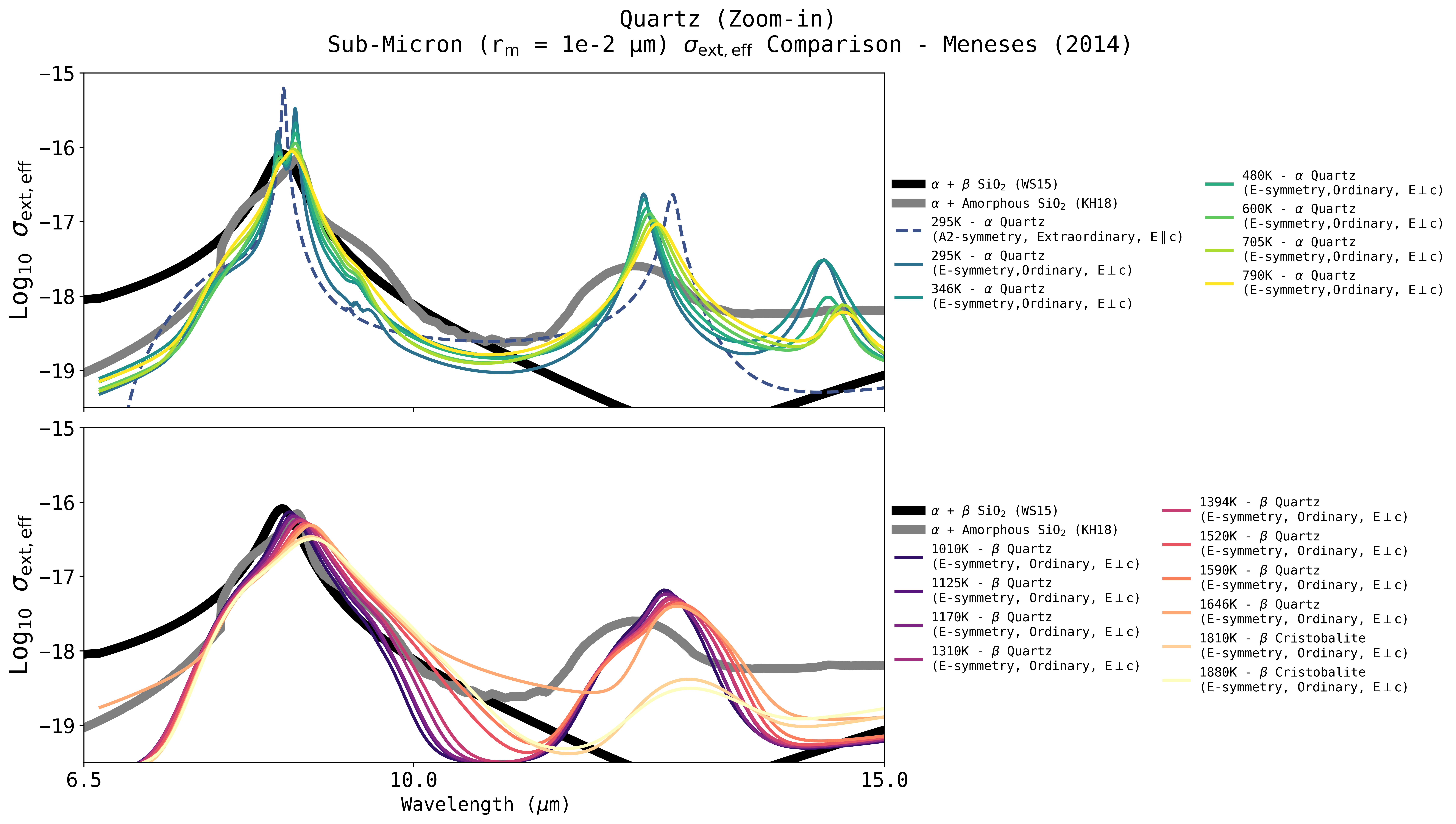
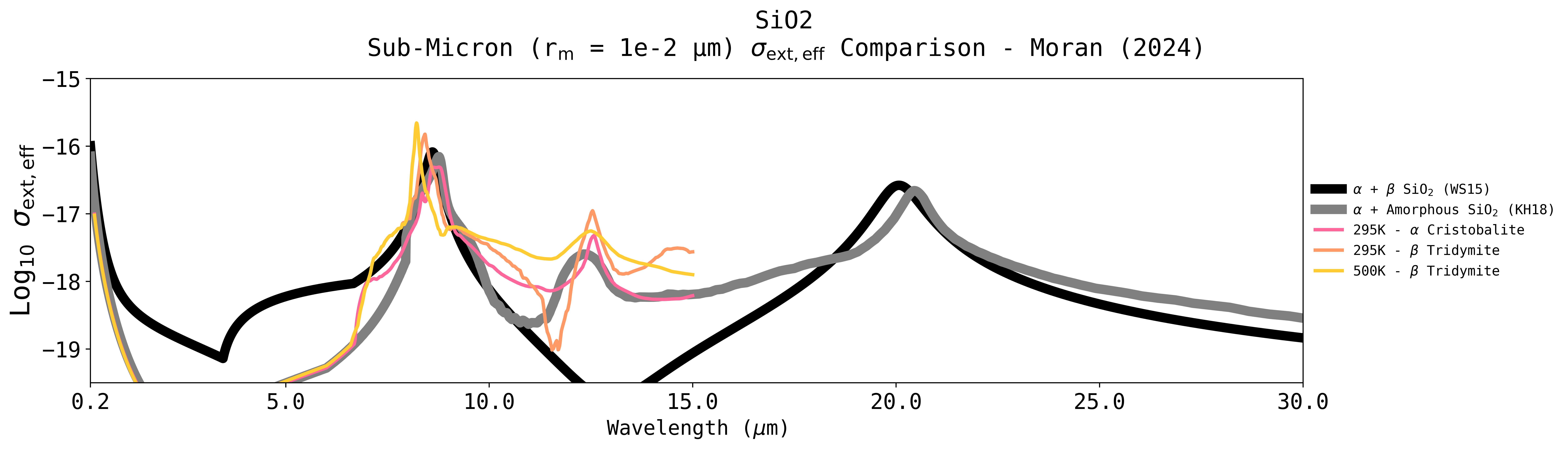
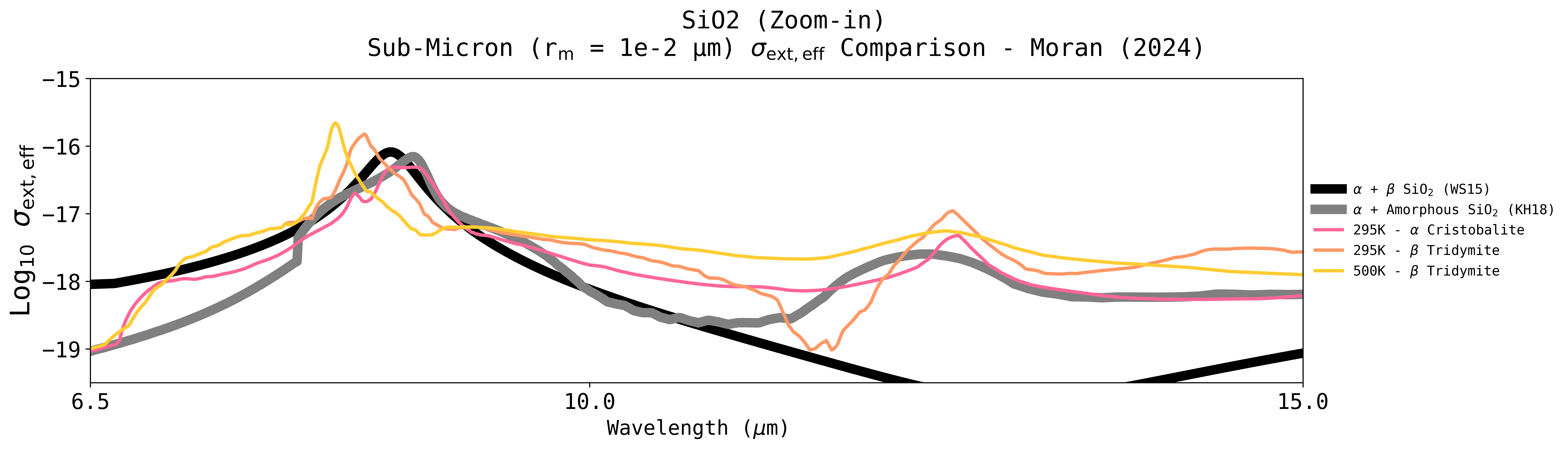


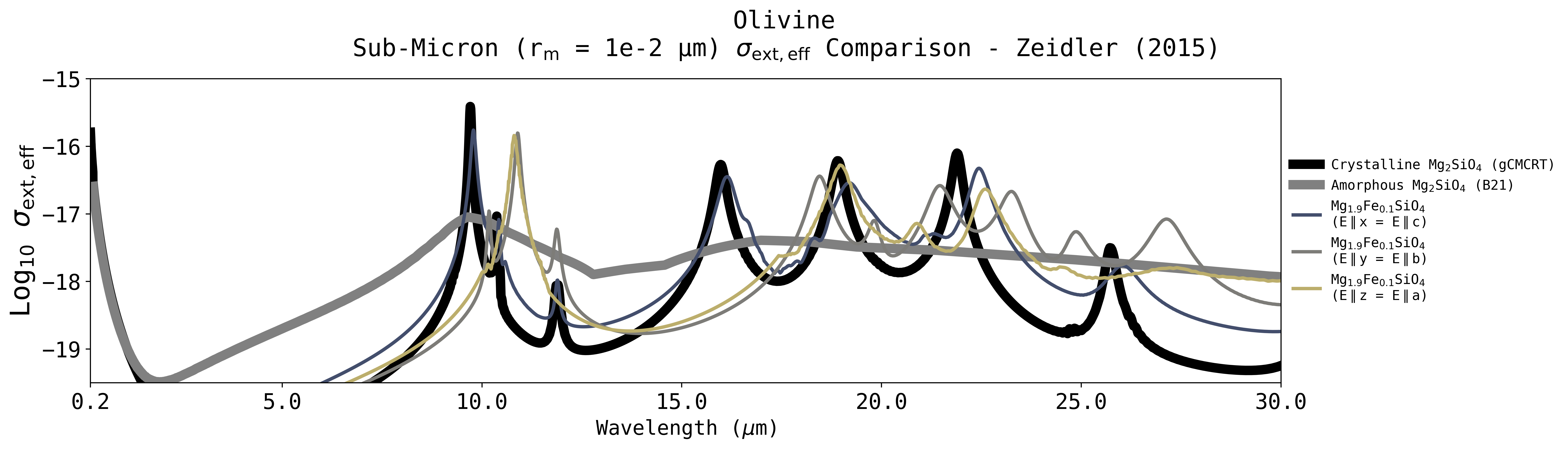
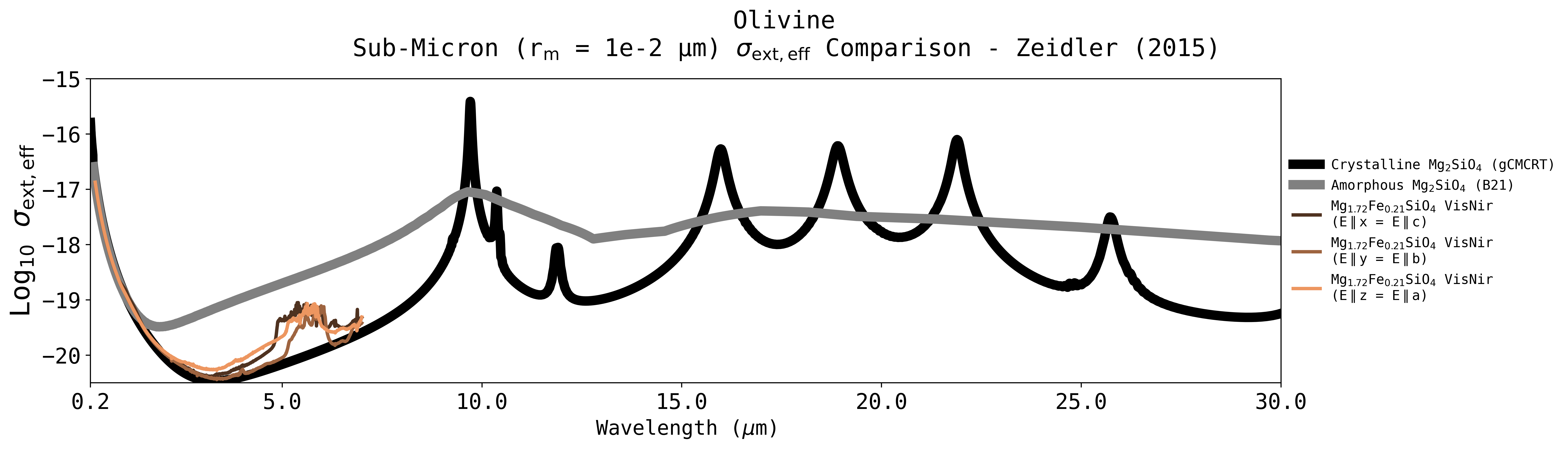



The below compared sub-micron (0.01 um) effective, extinction cross sections of the drectional/temperature dependent aerosols to their counterparts in the normal aerosol database.
For full previews of extinction cross sections and scattering properties of each aerosol, see
“Directional Opacity Previews”
For a detailed table, see
All refractive index txt files can be found in
“Directional Refractive Indices”
Also see the new tutorial (as of V1.3.1):
“Aerosols Advanced: Directionality”
Species |
Name in POSEIDON |
Plot (Click) |
Refractive Index References |
Wavelength Range |
Notes |
|---|---|---|---|---|---|
\(\mathrm{CaAl_{12}O_{19}}\) Directional Properties (Uniaxial) |
CaAl12O19_crystal_natural_extraordinary (E \(\parallel\) c) CaAl12O19_crystal_natural_ordinary (E \(\perp\) c) |
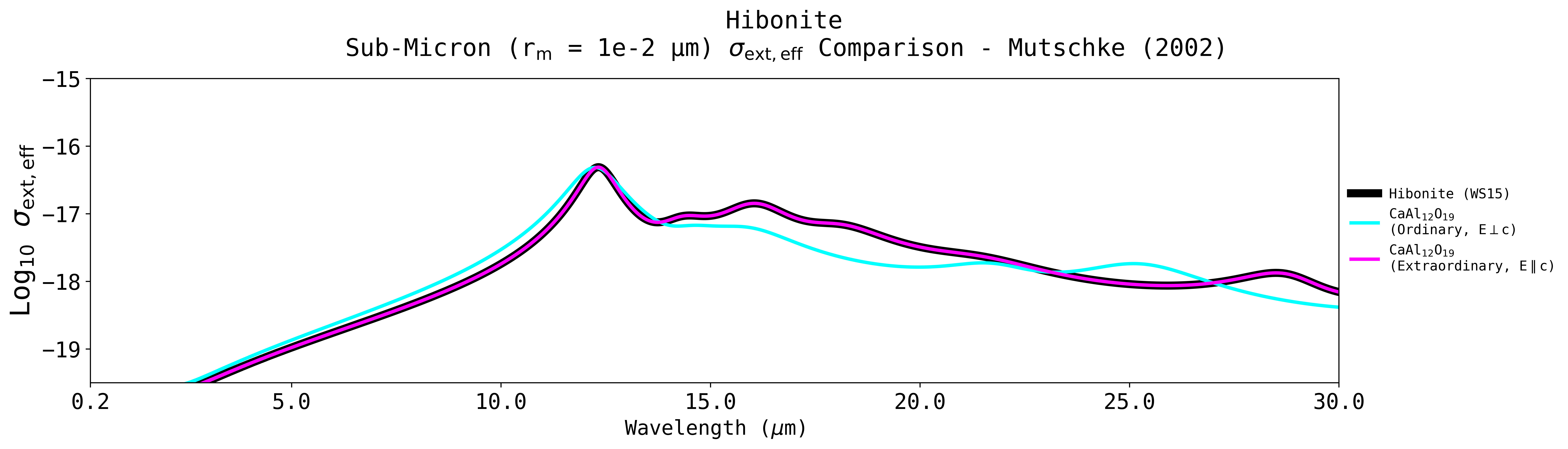
|
\(\hookrightarrow\) DOCCD Link |
2–30 μm |
Crystalline (hexagonal, uniaxial) Natural Crystal (\(\mathrm{Ca_{0.85}Al_{11.37}Ti_{0.26}Fe_{0.38}O_{19}}\)) |
\(\mathrm{Al_{2}O_{3}}\) Porous vs Compact |
Al2O3_amorph_compact Al2O3_amorph_porous |
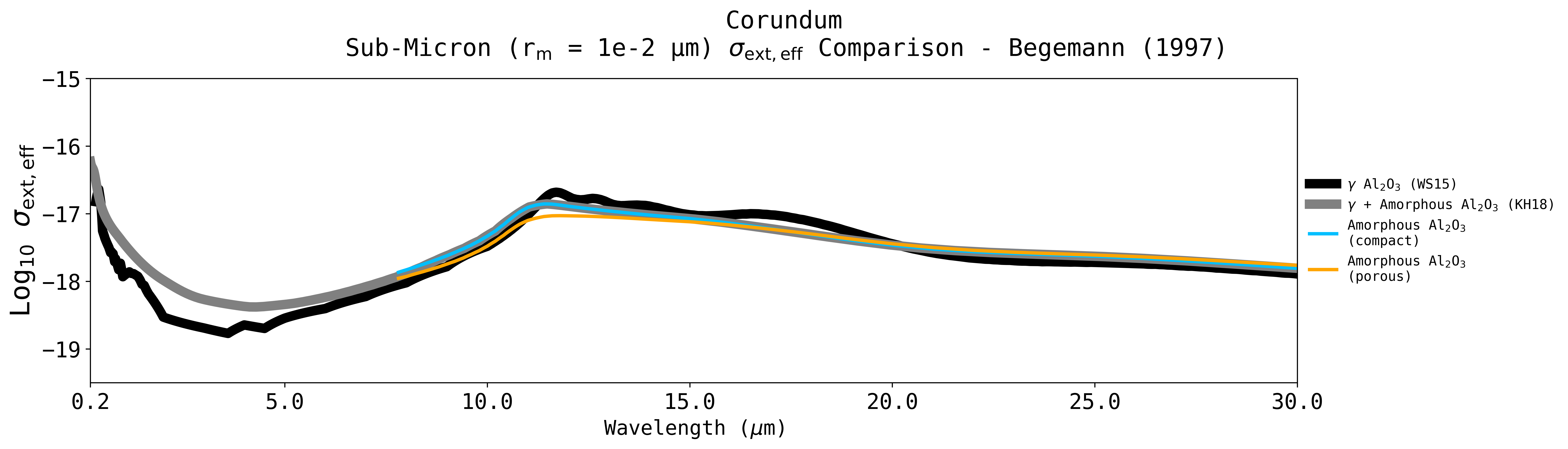
|
\(\hookrightarrow\) DOCCD Link |
7.81–30 μm |
Amorphous (isotropic). |
\(\mathrm{Al_{2}O_{3}}\) Directional and Temperature Properties (Uniaxial) |
Al2O3_alpha_crystal_300K_ordinary (E \(\perp\) c) Al2O3_alpha_crystal_551K_ordinary (E \(\perp\) c) Al2O3_alpha_crystal_738K_ordinary (E \(\perp\) c) Al2O3_alpha_crystal_928K_ordinary (E \(\perp\) c) Al2O3_alpha_crystal_300K_extraordinary (E \(\parallel\) c) Al2O3_alpha_crystal_551K_extraordinary (E \(\parallel\) c) Al2O3_alpha_crystal_738K_extraordinary (E \(\parallel\) c) Al2O3_alpha_crystal_928K_extraordinary (E \(\parallel\) c) |
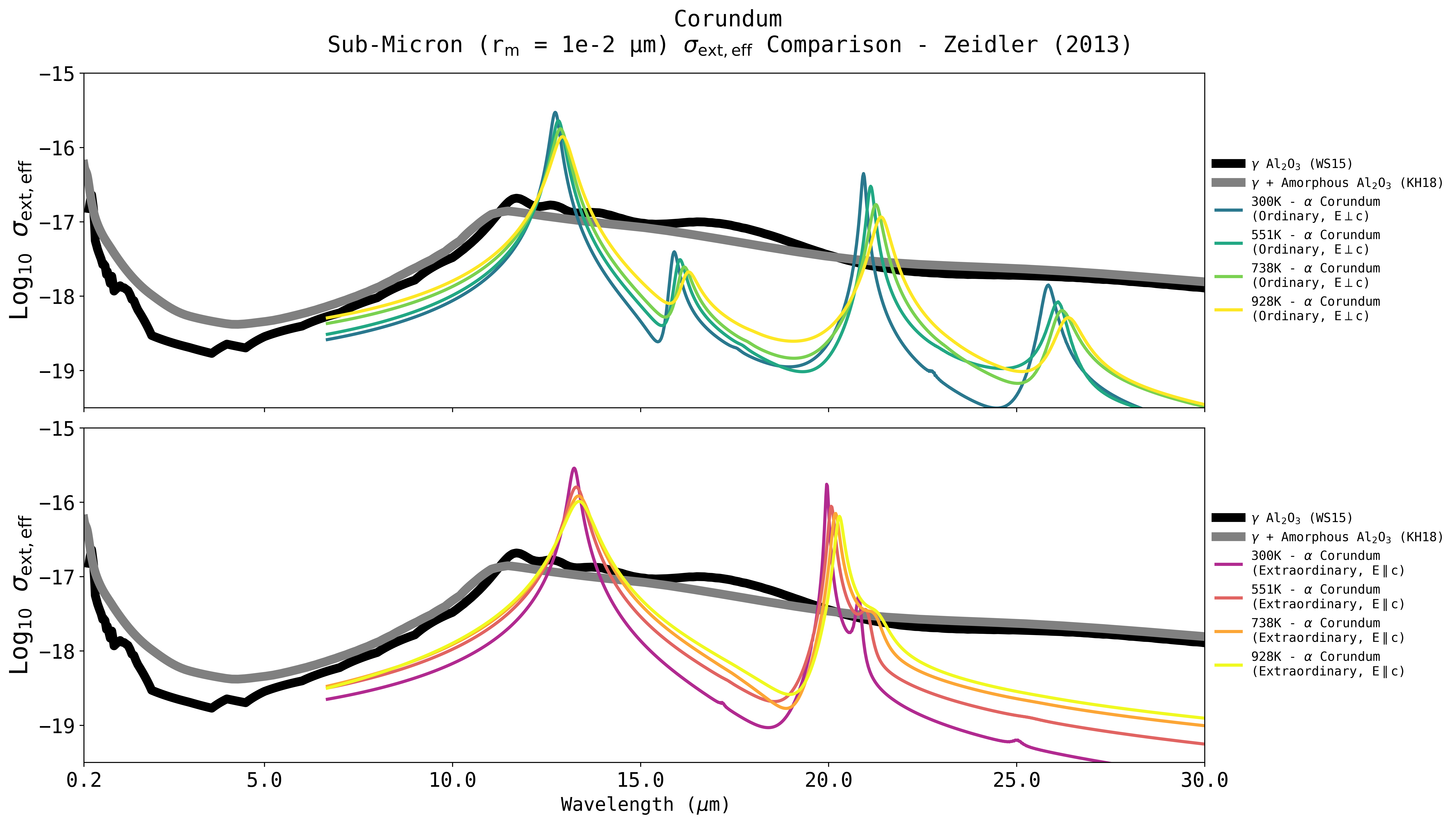
|
\(\hookrightarrow\) DOCCD Link |
6.67–30 μm |
Crystalline (trigonal, uniaxial) Synthetic Crystal |
\(\mathrm{MgAl_{2}O_{4}}\) Annealed |
MgAl2O4_crystalline_natural MgAl2O4_crystalline_natural_annealed_1223K |
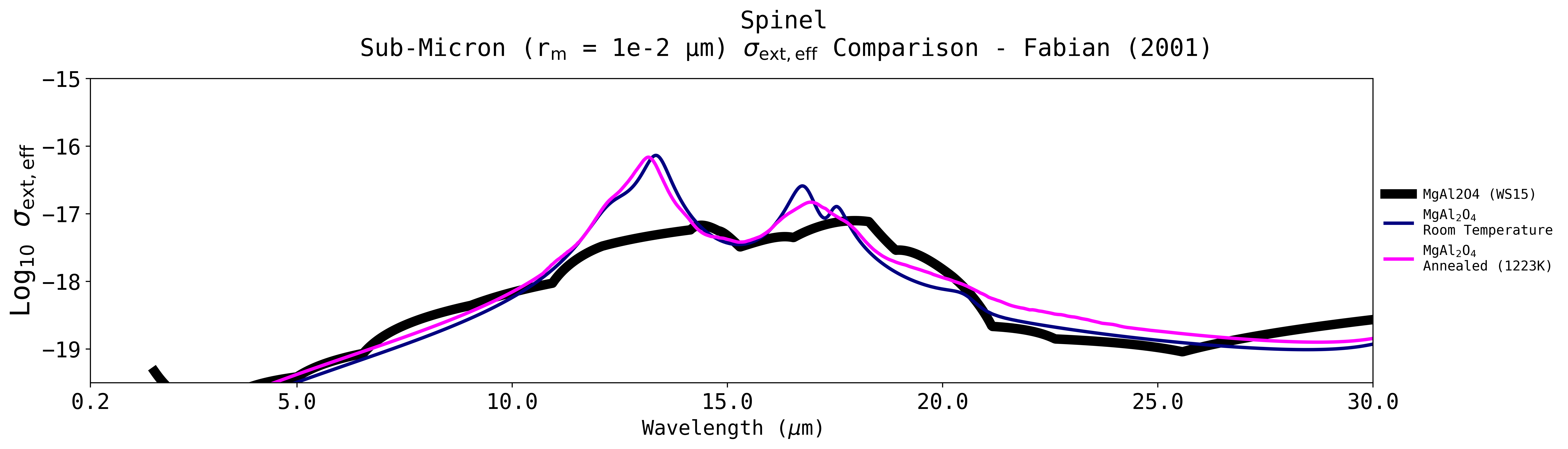
|
\(\hookrightarrow\) DOCCD Link |
2–30 μm (1.67–30 μm for annealed) |
Crystalline (cubic, isotropic) Natural crystal |
\(\mathrm{MgAl_{2}O_{4}}\) Temperature Properties |
MgAl2O4_synthetic_10K MgAl2O4_synthetic_100K MgAl2O4_synthetic_300K MgAl2O4_synthetic_551K MgAl2O4_synthetic_738K MgAl2O4_synthetic_928K |
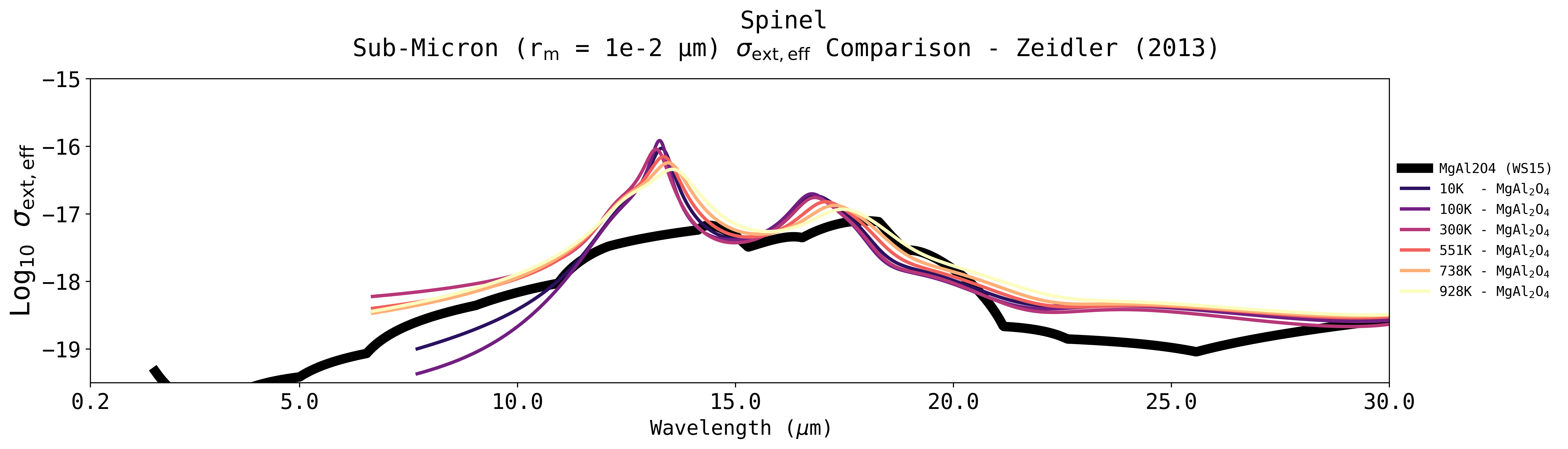
|
\(\hookrightarrow\) DOCCD Link |
6.71–30 μm (7.70–30 μm for 10K, 100K) |
Crystalline (cubic, isotropic) Natural crystal |
\(\mathrm{Fe_{2}SiO_{4}}\) Directional Properties (Biaxial) |
Fe2SiO4_crystal_synthetic_Ez (E \(\parallel\) c) Fe2SiO4_crystal_synthetic_Ey (E \(\parallel\) b) Fe2SiO4_crystal_synthetic_Ex (E \(\parallel\) a) |
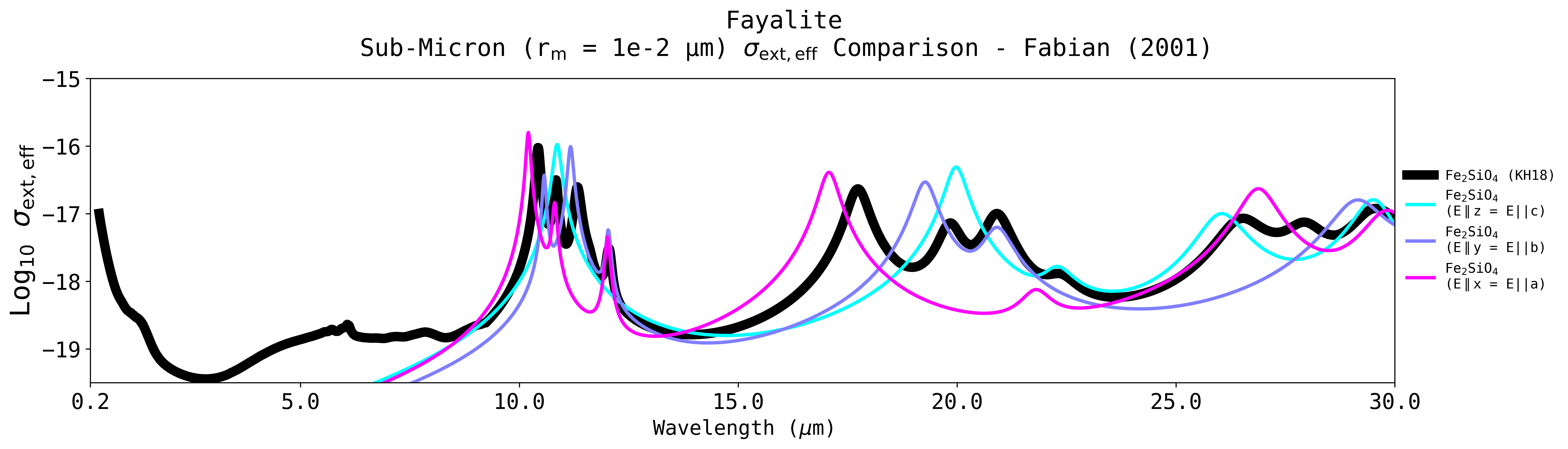
|
\(\hookrightarrow\) DOCCD Link |
2–30 μm |
Crystalline (orthorhomboc, biaxial) Synthetic crystal Orthorhombic means the optical axes align with the crystallographic axes Original text does not specify how x,y,z correspond to c,b,a so we assume it follows the D2H symmetry group (Ez = B1U = Ec, Ey = B2U = Eb, Ex = B3U = Ea) |
\(\mathrm{TiO_{2}}\) Polymorphs and Directional Properties (Uniaxial/Biaxial) |
TiO2_anatase_ordinary (E \(\perp\) c) TiO2_anatase_extraordinary (E \(\parallel\) c) TiO2_rutile_ordinary (E \(\perp\) c) TiO2_rutile_extraordinary (E \(\parallel\) c) TiO2_brookite_Ez (E \(\parallel\) c) TiO2_brookite_Ey (E \(\parallel\) b) TiO2_brookite_Ex (E \(\parallel\) a) |

|
\(\hookrightarrow\) DOCCD Link |
2–30 μm (0.47–30 μm for rutile) |
Anatase (tetragonal, uniaxial, stable at room temperature) Rutile (tetragonal, uniaxial, stable at high temperatures) Brookite (orthorhombic, biaxial, rare polymorph at room temperatures) Orthorhombic means the optical axes align with the crystallographic axes Original text does not specify how x,y,z correspond to c,b,a so we assume it follows the D2H symmetry group (Ez = B1U = Ec, Ey = B2U = Eb, Ex = B3U = Ea) |
\(\mathrm{SiO_{2}}\) Polymorphs, Directional, and Temperature Properties (Uniaxial) |
SiO2_alpha_crystal_300K_ordinary (E \(\perp\) c) SiO2_alpha_crystal_551K_ordinary (E \(\perp\) c) SiO2_alpha_crystal_738K_ordinary (E \(\perp\) c) SiO2_alpha_crystal_833K_ordinary (E \(\perp\) c) SiO2_beta_crystal_928K_ordinary (E \(\perp\) c) SiO2_alpha_crystal_300K_extraordinary (E \(\parallel\) c) SiO2_alpha_crystal_551K_extraordinary (E \(\parallel\) c) SiO2_alpha_crystal_738K_extraordinary (E \(\parallel\) c) SiO2_alpha_crystal_833K_extraordinary (E \(\parallel\) c) SiO2_beta_crystal_928K_extraordinary (E \(\parallel\) c) SiO2_alpha_crystal_300K_averaged (2/3 E \(\perp\) c + 1/3 E \(\parallel\) c) SiO2_beta_crystal_928K_averaged (2/3 E \(\perp\) c + 1/3 E \(\parallel\) c) |
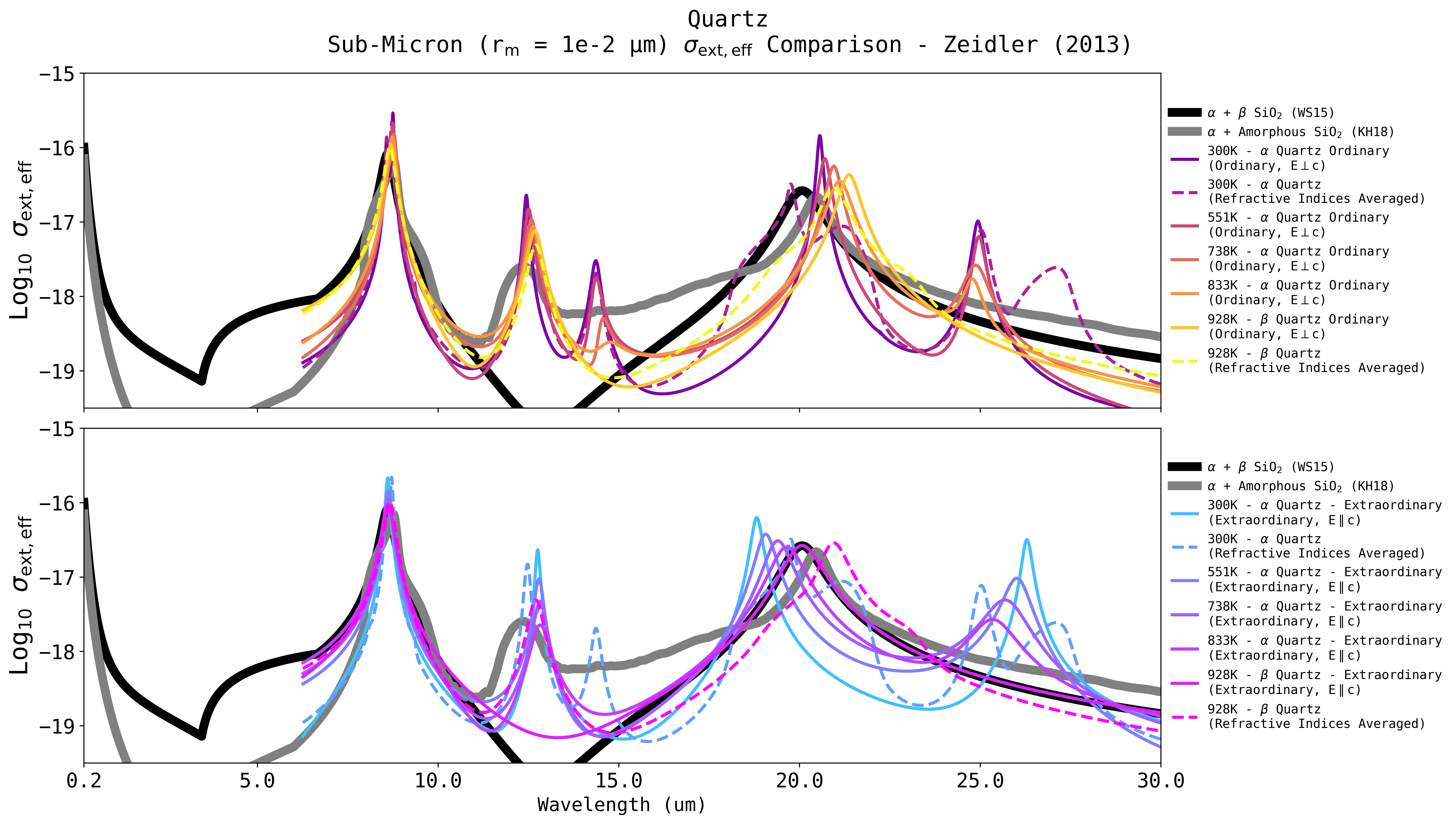
|
\(\hookrightarrow\) DOCCD Link |
6.26–30 μm |
\(\alpha\) Quartz (trigonal, uniaxial, room temperature polymorph) \(\beta\) Quartz (trigonal, uniaxial, transforms from \(\alpha\) quartz at ~850K) Natural crystal from Brazil. We include opacities for when refractive indices are averaged before Mie calculations WARNING: We reccomend using opacities seperate, than these averaged opacities, as averaging refractive indices before precomputation can shift absorption features. |
\(\mathrm{SiO_{2}}\) Polymorphs, and Temperature Properties |
SiO2_alpha_crystal_A2_295K (E \(\parallel\) c) SiO2_alpha_crystal_E_295K (E \(\perp\) c) SiO2_alpha_crystal_E_346K (E \(\perp\) c) SiO2_alpha_crystal_E_480K (E \(\perp\) c) SiO2_alpha_crystal_E_600K (E \(\perp\) c) SiO2_alpha_crystal_E_705K (E \(\perp\) c) SiO2_alpha_crystal_E_790K (E \(\perp\) c) SiO2_beta_crystal_E_1010K (E \(\perp\) c) SiO2_beta_crystal_E_1125K (E \(\perp\) c) SiO2_beta_crystal_E_1170K (E \(\perp\) c) SiO2_beta_crystal_E_1310K (E \(\perp\) c) SiO2_beta_crystal_E_1394K (E \(\perp\) c) SiO2_beta_crystal_E_1520K (E \(\perp\) c) SiO2_beta_crystal_E_1590K (E \(\perp\) c) SiO2_beta_crystal_E_1646K (E \(\perp\) c) SiO2_beta_cristobalite_E_1810K SiO2_beta_cristobalite_E_1880K |
|
6.67–30 μm |
\(\alpha\) Quartz (trigonal, uniaxial, room temperature polymorph) \(\beta\) Quartz (trigonal, uniaxial, transforms from \(\alpha\) quartz at ~850K) \(\beta\) Cristobalite (cubic, isotropic, transforms from \(\beta\) quartz at ~1750K) Cut crystal. Note that these indices were only measured for the ordinary ray (E), with the exception of the single extraordinary measurement (A2). Also note that cristobalite is isotropic while the other polymorphs are uniaxial. |
|
\(\mathrm{SiO_{2}}\) Polymorphs, and Temperature Properties |
SiO2_alpha_cristobalite_295K SiO2_beta_tridymite_295K SiO2_beta_tridymite_500K |
|
0.30–15 μm |
\(\alpha\) Cristobalite (tetragonal, uniaxial, transforms from \(\beta\) cristobalite that has been rapidly quenched) \(\beta\) Tridymite (hexagonal, uniaxial, transforms from \(\beta\) quartz (w/ impuritied) at ~1150K) Wavelengths for some indices were extrapolated from other datasets. See original paper for details. |
|
\(\mathrm{Mg_{2}SiO_{4}}\) Directional and Temperature Properties (Biaxial) |
Mg2SiO4_295K_B1U (E \(\parallel\) c) Mg2SiO4_546K_B1U (E \(\parallel\) c) Mg2SiO4_950K_B1U (E \(\parallel\) c) Mg2SiO4_1102K_B1U (E \(\parallel\) c) Mg2SiO4_1147K_B1U (E \(\parallel\) c) Mg2SiO4_1431K_B1U (E \(\parallel\) c) Mg2SiO4_1518K_B1U (E \(\parallel\) c) Mg2SiO4_1648K_B1U (E \(\parallel\) c) Mg2SiO4_1742K_B1U (E \(\parallel\) c) Mg2SiO4_1809K_B1U (E \(\parallel\) c) Mg2SiO4_295K_B2U (E \(\parallel\) b) Mg2SiO4_547K_B2U (E \(\parallel\) b) Mg2SiO4_720K_B2U (E \(\parallel\) b) Mg2SiO4_946K_B2U (E \(\parallel\) b) Mg2SiO4_1122K_B2U (E \(\parallel\) b) Mg2SiO4_1303K_B2U (E \(\parallel\) b) Mg2SiO4_1417K_B2U (E \(\parallel\) b) Mg2SiO4_1535K_B2U (E \(\parallel\) b) Mg2SiO4_1617K_B2U (E \(\parallel\) b) Mg2SiO4_1818K_B2U (E \(\parallel\) b) Mg2SiO4_295K_B3U (E \(\parallel\) a) Mg2SiO4_602K_B3U (E \(\parallel\) a) Mg2SiO4_757K_B3U (E \(\parallel\) a) Mg2SiO4_918K_B3U (E \(\parallel\) a) Mg2SiO4_1055K_B3U (E \(\parallel\) a) Mg2SiO4_1131K_B3U (E \(\parallel\) a) Mg2SiO4_1256K_B3U (E \(\parallel\) a) Mg2SiO4_1503K_B3U (E \(\parallel\) a) Mg2SiO4_1793K_B3U (E \(\parallel\) a) Mg2SiO4_1948K_B3U (E \(\parallel\) a) Mg2SiO4_295K_averaged (1/3 E \(\parallel\) c,b,a) Mg2SiO4_1000K_averaged (1/3 E \(\parallel\) c,b,a) |
|
2.5–30 μm |
Crystal (orthorhombic, biaxial) Synthetic Orthorhombic means the optical axes align with the crystallographic axes It is defined that B1U = Ec, B2U = Eb, B3U = Ea (pers. comm)
WARNING: We reccomend using opacities seperate, than these averaged opacities, as averaging refractive indices before precomputation can shift absorption features. |
|
\(\mathrm{Mg_{1.9}Fe_{0.1}SiO_{4}}\) Directional Properties (Biaxial) |
Mg19Fe01SiO4_crystal_natural_Ex (E \(\parallel\) c) Mg19Fe01SiO4_crystal_natural_Ey (E \(\parallel\) b) Mg19Fe01SiO4_crystal_natural_Ez (E \(\parallel\) a) |
|
\(\hookrightarrow\) DOCCD Link |
2–30 μm |
Crystalline (orthorhombic, biaxial) Natural Crystal (Stubachtal) Orthorhombic means the optical axes align with the crystallographic axes While DOCCD does not explictly label their axes, we assume its the same as Mg172Fe021SiO4: Ex = Ec, Ey = Eb, and Ez = Ea. |
\(\mathrm{Mg_{1.72}Fe_{0.21}SiO_{4}}\) Directional Properties VIS/NIR Wavelengths (Biaxial) |
Mg172Fe021SiO4_crystal_visnir_Ex (E \(\parallel\) c) Mg172Fe021SiO4_crystal_visnir_Ey (E \(\parallel\) b) Mg172Fe021SiO4_crystal_visnir_Ez (E \(\parallel\) a) |
|
\(\hookrightarrow\) DOCCD Link |
0.32–6.99 μm |
Crystalline (orthorhombic, biaxial) Natural Crystal (San Carlos) Orthorhombic means the optical axes align with the crystallographic axes As stated on DOCCD, we assume: Ex = Ec, Ey = Eb, and Ez = Ea. |
\(\mathrm{Mg_{1.72}Fe_{0.21}SiO_{4}}\) Directional and Temperature Properties (Biaxial) |
Mg172Fe021SiO4_crystal_10K_Ex (E \(\parallel\) c) Mg172Fe021SiO4_crystal_100K_Ex (E \(\parallel\) c) Mg172Fe021SiO4_crystal_200K_Ex (E \(\parallel\) c) Mg172Fe021SiO4_crystal_300K_Ex (E \(\parallel\) c) Mg172Fe021SiO4_crystal_551K_Ex (E \(\parallel\) c) Mg172Fe021SiO4_crystal_738K_Ex (E \(\parallel\) c) Mg172Fe021SiO4_crystal_928K_Ex (E \(\parallel\) c) Mg172Fe021SiO4_crystal_10K_Ey (E \(\parallel\) b) Mg172Fe021SiO4_crystal_100K_Ey (E \(\parallel\) b) Mg172Fe021SiO4_crystal_200K_Ey (E \(\parallel\) b) Mg172Fe021SiO4_crystal_300K_Ey (E \(\parallel\) b) Mg172Fe021SiO4_crystal_551K_Ey (E \(\parallel\) b) Mg172Fe021SiO4_crystal_738K_Ey (E \(\parallel\) b) Mg172Fe021SiO4_crystal_928K_Ey (E \(\parallel\) b) Mg172Fe021SiO4_crystal_10K_Ez (E \(\parallel\) a) Mg172Fe021SiO4_crystal_100K_Ez (E \(\parallel\) a) Mg172Fe021SiO4_crystal_200K_Ez (E \(\parallel\) a) Mg172Fe021SiO4_crystal_300K_Ez (E \(\parallel\) a) Mg172Fe021SiO4_crystal_551K_Ez (E \(\parallel\) a) Mg172Fe021SiO4_crystal_738K_Ez (E \(\parallel\) a) Mg172Fe021SiO4_crystal_928K_Ez (E \(\parallel\) a) |
|
\(\hookrightarrow\) DOCCD Link |
6.71–30 μm |
Crystalline (orthorhombic, biaxial) Natural Crystal (San Carlos) Orthorhombic means the optical axes align with the crystallographic axes As stated on DOCCD, we assume: Ex = Ec, Ey = Eb, and Ez = Ea. |
\(\mathrm{Mg_{0.92}Fe_{0.09}SiO_{3}}\) Directional and Temperature Properties (Biaxial) |
Mg092Fe009SiO3_crystal_10K_Ez (E \(\parallel\) c) Mg092Fe009SiO3_crystal_100K_Ez (E \(\parallel\) c) Mg092Fe009SiO3_crystal_200K_Ez (E \(\parallel\) c) Mg092Fe009SiO3_crystal_300K_Ez (E \(\parallel\) c) Mg092Fe009SiO3_crystal_551K_Ez (E \(\parallel\) c) Mg092Fe009SiO3_crystal_738K_Ez (E \(\parallel\) c) Mg092Fe009SiO3_crystal_928K_Ez (E \(\parallel\) c) Mg092Fe009SiO3_crystal_10K_Ex (E \(\parallel\) b) Mg092Fe009SiO3_crystal_100K_Ex (E \(\parallel\) b) Mg092Fe009SiO3_crystal_200K_Ex (E \(\parallel\) b) Mg092Fe009SiO3_crystal_300K_Ex (E \(\parallel\) b) Mg092Fe009SiO3_crystal_551K_Ex (E \(\parallel\) b) Mg092Fe009SiO3_crystal_738K_Ex (E \(\parallel\) b) Mg092Fe009SiO3_crystal_928K_Ex (E \(\parallel\) b) Mg092Fe009SiO3_crystal_10K_Ey (E \(\parallel\) a) Mg092Fe009SiO3_crystal_100K_Ey (E \(\parallel\) a) Mg092Fe009SiO3_crystal_200K_Ey (E \(\parallel\) a) Mg092Fe009SiO3_crystal_300K_Ey (E \(\parallel\) a) Mg092Fe009SiO3_crystal_551K_Ey (E \(\parallel\) a) Mg092Fe009SiO3_crystal_738K_Ey (E \(\parallel\) a) Mg092Fe009SiO3_crystal_928K_Ey (E \(\parallel\) a) Mg092Fe009SiO3_crystal_300K_averaged (1/3 E \(\parallel\) c,b,a) Mg092Fe009SiO3_crystal_928K_averaged (1/3 E \(\parallel\) c,b,a) |
|
\(\hookrightarrow\) DOCCD Link |
6.71–30 μm |
Crystalline (orthorhombic, biaxial) Natural Crystal (Burma) Orthorhombic means the optical axes align with the crystallographic axes As stated on DOCCD, we assume: Ex = Eb, Ey = Ea, and Ez = Ec. |
Optional: Diamond Database
POSEIDON v1.3.1 also includes an optional database of Mie scattering properties for diamonds. By default, this database is not included in POSEIDON’s input files. You can download it from Zenodo: Optional Aerosol Files.
After downloading the files, please put them in your inputs/opacity folder.
For full previews of extinction cross sections and scattering properties of each aerosol, see “Diamond Opacity Previews”
All refractive index txt files can be found “Diamond Refractive Indices”
Note that the entry ‘NanoDiamonds’ (meteoric diamonds, detailed above in the normal aerosol database) is also included in this database, for convenience.
Name in POSEIDON |
Plot (Click) |
Database Reference |
Refractive Index References |
Wavelength Range |
Notes |
|---|---|---|---|---|---|
Diamond_palik |
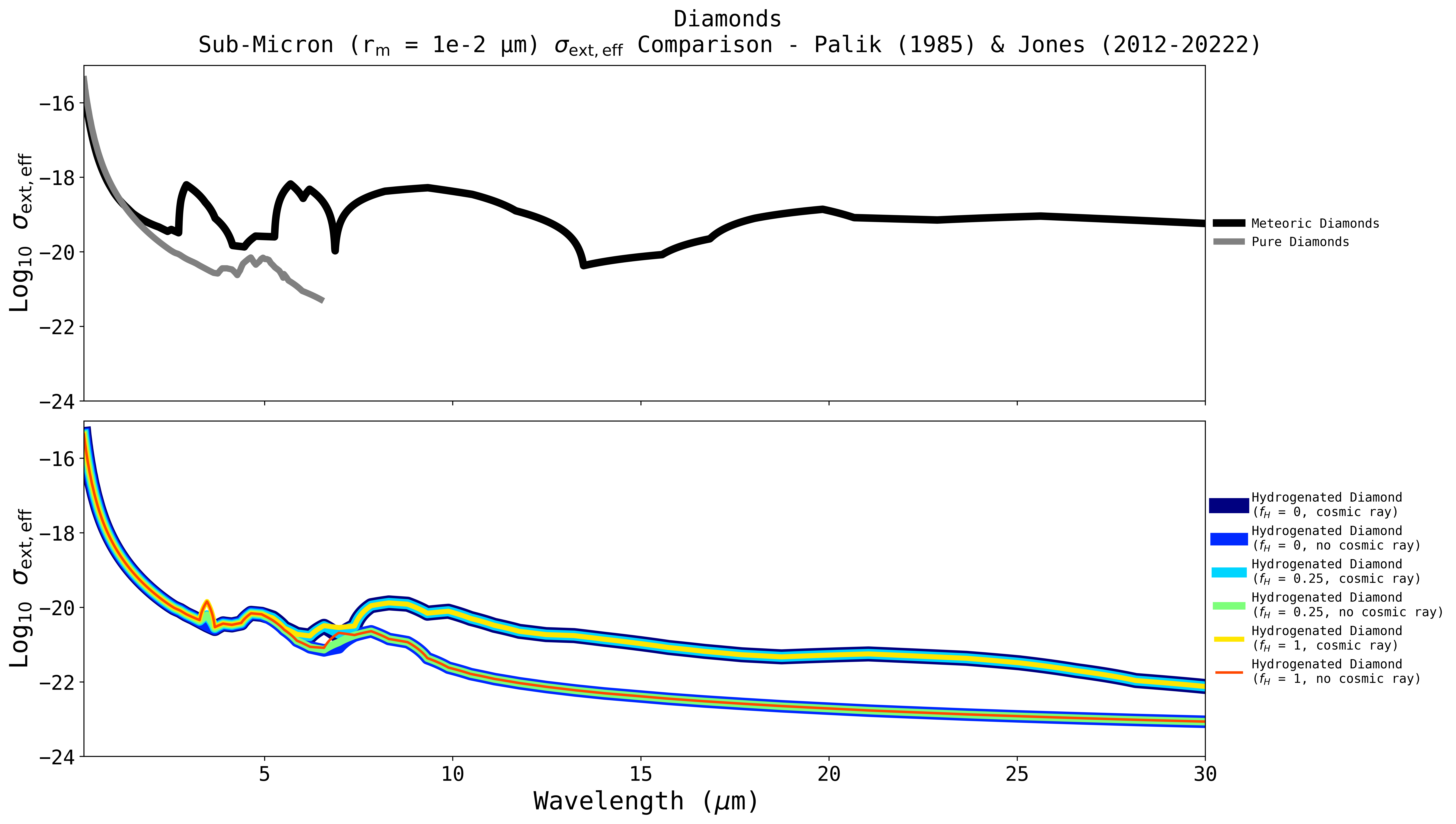
|
0.2-6.5 μm |
Crystalline (cubic, isotropic) Pure Diamond |
||
Hydrogentated_Diamond_fH0_N0_irradiated Hydrogentated_Diamond_fH0_N0_not_irradiated Hydrogentated_Diamond_fH025_N0_irradiated Hydrogentated_Diamond_fH025_N0_not_irradiated Hydrogentated_Diamond_fH1_N0_irradiated Hydrogentated_Diamond_fH1_N0_not_irradiated |
|
0.2-30 μm |
Crystalline (cubic, isotropic) 6 samples of hydrogenated diamonds f_H = fraction of hydrogenation (0, 0.25, and 1) Irradiated and non-irradiated by cosmic-rays |
Optional: \(\mathrm{SiO_2}\) Free Lognormal Logwidth Database
POSEIDON v1.3.1 also includes a database of Mie scattering properties for \(\mathrm{SiO_2}\) where the lognormal logwidth (used in the lognormal distribution) is a free parameter. By default, this database is not included in POSEIDON’s input files. You can download it from Zenodo: Optional Aerosol Files.
After downloading the files, please put them in your inputs/opacity folder.
Also see the updated tutorial (as of V1.3.1) to see how to make and use this database: “Making an Aerosol Database”.