Surface Albedo Database
Surface albedos, curated from lab data, can be used when modeling the emission and/or reflection spectra of rocky planets with a hard surface. This albedo database was introduced in the POSEIDON v1.4 update (see Mullens et al. 2026).
When using any albedos in a publication, please be sure to cite the publication the data was collected in, as well as relevant publications for original laboratory measurements. If you use the functionality of surfaces with POSEIDON, or use the surface albedo database, please cite Mullens et al. 2026.
Surface Albedo Previews
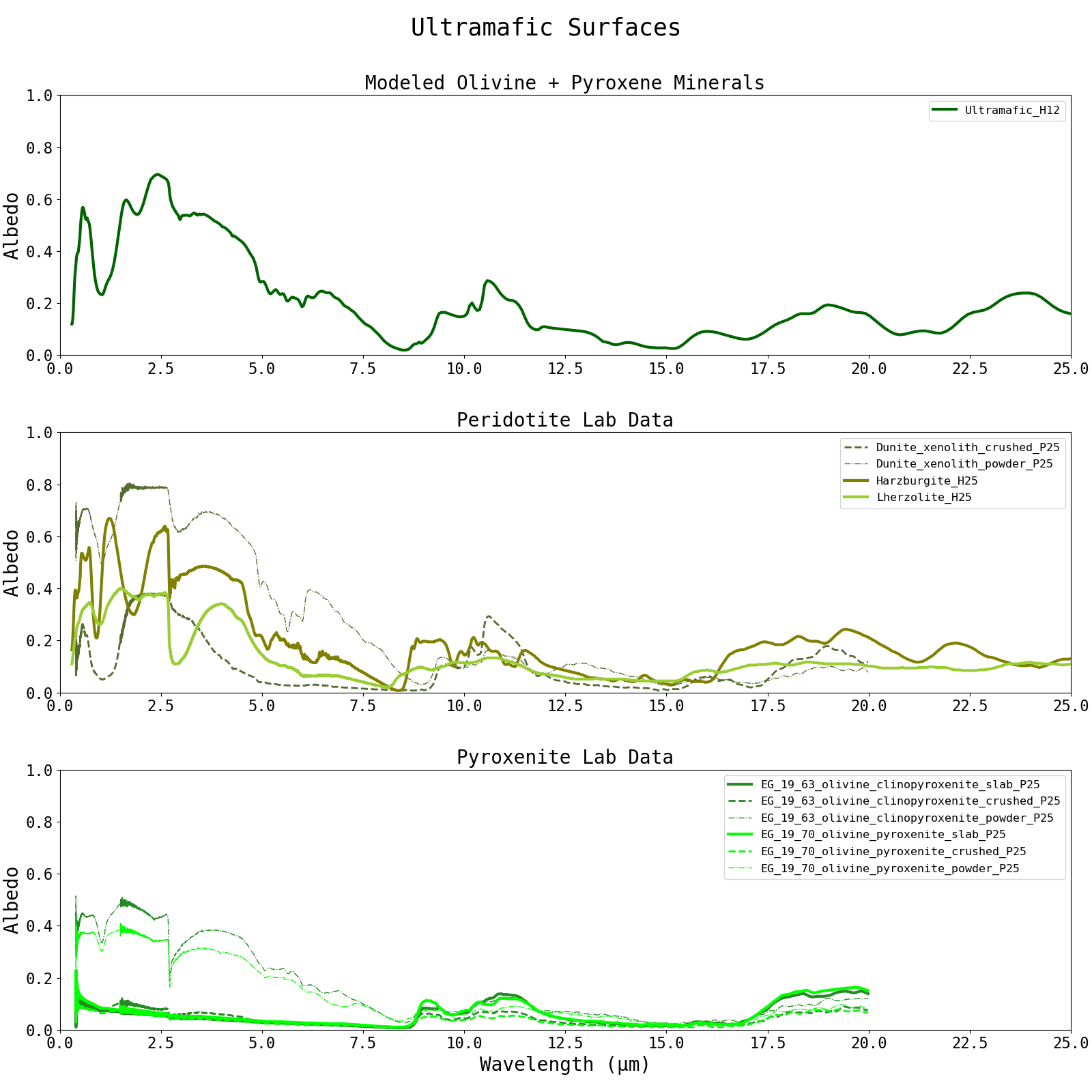
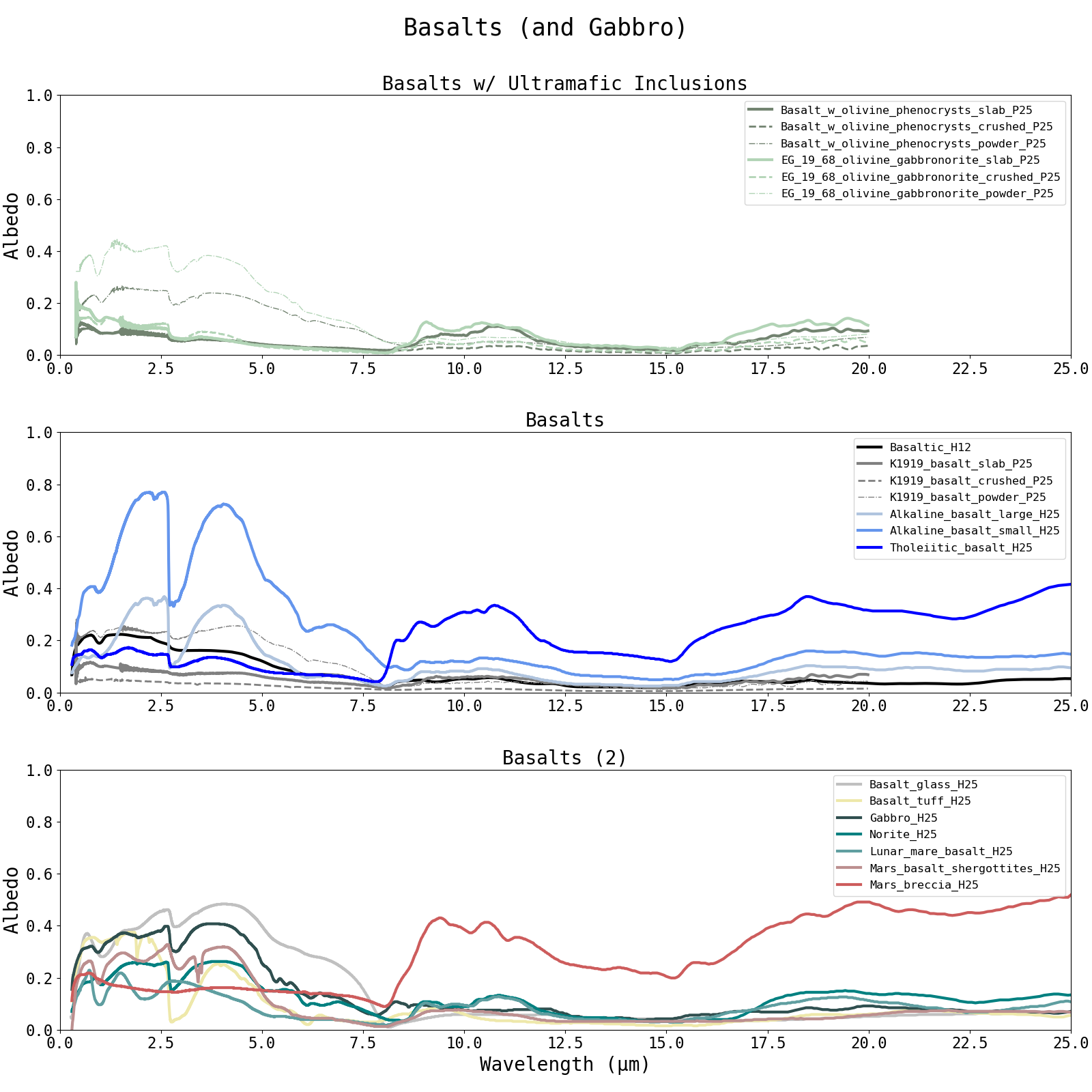
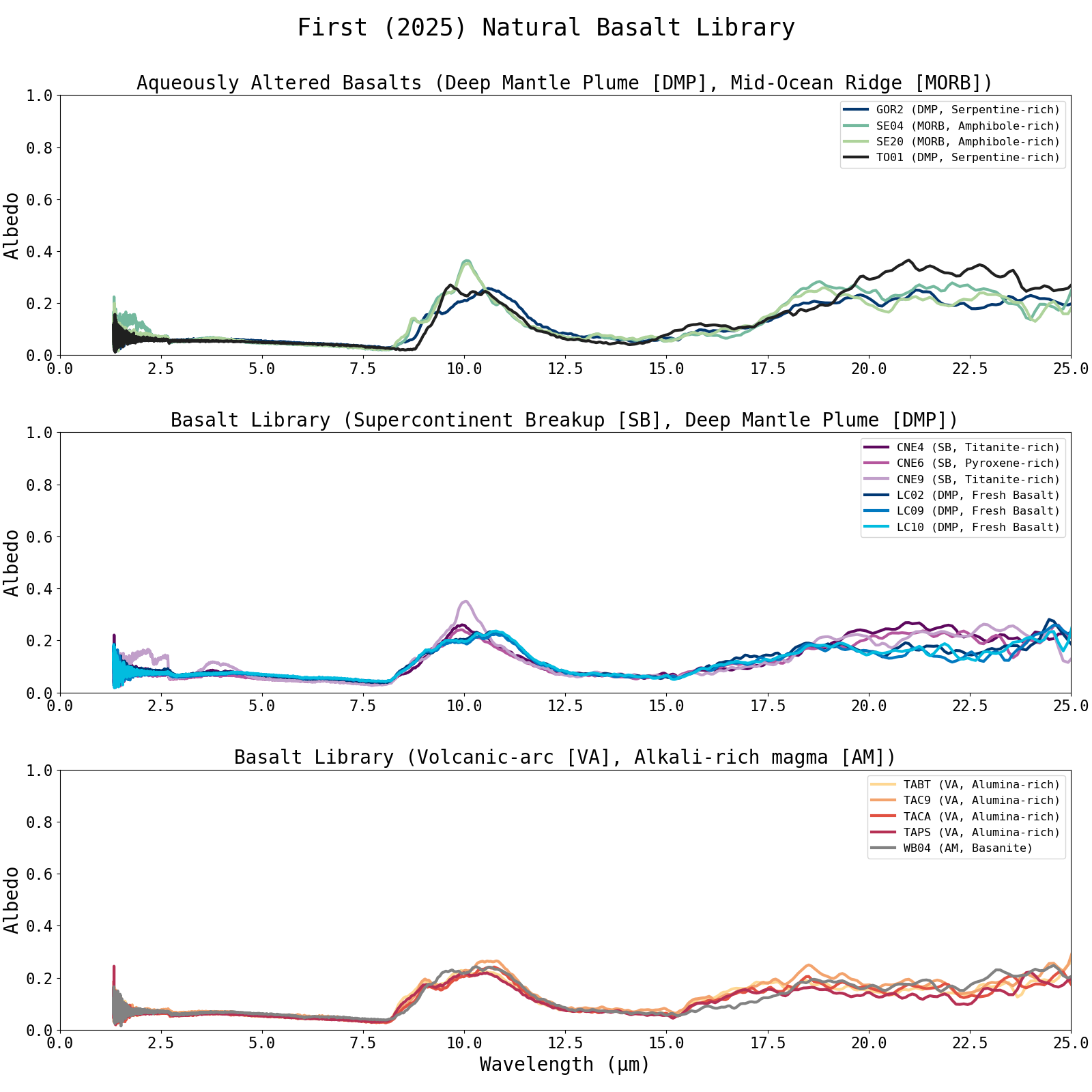
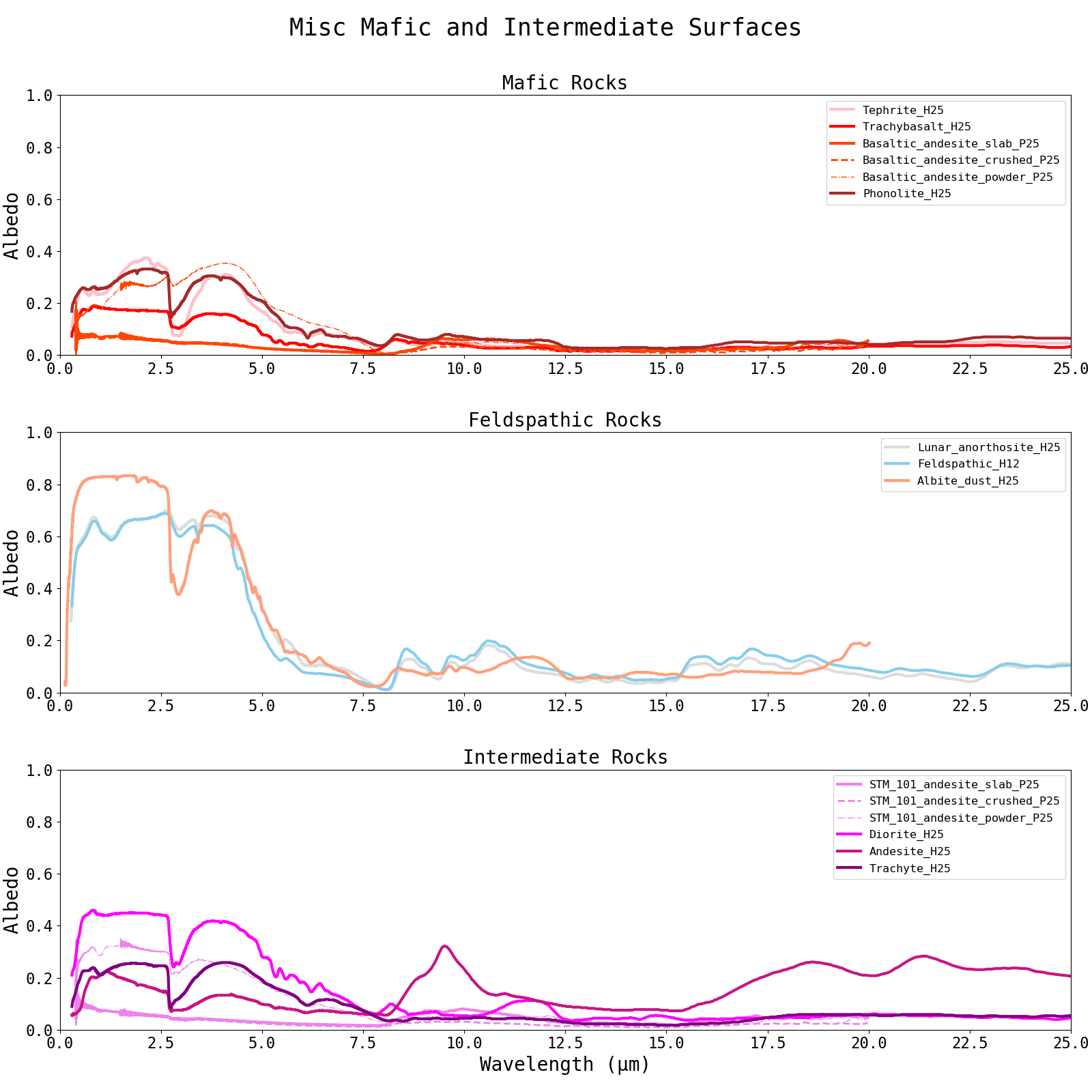
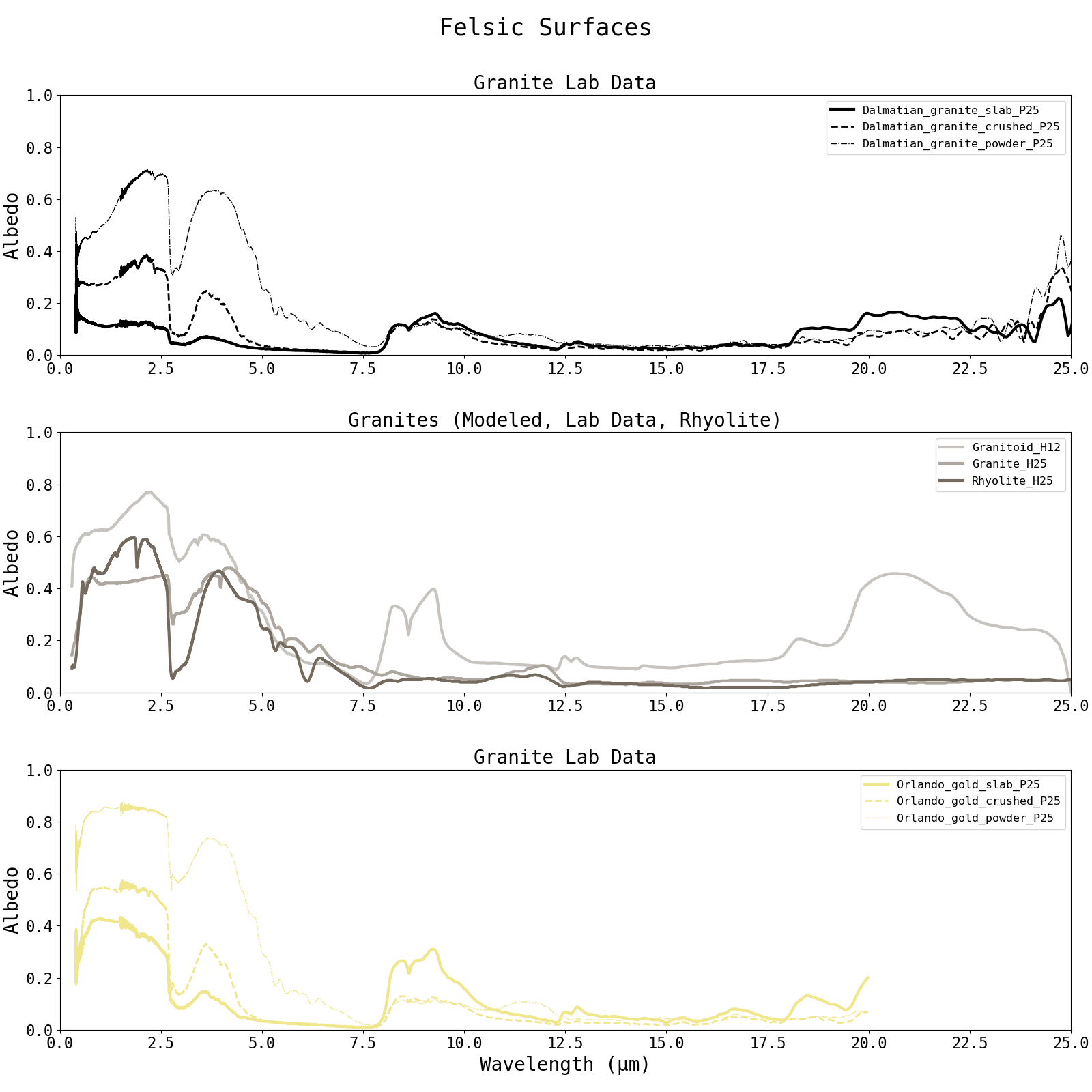
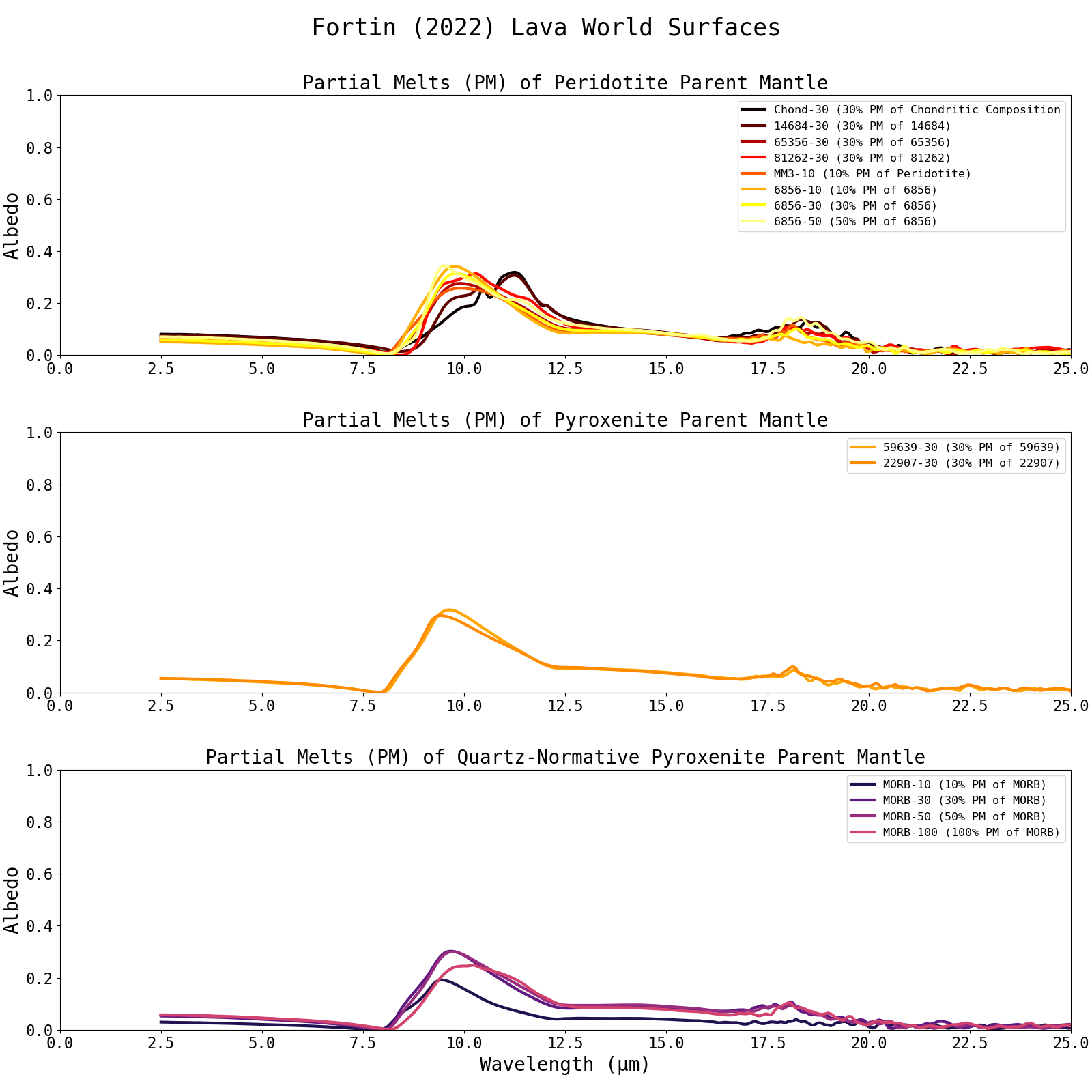
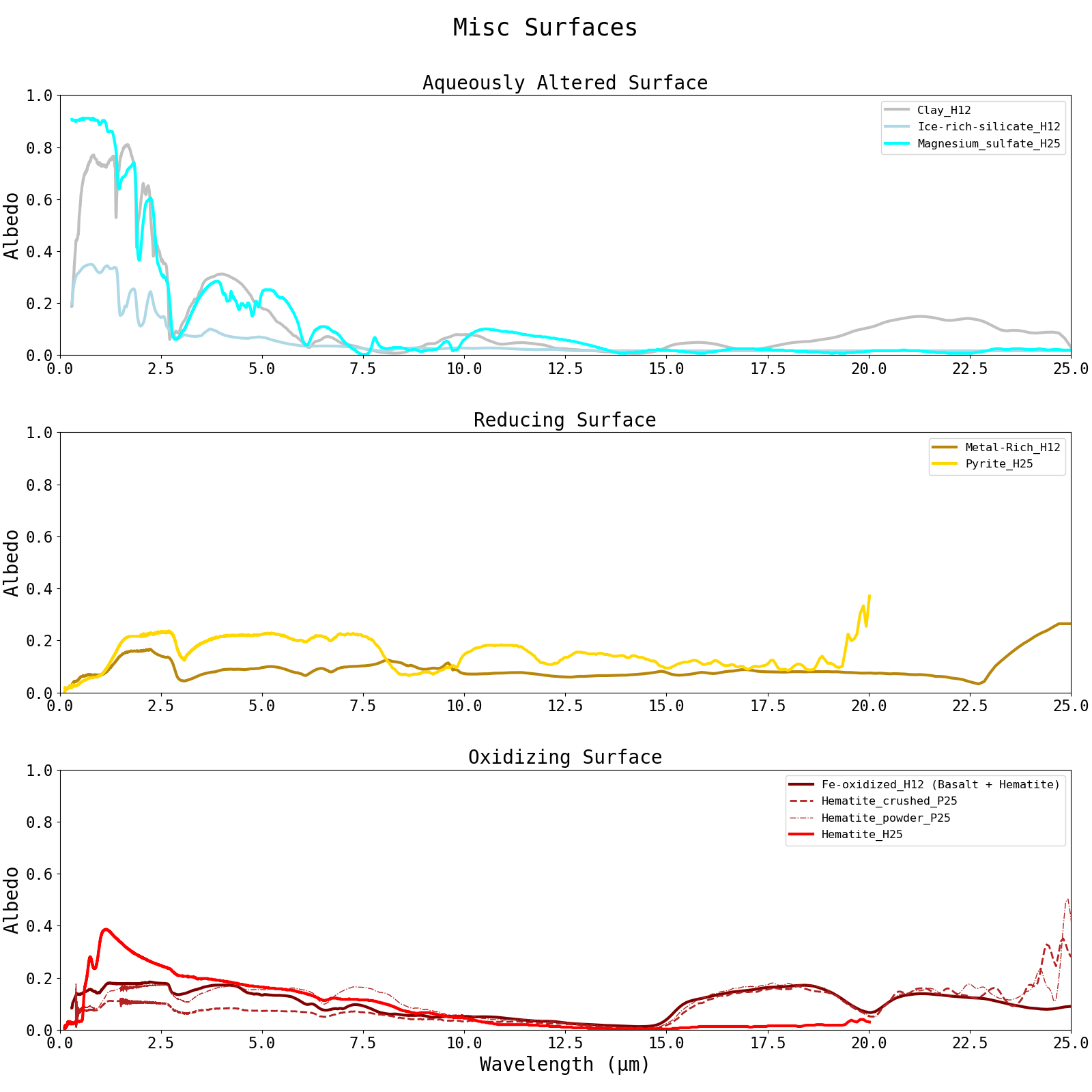
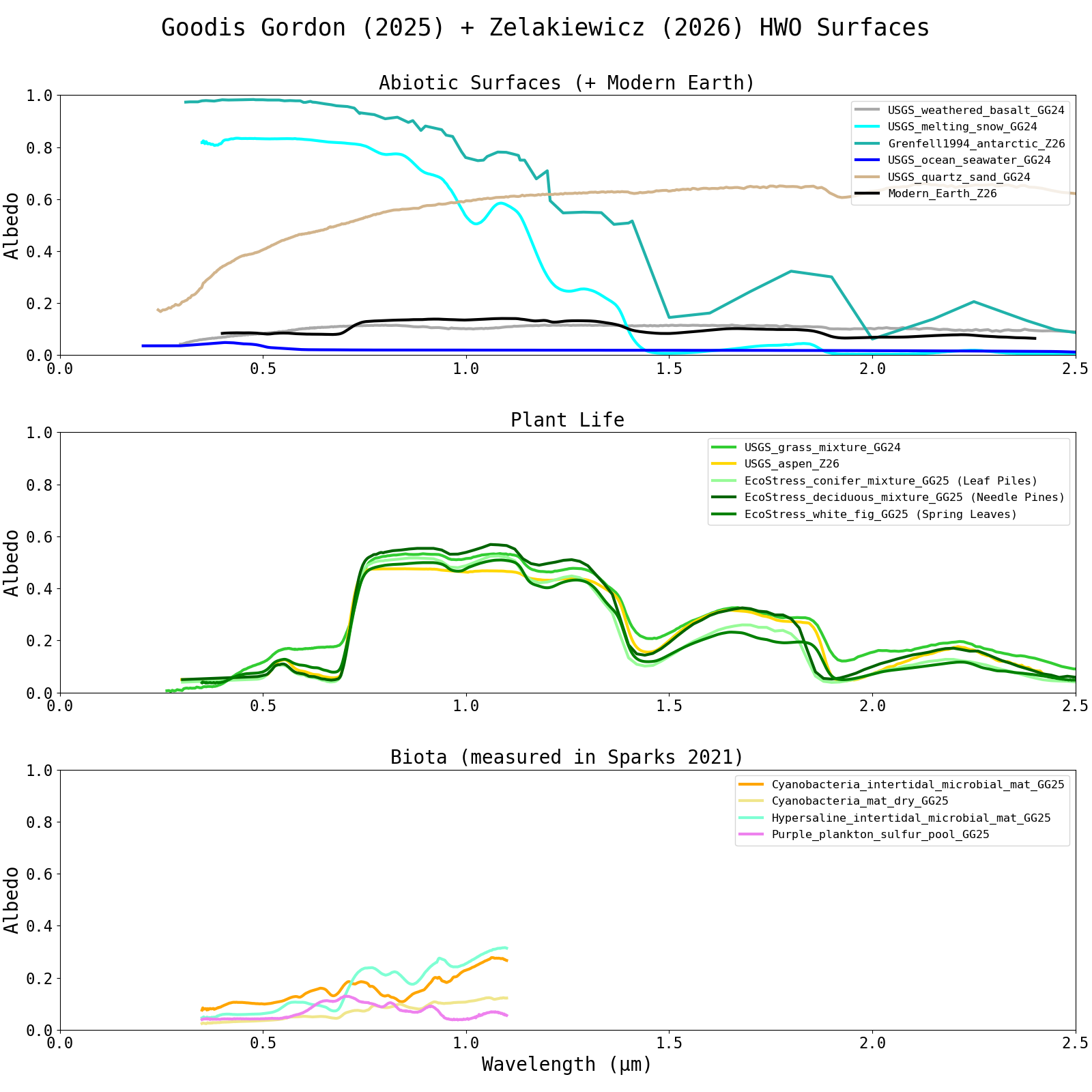
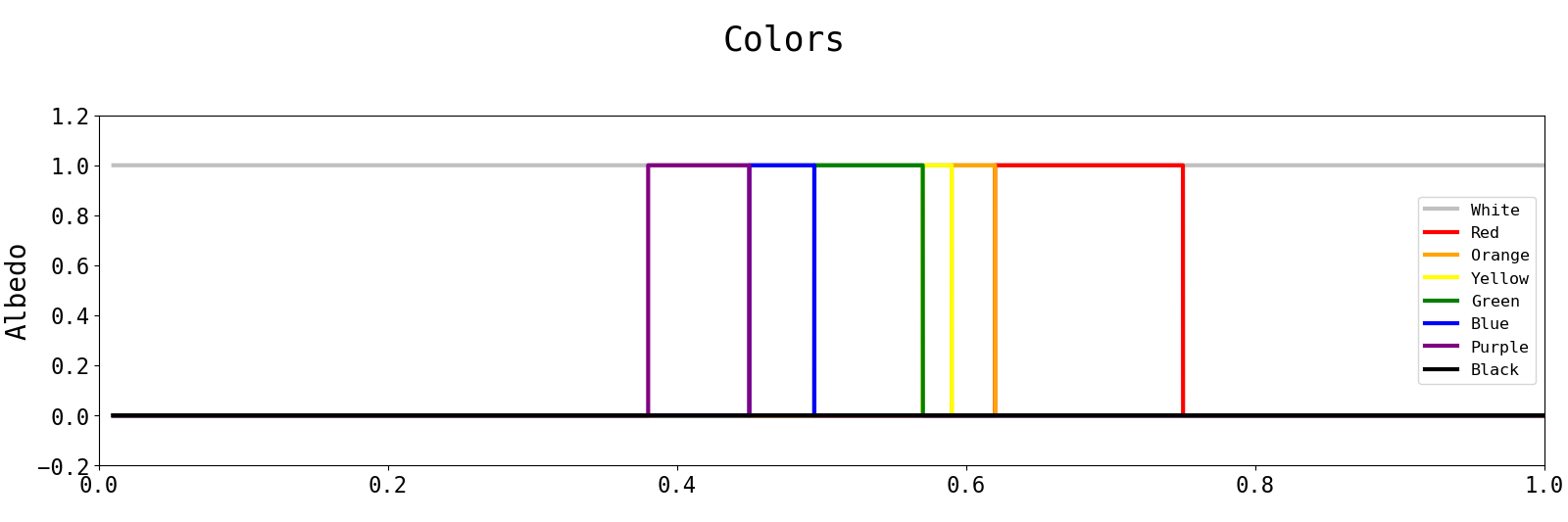
Here we show wavelength vs albedo for all albedos pre-included in the database. For more details, see the pdfs below.
Surface Albedo References
As of POSEIDON v1.4, a fresh install of POSEIDON comes with a surface_reflectivities folder in the inputs folder. This folder contains the pre-included surface albedos (as .txt files) from the following source, where all txt files can be found collected here. The last portion of the albedo name signifies its source (i.e., _H12 = Hu 2012)
All albedos presented in the database are in the form directional-hemispherical reflectances (with the exception of albedos from Goodis Gordon (2025) and Zelakiewicz (2026), see Table A7 and their papers).
Users can simply add their own lab data to use with POSEIDON: just generate a txt file with the first column being wavelength, second column being albedo, and place it in the ‘surface_reflectivities’ folder. POSEIDON will automatically detect whether or not their is a txt file with the name matching that of the albedo defined in the ‘surface_components’ list in model initialization.
We recommend that users try to ensure that their data is in the form of directional-hemispherical reflectance (for more details, see Appendix A in Mullens et al (2026)).
When using any albedos in a publication, please be sure to cite the publication the data was collected in, as well as relevant publications for original laboratory measurements.
Don’t see your favourite albedo included in the database? Do you want to add your own lab data to the database? Please do reach out: eem85@cornell.edu.
H12, GG25, H25, and Z26 collected and/or reformatted previously published laboratory data.
F22, F25, P25 performed and reported newly measured laboratory data.
Mullens (2026), which compiled the original database.
1. Hu (2012) [H12] (Txt files found here)
\(\hookrightarrow\) Note: H12 sourced data from Wyatt et al. 2011 for basalt, Cheek et al. 2009 for feldspatchic, and the USGS Spectral Library for all other albedos.
2. Fortin (2022) [F22] (Txt files found here)
3. First (2025) [F25] (Txt files found here)
4. Goodis Gordon (2025) [G25] (Txt files found here)
\(\hookrightarrow\) Note: GG25 sourced data from NASA JPL ECOSTRESS Spectral Library, USGS Spectral Library, and microbial mats from Sparks et al. (2021) (mats housed at NASA Ames Research Center). See Table linked here for specific USGS and ECOSTRESS reference numbers.
5. Hammond (2025) [H25] (Txt files found here )
\(\hookrightarrow\) Note: H25 sourced data fomr RELAB Spectral Database. See Table linked here for specific RELAB reference numbers.
6. Paragas (2025) [P25] (Txt files found here)
7. Zelakiewicz (2026) [Z26] (Txt files found here)
\(\hookrightarrow\) Note: Z26 sourced data from USGS Spectral Library, and antartic spectrum from Grenfell et al. (1994). See Table 2 in Z26 paper for specific USGS reference numbers.
Miscellaneous (i.e., colors) txt files found here
For in-depth tabulations of the albedo data included in the database, see Tables A4-7:
Specific USGS, ECOSTRESS, and RELAB reference numbers for GG25 and H25 can be found here:
Geology Supplemental Material
Many of the albedos curated in the database are linked to specific minerals and rocks.
In order to foster future collaboration between geologists and exoplanet scientists, in the appendix of Mullens et al 2026 (the POSEIDON v1.4 paper) there are supplemental tables developed to elucidate the albedos included in this database. If unfamiliar with different rocks and minerals, we reccomend users to read these tables. The full list of tables can be found here
For a primer on relevant geology terms and their connection to exoplanet science, see Table A1:
For geological categories, which includes definitions and the Solar System context of rocks and minerals in the database, see Table A2:
For broad surface type categories, which we use here to organize the albedos in our opacity previews, and potential considerations for interpretation if detected, see Table A3:
Additional Resources
These are additional figures that can be used, alongside the Appendix tables, to better understand entries in the surface albedo database.
Mineral composition of igenous rocks
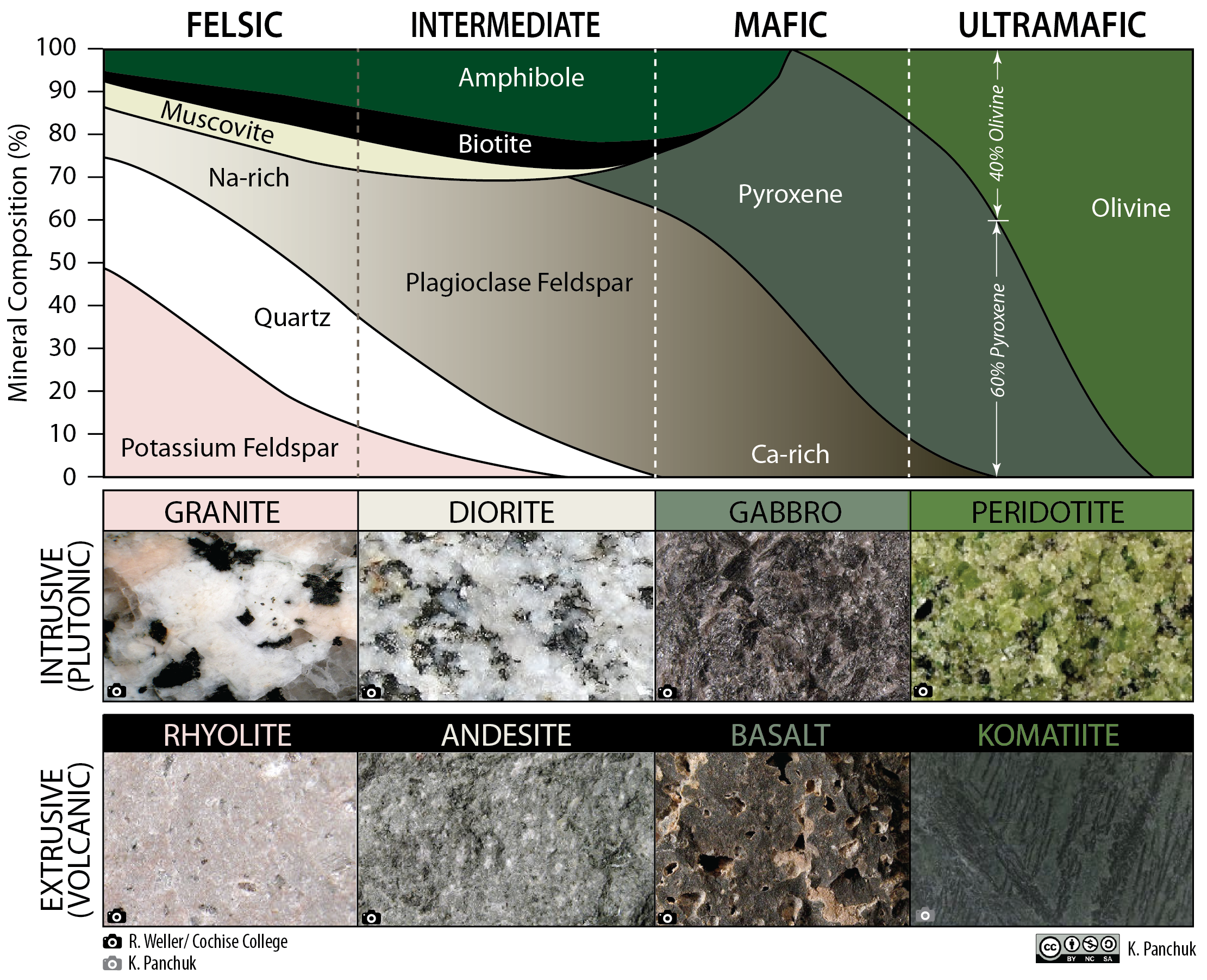
\(\hookrightarrow\) sourced from here
Total-Alkali Silica diagram
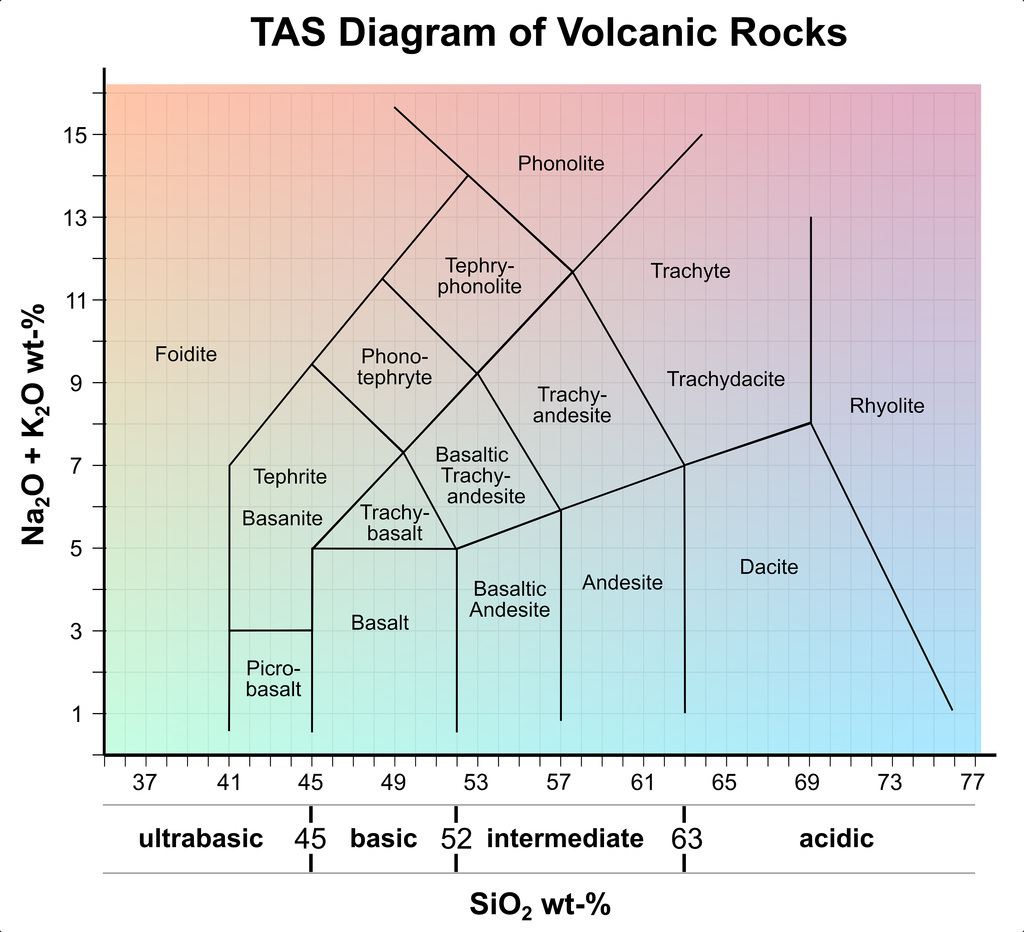
\(\hookrightarrow\) sourced from here