Stellar Contamination in Transmission Spectra
When we observe a transiting exoplanet, the transmission spectrum we measure depends not only on the planet’s atmosphere, but also on the stellar spectrum behind the planet. If the host star has an inhomogeneous surface — with cool starspots and/or hot faculae — then the spectrum of the unocculted stellar surface differs from the average stellar spectrum. This introduces a wavelength-dependent bias in the observed transit depth known as the Transit Light Source (TLS) effect (Rackham et al. 2018).
The contamination factor, \(\epsilon(\lambda)\), acts as a multiplicative correction to the “true” atmospheric transit depth:
where \(\epsilon(\lambda) = \frac{1}{1 - \sum_i f_i \left(1 - \frac{I_i(\lambda)}{I_\mathrm{phot}(\lambda)}\right)}\), with the sum running over each heterogeneity region \(i\) with covering fraction \(f_i\) and specific intensity \(I_i(\lambda)\), and \(I_\mathrm{phot}(\lambda)\) is the photosphere intensity.
Stellar contamination is particularly important for planets orbiting M dwarfs, since these stars tend to have large spot covering fractions and/or large temperature differences between the photosphere and any active regions.
In this tutorial, we will model the impact of stellar contamination on the transmission spectrum of TRAPPIST-1f.
This tutorial is split into two parts:
Part 1: stellar contamination for a bare rocky planet (with no atmosphere).
Part 2: stellar contamination for TRAPPIST-1f with an Earth-like atmosphere, showing how stellar activity can mimic or mask atmospheric features.
Let’s get started!
Stellar Grids in POSEIDON
To model stellar contamination, POSEIDON needs realistic stellar spectra — not just blackbodies — because the contamination factor \(\epsilon(\lambda)\) depends on the wavelength-dependent ratio of the heterogeneity and photosphere specific intensities. POSEIDON can use two packages to interpolate stellar model grids:
'pysynphot'(pre-installed): installs automatically with POSEIDON, and is what we use in this tutorial.'pymsg'(recommended): uses a more accurate interpolation method and is strongly recommended for forward models and retrievals that include stellar contamination. However,pymsgrequires a separate manual installation — see the MSG documentation for instructions.
To switch to pymsg, simply pass interp_backend = 'pymsg' when calling create_star(). For example:
star = create_star(R_s, T_s, log_g_s, Met_s,
                   stellar_contam = 'one_spot',
                   stellar_grid = 'phoenix',
                   f_het = f_het, T_het = T_het,
                   wl = wl, interp_backend = 'pymsg')
The 'pysynphot' installation with POSEIDON comes with two stellar model grids:
'cbk04': the Castelli & Kurucz (2004) atlas. These models cover a wide range of \(T_\mathrm{eff}\), \(\log g\), and metallicity.'phoenix': the PHOENIX model grid (Husser et al. 2013). These models are better suited for cool stars (\(T_\mathrm{eff} \lesssim 4000\) K), since they include more complete molecular line lists (e.g., TiO, VO, \(\rm{H}_2 \rm{O}\)) that dominate the spectra of M dwarfs. The PHOENIX models in'pysynphot'are accurate and high-resolution for stars with solar metallicity, but we generally recommend installing the'pymsg'package when using PHOENIX models for the most accurate interpolation scheme.
Note:
The coldest model in the pymsg PHOENIX grid has \(T_\mathrm{eff} = 2300\) K. If your star or heterogeneity temperature falls below this limit, pymsg will not be able to interpolate the stellar spectrum. For the full list of available pymsg stellar grids and their parameter ranges, see: http://user.astro.wisc.edu/~townsend/static.php?ref=msg-grids.
For the purposes of this tutorial, we will use the PHOENIX grid in 'pysynphot' to model TRAPPIST-1.
Setting Up the TRAPPIST-1 System
First, let’s define the properties of TRAPPIST-1 and TRAPPIST-1f. Since TRAPPIST-1f is a rocky planet, we use Earth units for the planetary radius and mass.
We begin by creating a clean stellar object (no heterogeneities) to establish our baseline, and compute the flat bare rock transit depth.
[1]:
from POSEIDON.core import create_star, create_planet, define_model, \
                        make_atmosphere, read_opacities, compute_spectrum, \
                        wl_grid_constant_R
from POSEIDON.stellar import stellar_contamination
from POSEIDON.constants import R_Sun, R_E, M_E
from POSEIDON.visuals import plot_spectra, plot_PT, plot_chem
from POSEIDON.utility import plot_collection
import numpy as np

#***** Define TRAPPIST-1 stellar properties *****#

R_s = 0.1197*R_Sun    # Stellar radius (m)
T_s = 2566.0          # Stellar effective temperature (K)
Met_s = 0.04          # Stellar metallicity [log10(Fe/H_star / Fe/H_solar)]
log_g_s = 5.21        # Stellar log surface gravity (log10(cm/s^2) by convention)

# Create a clean stellar object (no heterogeneities)
star_clean = create_star(R_s, T_s, log_g_s, Met_s)

#***** Define TRAPPIST-1f planet properties *****#

planet_name = 'TRAPPIST-1f'

R_p = 1.045*R_E      # Planetary radius (m)
M_p = 0.926*M_E      # Planetary mass (kg)
T_eq = 219.0         # Equilibrium temperature (K)

planet = create_planet(planet_name, R_p, mass = M_p, T_eq = T_eq)

#***** Set up the wavelength grid *****#

wl_min = 0.6      # Minimum wavelength (um)
wl_max = 14.0     # Maximum wavelength (um)
R = 10000         # Spectral resolution of grid

wl = wl_grid_constant_R(wl_min, wl_max, R)

#***** Bare rock transit depth: simply (Rp/Rs)^2 *****#

spectrum_bare_clean = (R_p / R_s)**2 * np.ones_like(wl)

print("Bare rock transit depth: {:.6f}".format(spectrum_bare_clean[0]))
Bare rock transit depth: 0.006406
Part 1: Bare Rocky Planet with Stellar Contamination
For a bare rocky planet with no atmosphere, the transit depth is simply \((R_p / R_s)^2\) — a flat line with no spectral features. But if the star has unocculted heterogeneities, the observed transit depth becomes wavelength-dependent even though the planet itself contributes no spectral features.
This is the key danger of stellar contamination: it can create the illusion of an atmosphere where none exists, or alter the inferred atmospheric properties.
We already computed the flat bare rock spectrum above. Now let’s see what happens when we add a starspot to TRAPPIST-1.
One-Spot Model: Cool Starspot on TRAPPIST-1
Now let’s see what happens when TRAPPIST-1 has an unocculted cool starspot. In the 'one_spot' model, a single heterogeneous region covers a fraction \(f_\mathrm{het}\) of the visible stellar disk.
To apply stellar contamination to a forward model spectrum in POSEIDON:
Create a stellar object with heterogeneity properties via
create_star().Compute \(\epsilon(\lambda)\) using
stellar_contamination()fromPOSEIDON.stellar.Multiply the clean transit depth by \(\epsilon(\lambda)\).
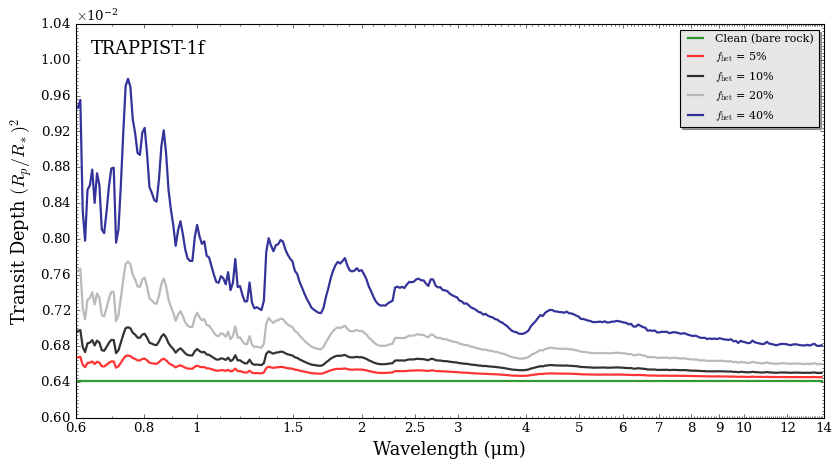
For TRAPPIST-1, photometric monitoring suggests spot covering fractions of ~ 8–54% (Morris et al. 2018). Let’s adopt a moderate spot with \(f_\mathrm{het} = 0.20\) and \(T_\mathrm{spot} = 2266\) K (300 K cooler than the photosphere).
[2]:
#***** One-spot model: Cool starspot *****#

f_het = 0.20             # 20% of the stellar disk is covered by the spot
T_het = T_s - 300.0      # Spot is 300 K cooler than the photosphere

# Create the star with a single heterogeneity
# We use the PHOENIX grid, which is best for cool M dwarfs
star_one_spot = create_star(R_s, T_s, log_g_s, Met_s,
                            stellar_contam = 'one_spot',
                            stellar_grid = 'phoenix',
                            f_het = f_het, T_het = T_het,
                            wl = wl)

# Compute the stellar contamination factor
epsilon_spot = stellar_contamination(star_one_spot, wl)

# Apply the contamination to the flat bare rock transit depth
spectrum_bare_spot = epsilon_spot * spectrum_bare_clean

print(f"Photosphere T_eff = {T_s:.0f} K")
print(f"Spot T_het = {T_het:.0f} K")
print(f"Spot covering fraction = {f_het:.0%}")
print(f"Mean contamination factor: {np.mean(epsilon_spot):.4f}")
Photosphere T_eff = 2566 K
Spot T_het = 2266 K
Spot covering fraction = 20%
Mean contamination factor: 1.0730
Varying Spot Covering Fraction
Let’s systematically vary the spot covering fraction to see how the contamination scales. We hold the spot temperature contrast fixed at \(\Delta T = -300\) K and sweep \(f_\mathrm{het}\) from 5% to 40%.
[3]:
#***** Vary spot covering fraction *****#

f_values = [0.05, 0.10, 0.20, 0.40]
delta_T_spot = -300.0   # Spot temperature offset (K)

spectra_vary_f = plot_collection(spectrum_bare_clean, wl, collection = [])
labels_vary_f = ['Clean (bare rock)']

for f in f_values:

    # Create star with this covering fraction
    star_f = create_star(R_s, T_s, log_g_s, Met_s,
                         stellar_contam = 'one_spot',
                         stellar_grid = 'phoenix',
                         f_het = f, T_het = T_s + delta_T_spot,
                         wl = wl)

    # Compute and apply contamination
    eps = stellar_contamination(star_f, wl)
    spectrum_f = eps * spectrum_bare_clean

    spectra_vary_f = plot_collection(spectrum_f, wl, collection = spectra_vary_f)
    labels_vary_f.append(f'$f_\\mathrm{{het}}$ = {f:.0%}')

# Plot using POSEIDON's built-in plotter
fig_vary_f = plot_spectra(spectra_vary_f, planet, R_to_bin = 100,
                          plot_full_res = False,
                          spectra_labels = labels_vary_f,
                          figure_shape = 'wide')
Varying Spot Temperature
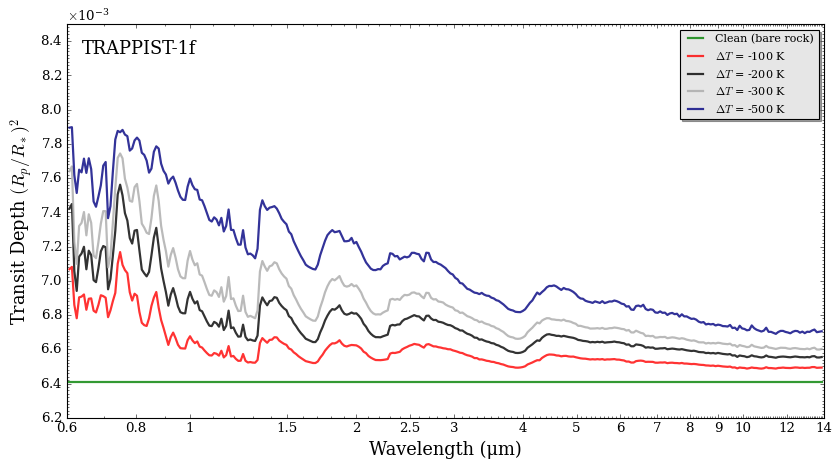
Now let’s hold the covering fraction fixed at \(f_\mathrm{het} = 20\%\) and vary the temperature contrast between the spot and the photosphere. Larger temperature contrasts mean a greater difference in the spectral energy distributions of the spot and photosphere, producing stronger contamination features.
[4]:
#***** Vary spot temperature *****#

delta_T_values = [-100, -200, -300, -500]
f_het_fixed = 0.20

spectra_vary_T = plot_collection(spectrum_bare_clean, wl, collection = [])
labels_vary_T = ['Clean (bare rock)']

for dT in delta_T_values:

    star_dT = create_star(R_s, T_s, log_g_s, Met_s,
                          stellar_contam = 'one_spot',
                          stellar_grid = 'phoenix',
                          f_het = f_het_fixed, T_het = T_s + dT,
                          wl = wl)

    eps_dT = stellar_contamination(star_dT, wl)
    spectrum_dT = eps_dT * spectrum_bare_clean

    spectra_vary_T = plot_collection(spectrum_dT, wl, collection = spectra_vary_T)
    labels_vary_T.append(f'$\\Delta T$ = {dT:+d} K')

fig_vary_T = plot_spectra(spectra_vary_T, planet, R_to_bin = 100,
                          plot_full_res = False,
                          spectra_labels = labels_vary_T,
                          figure_shape = 'wide',
                          y_max = 8.5e-3)
One-Spot Model: Hot Faculae
Faculae are regions on the stellar surface that are hotter than the surrounding photosphere — the opposite of starspots. On M dwarfs, faculae are associated with magnetically active regions and can cover a significant fraction of the stellar disk.
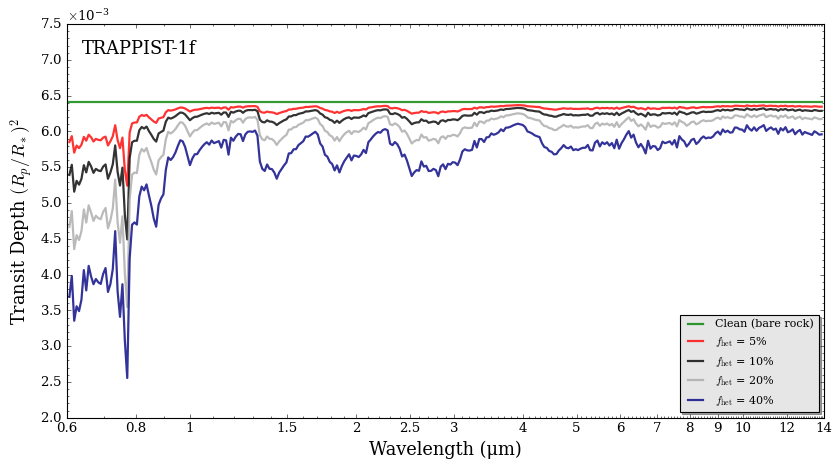
We can model faculae using the same 'one_spot' framework by setting \(T_\mathrm{het} > T_\mathrm{eff}\). While spots inflate the observed transit depth (since the unocculted photosphere appears brighter relative to the spotted regions), faculae decrease the apparent transit depth.
Let’s explore faculae contamination by varying the covering fraction and temperature, just as we did for spots.
[5]:
#***** Vary faculae covering fraction *****#

f_fac_values = [0.05, 0.10, 0.20, 0.40]
delta_T_fac = 200.0   # Faculae are 200 K hotter than the photosphere

spectra_vary_f_fac = plot_collection(spectrum_bare_clean, wl, collection = [])
labels_vary_f_fac = ['Clean (bare rock)']

for f in f_fac_values:

    star_fac = create_star(R_s, T_s, log_g_s, Met_s,
                           stellar_contam = 'one_spot',
                           stellar_grid = 'phoenix',
                           f_het = f, T_het = T_s + delta_T_fac,
                           wl = wl)

    eps_fac = stellar_contamination(star_fac, wl)
    spectrum_fac = eps_fac * spectrum_bare_clean

    spectra_vary_f_fac = plot_collection(spectrum_fac, wl, collection = spectra_vary_f_fac)
    labels_vary_f_fac.append(f'$f_\\mathrm{{het}}$ = {f:.0%}')

fig_vary_f_fac = plot_spectra(spectra_vary_f_fac, planet, R_to_bin = 100,
                              plot_full_res = False,
                              spectra_labels = labels_vary_f_fac,
                              figure_shape = 'wide',
                              y_min = 2e-3, y_max = 7.5e-3,
                              legend_location = 'lower right')
Varying Faculae Temperature
Let’s hold the faculae covering fraction fixed at \(f_\mathrm{het} = 10\%\) and vary the temperature contrast.
[6]:
#***** Vary faculae temperature *****#

delta_T_fac_values = [100, 200, 300, 500]
f_fac_fixed = 0.10

spectra_vary_T_fac = plot_collection(spectrum_bare_clean, wl, collection = [])
labels_vary_T_fac = ['Clean (bare rock)']

for dT in delta_T_fac_values:

    star_fac_dT = create_star(R_s, T_s, log_g_s, Met_s,
                              stellar_contam = 'one_spot',
                              stellar_grid = 'phoenix',
                              f_het = f_fac_fixed, T_het = T_s + dT,
                              wl = wl)

    eps_fac_dT = stellar_contamination(star_fac_dT, wl)
    spectrum_fac_dT = eps_fac_dT * spectrum_bare_clean

    spectra_vary_T_fac = plot_collection(spectrum_fac_dT, wl, collection = spectra_vary_T_fac)
    labels_vary_T_fac.append(f'$\\Delta T$ = +{dT} K')

fig_vary_T_fac = plot_spectra(spectra_vary_T_fac, planet, R_to_bin = 100,
                              plot_full_res = False,
                              spectra_labels = labels_vary_T_fac,
                              figure_shape = 'wide',
                              y_min = 1e-3, y_max = 7.5e-3,
                              legend_location = 'lower right')
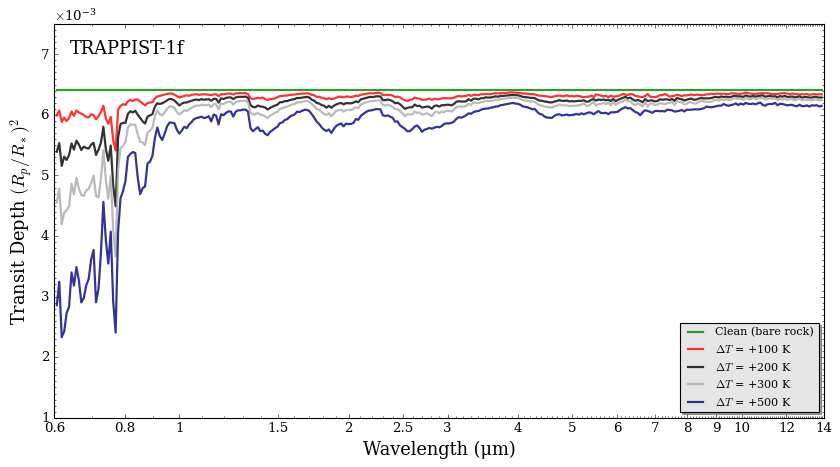
Notice how faculae produce the opposite effect compared to starspots: the observed transit depth decreases because the unocculted faculae make the stellar disk brighter than a uniform photosphere would be. The spectral shape of the contamination is also different, since the hotter faculae have a bluer spectral energy distribution.
Two-Spots Model: Spots + Faculae
Real stellar surfaces typically have both cool spots and hot faculae simultaneously. POSEIDON supports this with the 'two_spots' contamination model. In this model:
A fraction \(f_\mathrm{spot}\) of the disk has spots at temperature \(T_\mathrm{spot}\).
A fraction \(f_\mathrm{fac}\) of the disk has faculae at temperature \(T_\mathrm{fac}\).
The remaining fraction \((1 - f_\mathrm{spot} - f_\mathrm{fac})\) is the photosphere.
Note the constraints: \(T_\mathrm{spot} < T_\mathrm{eff} < T_\mathrm{fac}\) and \(f_\mathrm{spot} + f_\mathrm{fac} < 1\).
Let’s set up a two-spots model and compare all three contamination scenarios side by side.
[7]:
#***** Two-spots model: Spots + Faculae *****#

f_spot = 0.20          # 20% spot coverage
T_spot = T_s - 300.0   # Spot is 300 K cooler (2266 K)

f_fac = 0.10           # 10% faculae coverage
T_fac = T_s + 200.0    # Facula is 200 K hotter (2766 K)

# Create the star with both spots and faculae
star_two_spots = create_star(R_s, T_s, log_g_s, Met_s,
                             stellar_contam = 'two_spots',
                             stellar_grid = 'phoenix',
                             f_spot = f_spot, f_fac = f_fac,
                             T_spot = T_spot, T_fac = T_fac,
                             wl = wl)

# Compute the contamination factor
epsilon_two = stellar_contamination(star_two_spots, wl)

# Apply the contamination
spectrum_bare_two = epsilon_two * spectrum_bare_clean

print(f"Spot: f = {f_spot:.0%}, T = {T_spot:.0f} K")
print(f"Faculae: f = {f_fac:.0%}, T = {T_fac:.0f} K")
print(f"Mean contamination factor (two-spots): {np.mean(epsilon_two):.4f}")

#***** Also create faculae-only for the comparison plot *****#

star_faculae = create_star(R_s, T_s, log_g_s, Met_s,
                           stellar_contam = 'one_spot',
                           stellar_grid = 'phoenix',
                           f_het = f_fac, T_het = T_fac,
                           wl = wl)

epsilon_fac = stellar_contamination(star_faculae, wl)
spectrum_bare_fac = epsilon_fac * spectrum_bare_clean

#***** Compare all contamination models *****#

spectra_bare = plot_collection(spectrum_bare_clean, wl, collection = [])
spectra_bare = plot_collection(spectrum_bare_spot, wl, collection = spectra_bare)
spectra_bare = plot_collection(spectrum_bare_fac, wl, collection = spectra_bare)
spectra_bare = plot_collection(spectrum_bare_two, wl, collection = spectra_bare)

fig_bare = plot_spectra(spectra_bare, planet, R_to_bin = 100,
                        plot_full_res = False,
                        spectra_labels = ['Clean (flat bare rock)',
                                          'Cool spot ($\\Delta T$ = −300 K, $f$ = 20%)',
                                          'Hot faculae ($\\Delta T$ = +200 K, $f$ = 10%)',
                                          'Two-spots (spots + faculae)'],
                        figure_shape = 'wide',
                        colour_list = ['grey', 'firebrick', 'royalblue', 'darkorange'],
                        y_min = 4e-3, y_max = 8.5e-3,
                        legend_location = 'lower right')
Spot: f = 20%, T = 2266 K
Faculae: f = 10%, T = 2766 K
Mean contamination factor (two-spots): 1.0263
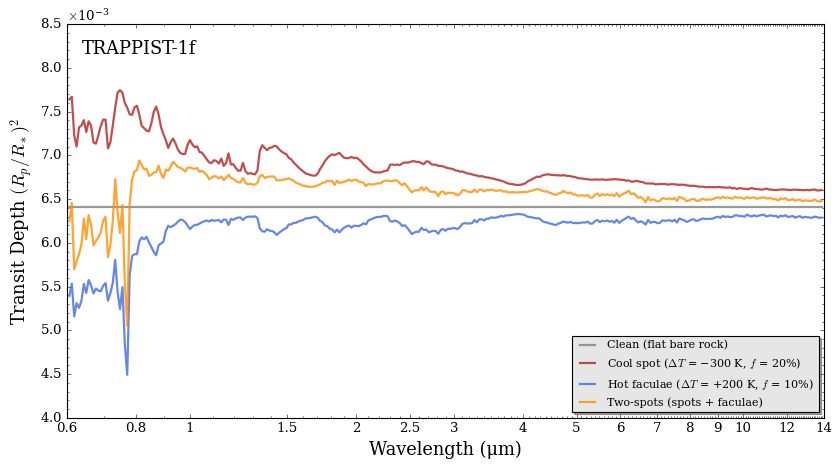
With both spots and faculae present, the contamination partially cancels out: cool spots push the transit depth up while hot faculae push it down. But the cancellation is not perfect — it is wavelength-dependent, so the net contamination still distorts the spectral shape. Whether the overall transit depth is inflated or deflated depends on the relative covering fractions and temperature contrasts of spots and faculae.
Part 2: Earth-like Atmosphere with Stellar Contamination
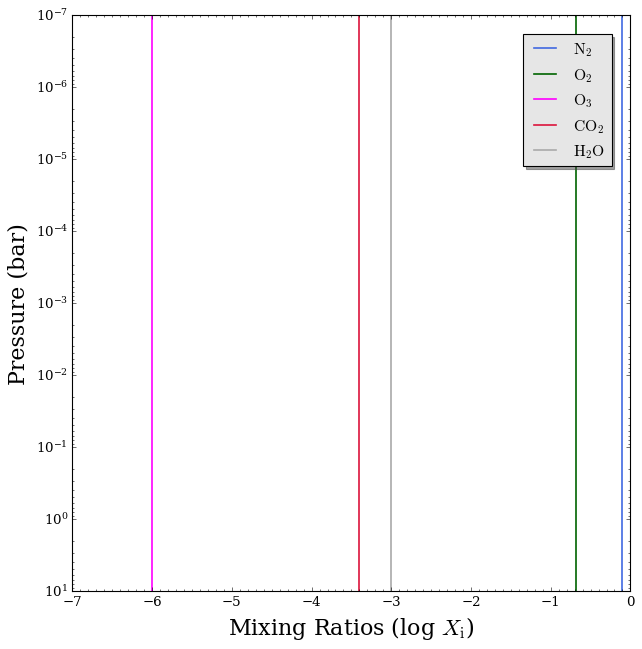
Now let’s add an atmosphere to TRAPPIST-1f and see how stellar contamination interacts with real atmospheric features. We’ll use a simple Earth-like model with \(\rm{N}_2\) as the bulk gas and \(\rm{O}_2\), \(\rm{O}_3\), \(\rm{CO}_2\), and \(\rm{H}_2 \rm{O}\) as trace species, with isothermal temperature and isochemical abundance profiles for simplicity.
This lets us directly compare the atmospheric signal to the stellar contamination signal.
[14]:
#***** Define the Earth-like atmosphere model *****#

model_name_atm = 'Earth-like'

bulk_species_atm = ['N2']
param_species_atm = ['O2', 'O3', 'CO2', 'H2O']

model_atm = define_model(model_name_atm, bulk_species_atm, param_species_atm,
                         PT_profile = 'isotherm', X_profile = 'isochem',
                         cloud_model = 'cloud-free', radius_unit = 'R_E',
                         surface = True)

print("Model free parameters: " + str(model_atm['param_names']))

#***** Set up the pressure grid *****#

P_min = 1.0e-7    # 0.1 ubar
P_max = 10.0      # 10 bar
N_layers = 100    # 100 layers

P = np.logspace(np.log10(P_max), np.log10(P_min), N_layers)

#***** Create the atmosphere *****#

P_surf = 1.0       # Surface pressure (bar)
P_ref = P_surf     # Reference pressure at the surface
R_p_ref = R_p      # Radius at reference pressure

PT_params = np.array([250])                            # Isothermal at 250 K
log_X_params = np.array([-0.678, -6.0, -3.4, -3.0])    # O2 ~ 21%, O3 ~ 1 ppm, CO2 ~ 400 ppm, H2O ~ 1000 ppm
surface_params = np.array([np.log10(P_surf)])          # log10(1 bar) = 0.0

atmosphere = make_atmosphere(planet, model_atm, P, P_ref, R_p_ref,
                             PT_params, log_X_params,
                             surface_params = surface_params)
Model free parameters: ['R_p_ref' 'T' 'log_O2' 'log_O3' 'log_CO2' 'log_H2O' 'log_P_surf']
Read the opacities.
[15]:
#***** Read opacities for the atmospheric species *****#

opacity_treatment = 'opacity_sampling'

# Define fine temperature grid (K)
T_fine_min = 100     # 400 K lower limit suffices for a typical hot Jupiter
T_fine_max = 300    # 2000 K upper limit suffices for a typical hot Jupiter
T_fine_step = 10     # 10 K steps are a good tradeoff between accuracy and RAM

T_fine = np.arange(T_fine_min, (T_fine_max + T_fine_step), T_fine_step)

# Define fine pressure grid (log10(P/bar))
log_P_fine_min = -6.0   # 1 ubar is the lowest pressure in the opacity database
log_P_fine_max = 2.0    # 100 bar is the highest pressure in the opacity database
log_P_fine_step = 0.2   # 0.2 dex steps are a good tradeoff between accuracy and RAM

log_P_fine = np.arange(log_P_fine_min, (log_P_fine_max + log_P_fine_step),
                       log_P_fine_step)

# Read opacities
opac = read_opacities(model_atm, wl, opacity_treatment, T_fine, log_P_fine,
                      opacity_database = 'Temperate')
Reading in cross sections in opacity sampling mode...
CO2-CO2 done
N2-N2 done
N2-H2O done
O2-O2 done
O2-CO2 done
O2-N2 done
O2 done
O3 done
CO2 done
H2O done
Opacity pre-interpolation complete.
Let’s visualise the atmospheric composition before computing the spectrum.
[23]:
#***** Plot the mixing ratio profiles *****#

fig_chem = plot_chem(planet, model_atm, atmosphere)
Clean Atmospheric Spectrum
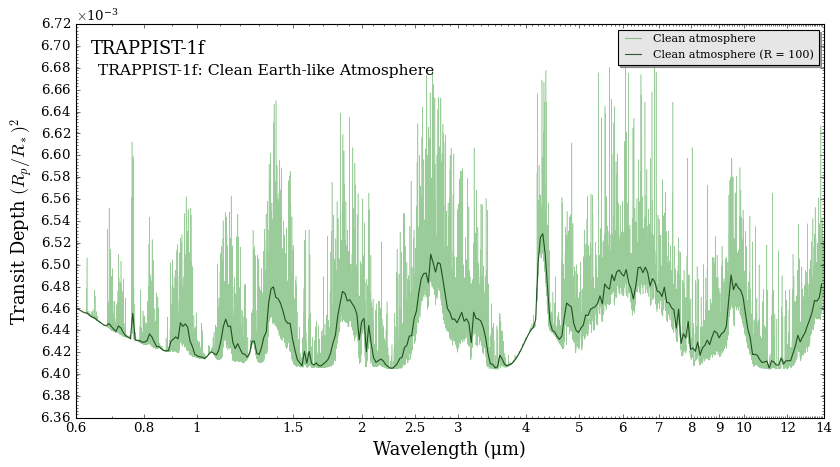
First, let’s compute the transmission spectrum of TRAPPIST-1f’s Earth-like atmosphere without any stellar contamination.
[17]:
#***** Compute the clean atmospheric spectrum *****#

spectrum_atm_clean = compute_spectrum(planet, star_clean, model_atm, atmosphere,
                                     opac, wl, spectrum_type = 'transmission')

#***** Plot the clean atmospheric spectrum *****#

spectra_atm_clean_coll = plot_collection(spectrum_atm_clean, wl, collection = [])

fig_clean_atm = plot_spectra(spectra_atm_clean_coll, planet,
                             spectra_labels = ['Clean atmosphere'],
                             figure_shape = 'wide',
                             R_to_bin = 100,
                             plt_label = 'TRAPPIST-1f: Clean Earth-like Atmosphere')
Contaminated Atmospheric Spectra
Now let’s apply our stellar contamination models to the atmospheric spectrum. We reuse the same \(\epsilon(\lambda)\) arrays from Part 1.
The contamination factor \(\varepsilon(\lambda)\) acts as a multiplicative scaling on the transit depth:
When applied to an atmosphere with spectral features, the contamination both shifts the baseline transit depth and distorts the relative strength of molecular absorption bands.
[19]:
#***** Apply stellar contamination to the atmospheric spectrum *****#

# One-spot model (cool spot only)
spectrum_atm_spot = spectrum_atm_clean * epsilon_spot

# Two-spots model (spot + faculae)
spectrum_atm_two = spectrum_atm_clean * epsilon_two

#***** Compare clean vs. contaminated atmospheric spectra *****#

spectra_atm_comp = plot_collection(spectrum_atm_clean, wl, collection = [])
spectra_atm_comp = plot_collection(spectrum_atm_spot, wl, collection = spectra_atm_comp)
spectra_atm_comp = plot_collection(spectrum_atm_two, wl, collection = spectra_atm_comp)

fig_contam_atm = plot_spectra(spectra_atm_comp, planet,
                              spectra_labels = ['Clean atmosphere',
                                                'Atmosphere + cool spot',
                                                'Atmosphere + spot & faculae'],
                              figure_shape = 'wide',
                              plot_full_res = False,
                              R_to_bin = 100,
                              colour_list = ['royalblue', 'firebrick', 'darkorange'],
                              plt_label = 'TRAPPIST-1f: Stellar Contamination with an Atmosphere',
                              y_min = 4.5e-3, y_max = 9e-3,
                              legend_location = 'lower right')
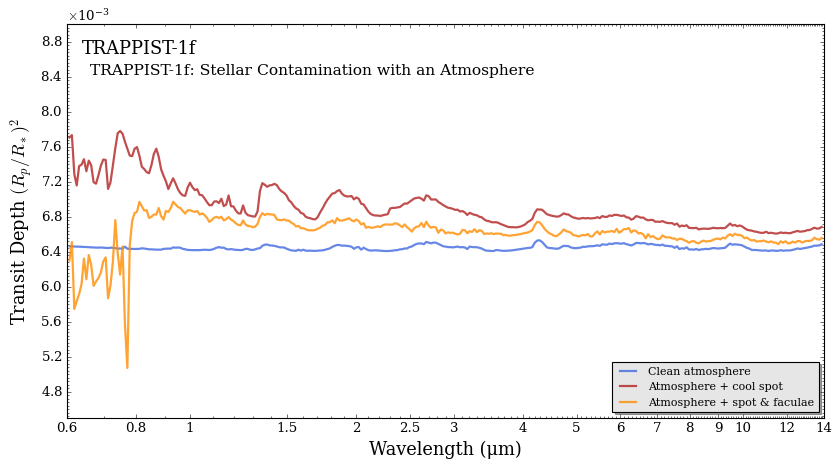
Notice how stellar contamination not only shifts the overall transit depth but also introduces wavelength-dependent distortions that can mimic or mask real atmospheric absorption features. This is the central challenge for characterising terrestrial exoplanet atmospheres around M dwarfs.
Finally, let’s compare models with and without stellar contamination.
[34]:
#***** Combined comparison: bare rock vs. atmosphere, clean vs. contaminated *****#

spectra_combined = plot_collection(spectrum_bare_clean, wl, collection = [])
spectra_combined = plot_collection(spectrum_bare_two, wl, collection = spectra_combined)
spectra_combined = plot_collection(spectrum_atm_clean, wl, collection = spectra_combined)
spectra_combined = plot_collection(spectrum_atm_two, wl, collection = spectra_combined)

fig_combined = plot_spectra(spectra_combined, planet,
                            spectra_labels = ['Bare rock',
                                              'Bare rock + stellar contam.',
                                              'Atmosphere',
                                              'Atmosphere + stellar contam.'],
                            figure_shape = 'wide',
                            plot_full_res = False,
                            R_to_bin = 100,
                            colour_list = ['grey', 'darkorange',
                                           'royalblue', 'firebrick'],
                            plt_label = 'TRAPPIST-1f: Atmospheric Features vs. Stellar Contamination',
                            y_min = 5.6e-3, y_max = 7.4e-3,
                            text_annotations = ['H$_2$O', 'CO$_2$', 'O$_3$'],
                            annotation_pos = [(1.3, 6.87e-3), (4.0, 6.78e-3), (9.2, 6.65e-3)],
                            legend_location = 'lower right')
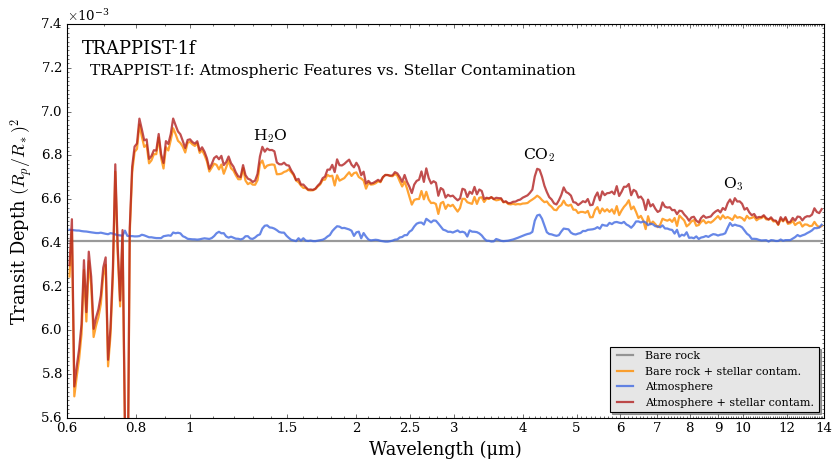
We see that \(\rm{H}_2 \rm{O}\) features are generally difficult to disentangle whether they come from the star or the planet’s atmosphere. However, the \(\rm{CO}_2\) band at 4.3 μm and the \(\rm{O}_3\) band near 10 μm are only present for the models including a planetary atmosphere on TRAPPIST-1f.